

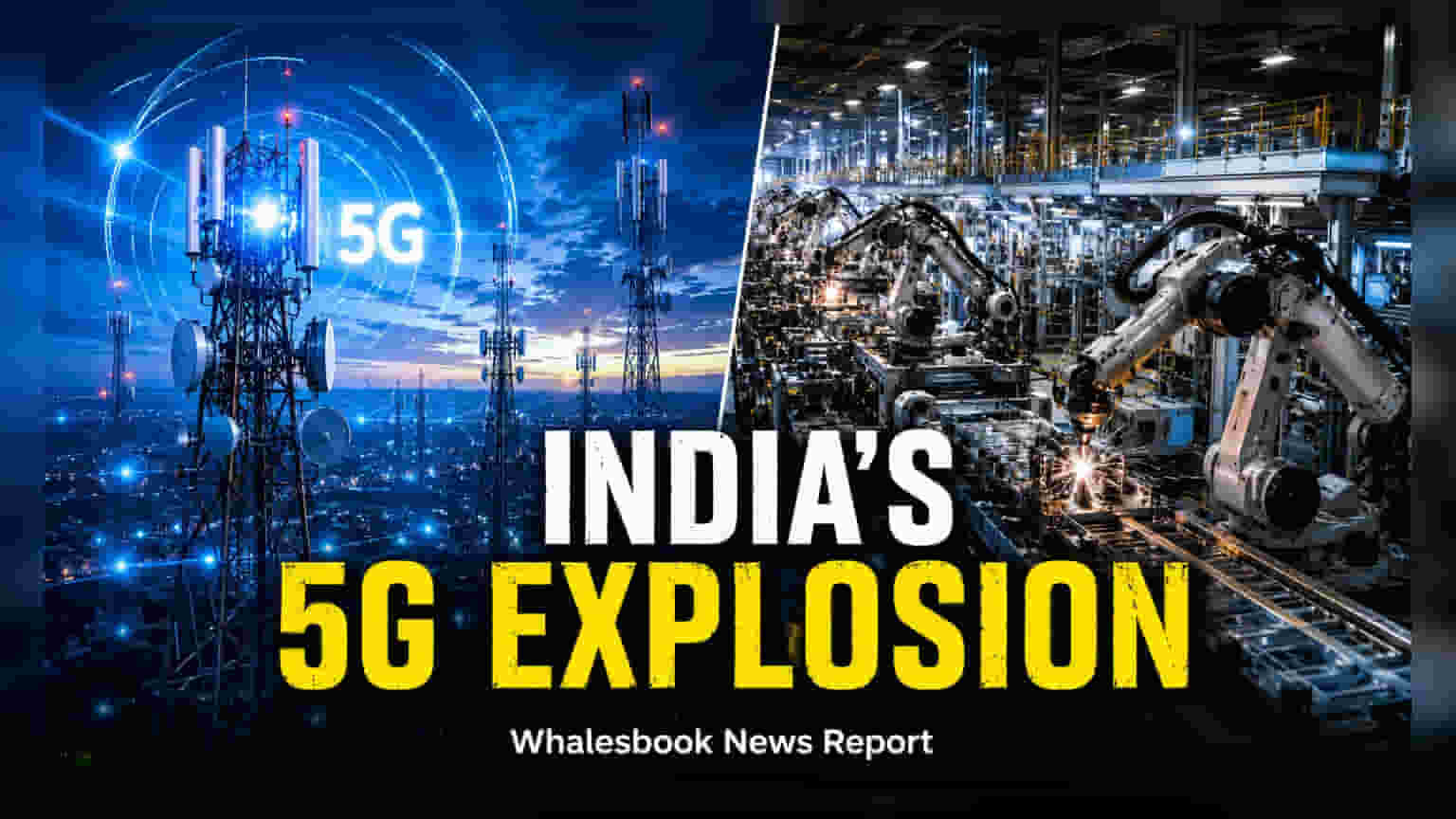
India aims to expand its 5G network to 100 crore users by 2030, building on the 50 crore connections added in the last two and a half years. To support this growth, the government is establishing its first Telecom Manufacturing Zone (TMZ) in Gwalior. This initiative focuses on strengthening domestic manufacturing for telecom gear, data centers, and semiconductor components.
Communications Minister Jyotiraditya Scindia announced that India is on track to bring 100 crore people onto its 5G network by 2030. This goal follows a rapid rollout that saw 50 crore users gain access in just two and a half years. The government reports that this expansion was supported by a capital investment of ₹4,50,000 crore and the installation of nearly 5,00,000 5G towers across the country.
Gwalior Telecom Manufacturing Zone Launch
A key part of this strategy is the creation of India’s first Telecom Manufacturing Zone (TMZ) in Gwalior, Madhya Pradesh. This zone is designed to act as a dedicated hub for telecom equipment, data center infrastructure, and chip manufacturing. The project utilizes a plug-and-play model, where the central and state governments provide the necessary infrastructure to reduce setup delays for private companies. This initiative aligns with the broader Production Linked Incentive (PLI) schemes aimed at making India a global manufacturing center for electronics and communication hardware.
Digital Transformation and Future Technology
Beyond current 5G expansion, the government is looking toward 6G technology, quantum communications, and artificial intelligence. Minister of State for Communications, Chandrasekhar Pemmasani, noted that indigenous 4G technology has already reached approximately 90% of international quality standards. The government continues to focus on broadening access through the BharatNet project and 5G Fixed Wireless Access (FWA) services, which provide high-speed internet to homes and businesses without the need for traditional fiber cabling.
Sector Context and Investor Focus
For investors, this shift indicates a sustained policy focus on domestic manufacturing and digital infrastructure. While the reduction in data costs—falling from ₹287 per GB to around ₹8 per GB—has democratized access for over 1.33 billion mobile users, it has also intensified competition among major telecom service providers. The success of the 100-crore user target will rely on the consistent financial health of these service providers, who remain responsible for the high cost of tower maintenance and spectrum acquisition.
Additionally, the upcoming India Mobile Congress (IMC) 2026, scheduled for October 7-10 in New Delhi, will serve as a platform to showcase these advancements. With over 300 exhibitors expected, the event will highlight progress in semiconductors and quantum computing. Investors may continue to track the pace of the Gwalior TMZ development and the ability of domestic manufacturers to gain market share in a sector traditionally dependent on imported equipment.