

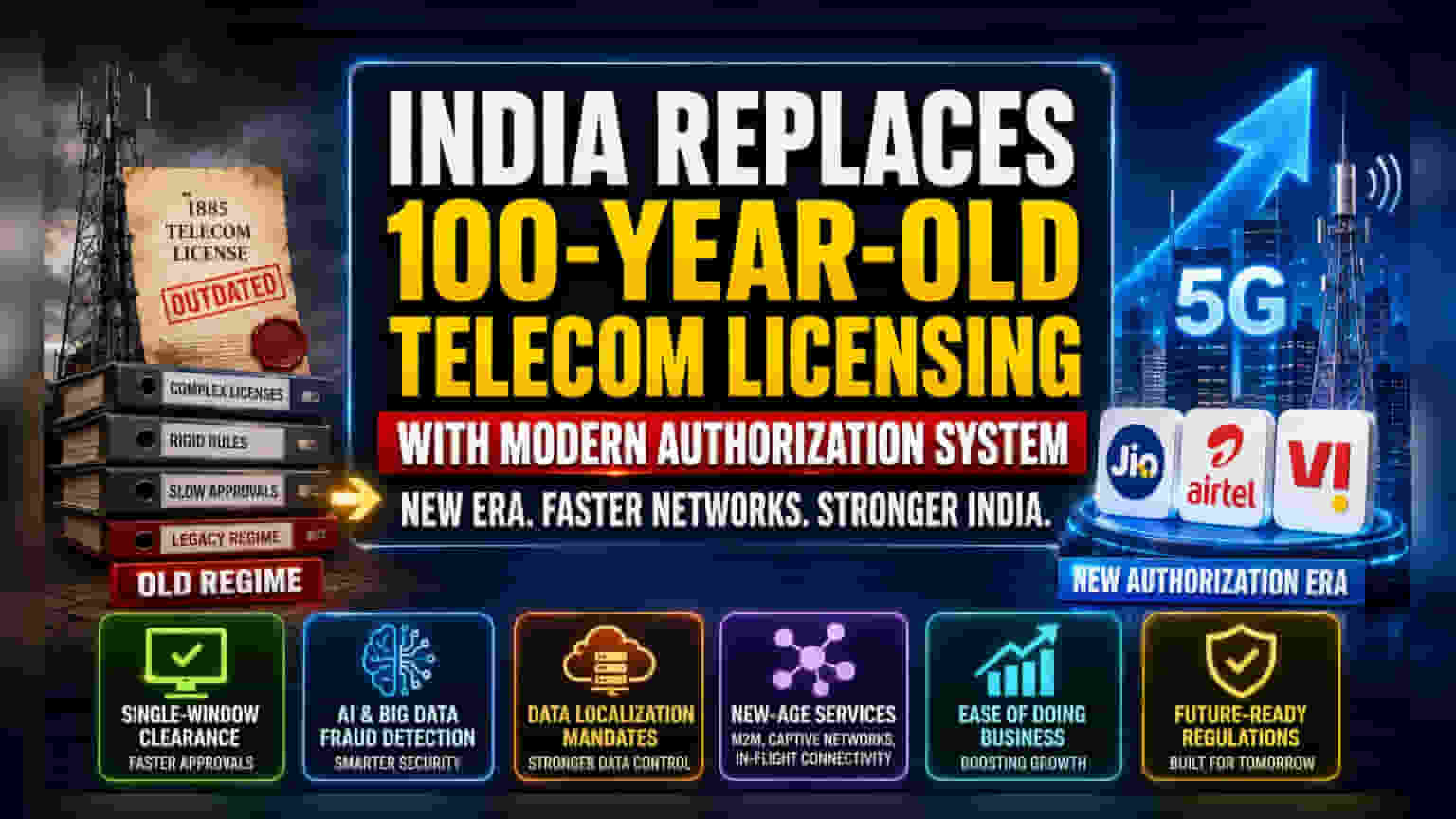
The Department of Telecommunications has officially transitioned from the legacy license-based telecom regime to a new authorization-based framework under the Telecommunications Act, 2023. This regulatory shift aims to simplify operations, introduce single-window clearances, and mandate modern security measures like AI-based fraud detection. Existing license holders will gradually migrate to this simplified structure.
What Happened
The Indian government has officially replaced its century-old telecom licensing regime with a modern authorization-based framework, implemented under the Telecommunications Act, 2023. This change shifts the regulatory landscape away from the colonial-era Indian Telegraph Act of 1885 and the Indian Wireless Telegraphy Act of 1933. The new system is designed to be more agile, allowing the Department of Telecommunications (DoT) to adapt to rapid technological shifts without needing to overhaul complex, individual license agreements.
Why It Matters For Investors
For major players like Reliance Jio, Bharti Airtel, and Vodafone Idea, this move signals a shift toward simplified compliance and operational efficiency. The traditional licensing model often involved rigid, service-specific agreements that were difficult to modify as technology evolved. The new authorization system moves toward a unified, rule-based structure, which is expected to reduce the administrative burden on operators. By consolidating these processes, the government aims to create a more transparent "ease of doing business" environment, which can eventually help companies deploy new services, such as 5G and future technologies, with greater speed.
Key Changes in the New Framework
The transition brings several important operational updates beyond just a name change from "license" to "authorization." A central feature is the new single-window clearance mechanism via the Telecom eServices Portal, which is intended to consolidate applications and speed up approvals. Additionally, the government has introduced new mandates that reflect the modern digital landscape. This includes requirements for telecom operators to implement artificial intelligence and big data analytics for fraud detection, as well as new standards for data localization. The framework also creates specific provisions for machine-to-machine (M2M) communications, captive enterprise networks, and in-flight connectivity, providing a clearer legal status for these growing business segments.
The Transition Process
The shift to the new authorization system will not happen overnight. The government has planned a phased transition to ensure stability for existing operators. Telecom companies currently operating under legacy licenses will be provided a roadmap to migrate their existing permissions to the new authorization structure. Existing licenses remain valid for their current terms unless companies choose to migrate early. This gradual approach is designed to prevent disruptions in ongoing telecom services while allowing the industry to adapt to the new regulatory requirements over time.
What Investors Should Track
As the industry migrates to this new framework, the key monitorables for investors will be the specific guidelines issued by the DoT regarding migration timelines and any potential changes in compliance costs or fees. Investors should also watch for how effectively companies integrate the mandatory new security measures—such as AI-led fraud prevention—without significantly increasing their capital spending. The overall effectiveness of the single-window clearance portal in reducing administrative delays will also be a critical factor to observe in the coming quarters.