

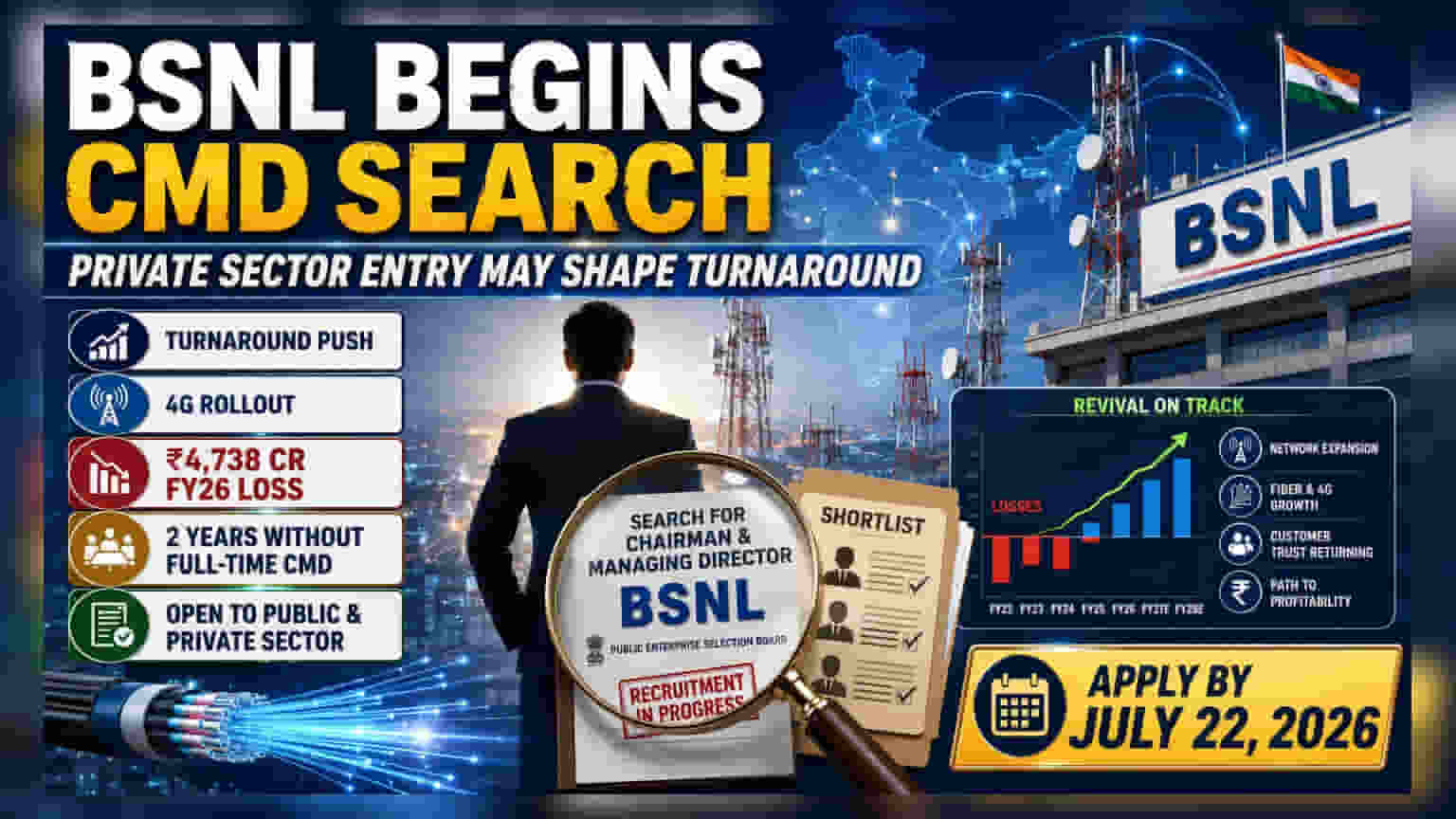
The Department of Telecommunications is inviting private sector executives to apply for the Chairman and Managing Director position at BSNL. This move marks a significant shift in the state-run telco’s leadership strategy, aiming to bring in fresh expertise as it undergoes a major, multi-year revival project amid ongoing financial challenges.
What Happened
The government has officially opened the search for a new Chairman and Managing Director (CMD) for Bharat Sanchar Nigam Limited (BSNL), allowing applications from both the public and private sectors for the first time in a major recruitment drive. The Department of Telecommunications (DoT) has formed a search committee to find a candidate on an immediate absorption basis.
To qualify, private sector candidates must currently work in, or have retired from, companies with an annual turnover of at least ₹2,000 crore. The role is also open to executives from central and state public sector enterprises. The deadline for submitting applications is July 22, 2026.
Why This Leadership Search Matters
BSNL has been operating without a full-time CMD for two years, with current leadership holding additional charge. By reaching into the private sector, the government is signaling a push for more professional, market-oriented management. This is a critical transition as BSNL attempts a complex turnaround, moving from a legacy telecom player to an entity focused on indigenous 4G technology and national digital connectivity.
The BSNL Turnaround Context
The government has injected significant capital into BSNL over the last few years through multiple revival packages to modernize its infrastructure, deploy 4G sites, and reduce debt. While officials have highlighted growth in average revenue per user (ARPU) and the successful installation of indigenous 4G technology, the operational reality remains mixed.
In its most recent financial reports for the fourth quarter of FY26, BSNL reported a net loss of ₹1,269 crore, compared to a profit in the same quarter the previous year. For the full fiscal year 2026, the company posted a net loss of ₹4,738 crore, indicating that despite substantial state support and expanded infrastructure, achieving sustained profitability remains a significant hurdle.
Governance and Operational Risks
Investors and observers tracking the telecom sector have noted specific risks beyond just financial performance. Recent financial filings included a qualified opinion from independent auditors, who flagged concerns regarding accounting irregularities in specific telecom circles, such as the Tamil Nadu and ALTTC units. The auditors also noted governance issues, including the lack of a mandatory woman director and an insufficient number of independent directors on the board. These factors are important to monitor, as strong governance is often seen as a prerequisite for any successful corporate revival.
What Investors Should Track
Because BSNL is an unlisted entity, it does not directly affect individual retail stock portfolios. However, its business activities have a massive ripple effect on listed vendors and partners in the Indian telecom supply chain.
The key things to watch are:
- The Quality of Leadership: The appointment of a private-sector leader could signal a more aggressive approach to cost control and operational efficiency.
- Vendor Impact: Any changes in BSNL’s procurement strategy or timeline for 4G/5G equipment rollout will directly affect listed companies that supply infrastructure, fiber, and hardware to the telco.
- Financial Compliance: Future filings will be critical to see if the company addresses the accounting and governance gaps flagged by auditors.
- Competitive Performance: BSNL’s ability to retain subscribers against aggressive competition from private players like Reliance Jio and Bharti Airtel will remain the ultimate test of its revival strategy.