

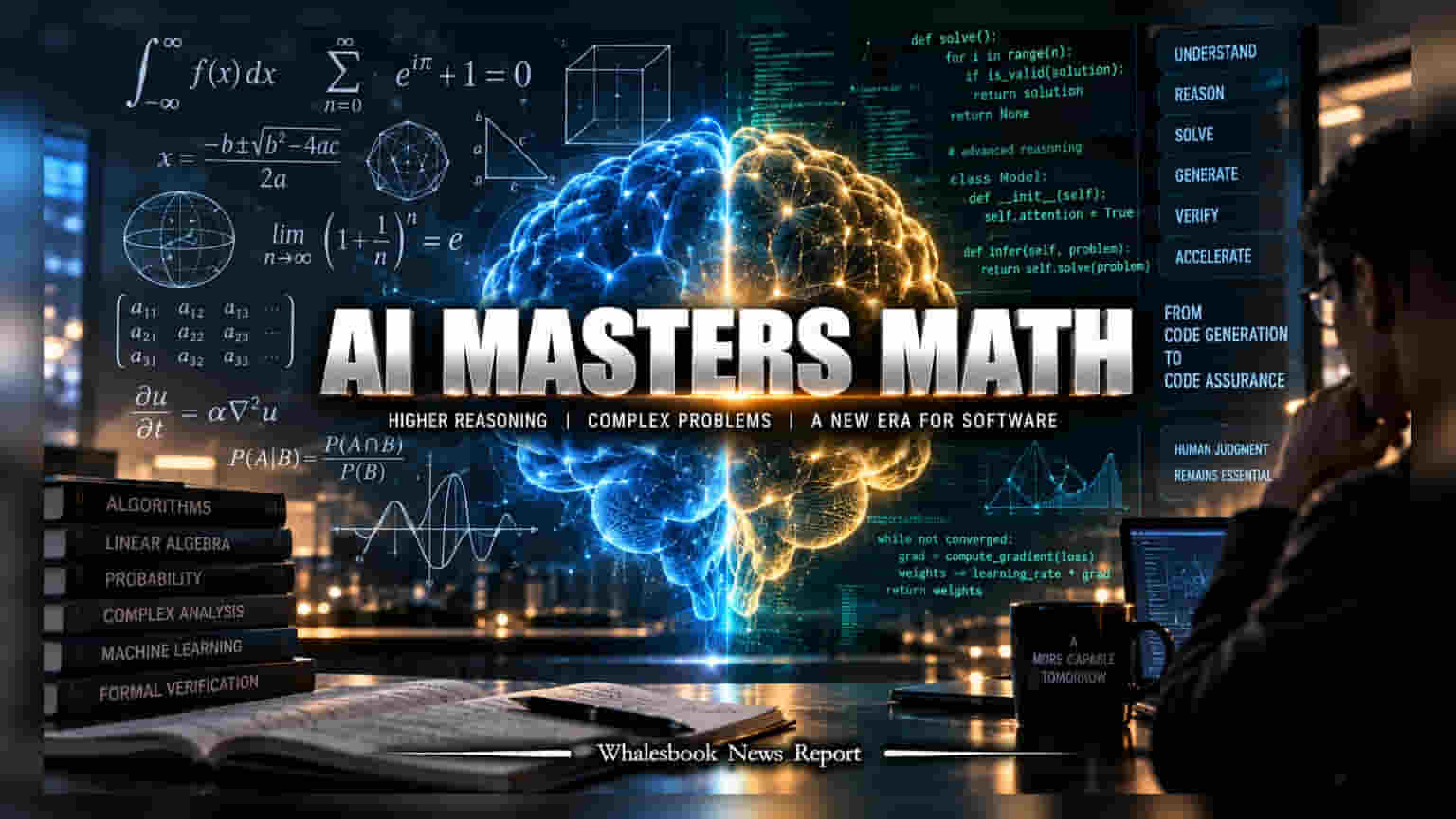
Sridhar Vembu, founder of private software major Zoho, warns that AI will soon master advanced mathematics, potentially changing how software is built. He suggests a future where human roles shift toward verifying AI-generated code, while also flagging systemic risks in the current AI investment frenzy.
Sridhar Vembu, the founder of Zoho Corporation, has issued a fresh warning about the rapid evolution of artificial intelligence. He believes AI is on the verge of mastering advanced mathematical problem-solving, a skill previously thought to be uniquely human. According to Vembu, this technological leap is not a long-term forecast but a near-term reality that could fundamentally disrupt the software industry's labor market.
For the tech sector, this shift means that the role of a programmer might change drastically. Vembu suggests that while machines may soon produce the bulk of software code, the critical human role will shift from writing code to ensuring its reliability. He advocates for the use of formal verification tools—mathematical systems used to test and prove that code is accurate—to act as a safety gate against systemic errors. In this view, human judgment will become the true differentiator as the technical production of code becomes increasingly automated.
Unlike many global technology companies currently pouring massive capital into AI development, Zoho remains a privately held, self-funded, and debt-free entity. The company does not trade on the stock exchange and is not required to publish quarterly financial results for public shareholders. This unique business structure allows the company to prioritize long-term research and development without the pressure of meeting short-term market expectations or justifying massive capital spending on AI infrastructure that relies on outside investment.
Vembu has consistently expressed caution regarding the wider AI investment environment, often comparing the current frenzy to the dot-com era. He warns that the market rush to integrate AI may be ignoring the risks of a contracting labor market and the mounting costs of essential hardware, cooling, and power infrastructure. For the broader industry, these observations highlight a growing divide: while many firms race to adopt AI to chase efficiency, there is a rising debate about the sustainability of these investments and the potential for a market correction if the promised productivity gains do not offset the heavy costs associated with building and maintaining AI systems.