 Whalesbook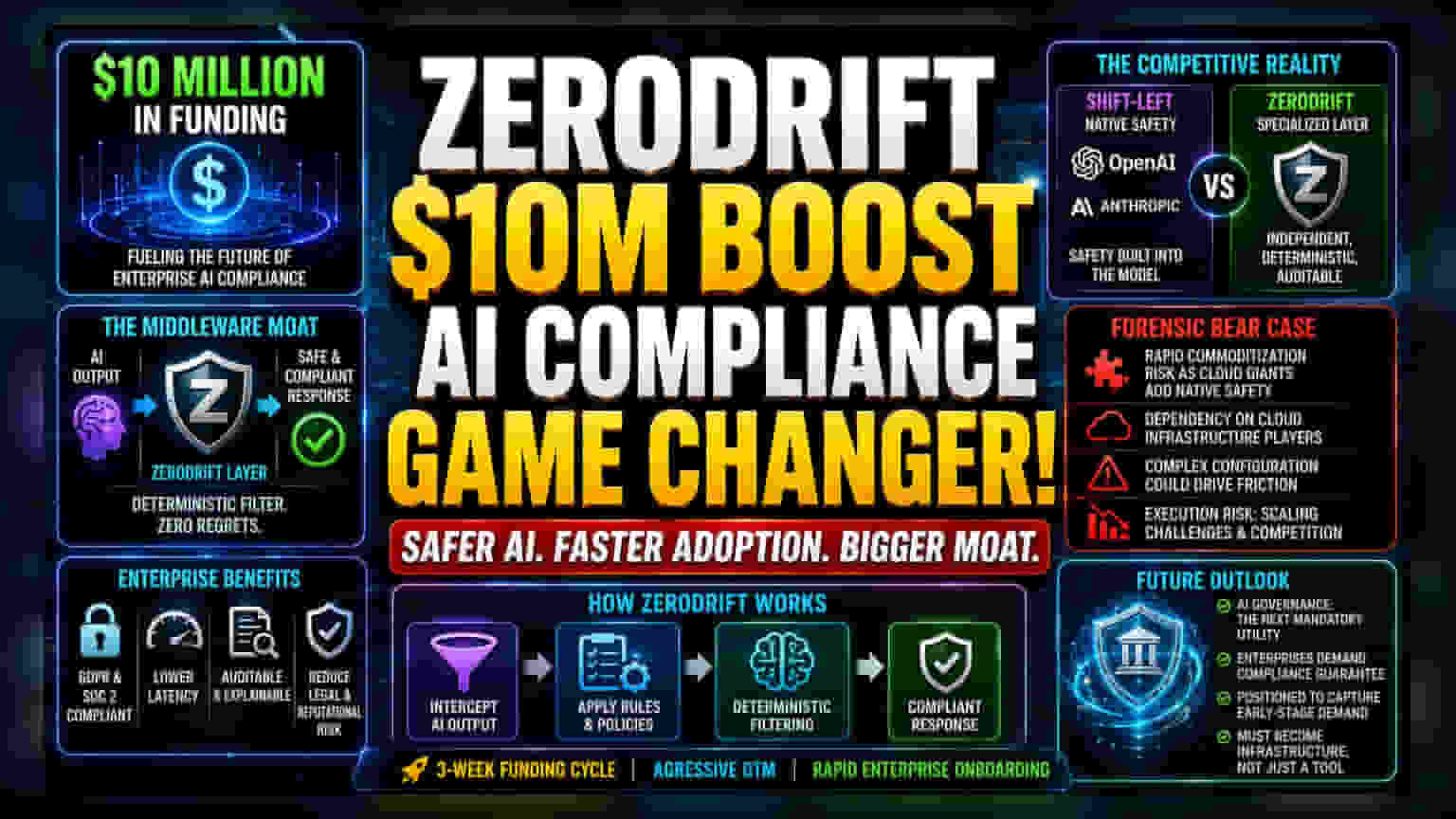


The Middleware Moat
The infusion of $10 million into ZeroDrift arrives at a moment where enterprise adoption of generative AI has hit a regulatory wall. Rather than attempting to build a foundational model, the company acts as a deterministic filter, intercepting AI-generated traffic to sanitize output against strict compliance frameworks like GDPR and SOC 2. This architecture shifts the compliance burden from the model provider to a dedicated integration layer, effectively creating a circuit breaker for corporate AI deployments that cannot afford hallucinated liability.
Scaling Against Native Integration
While the company touts lower latency compared to monolithic LLM-based filtering, the broader market remains dominated by a "shift-left" mentality where safety is increasingly baked into the model architecture itself. Major players such as OpenAI and Anthropic are rapidly integrating native guardrails, which raises questions about the long-term viability of third-party compliance middleware. Investors appear to be betting that the specialized, deterministic nature of ZeroDrift's rules engine—which relies on hard-coded logic before triggering LLM-based rewrites—offers a level of auditability that black-box models currently lack. The company must now prove that its performance gains can be maintained as the underlying models evolve toward higher output complexity.
The Forensic Bear Case
The primary structural risk lies in the rapid commoditization of AI safety tools. As enterprise-grade safety features become standard offerings within existing cloud infrastructure provided by Microsoft Azure and Amazon Web Services, specialized startups often find their total addressable market shrinking to niche enterprise requirements. Furthermore, Kumesh Aroomoogan enters this competitive environment following his tenure at Bloom Financial, a venture that faced significant scrutiny regarding its growth trajectory and operational management. Whether ZeroDrift can avoid similar scaling pitfalls will depend on its ability to integrate seamlessly into existing CI/CD pipelines without introducing the very latency it claims to solve. If the product requires extensive manual configuration to map regulatory requirements, the initial surge of interest may struggle to convert into high-margin recurring revenue.
Future Outlook
With a three-week funding cycle, the company has signaled an aggressive go-to-market strategy that prioritizes rapid enterprise onboarding. Market consensus suggests that AI governance will evolve into a mandatory utility, similar to cybersecurity firewalls. ZeroDrift is currently positioned to capture early-stage demand from firms currently paralyzed by the fear of regulatory fines, yet it must pivot from a standalone tool to an indispensable infrastructure component before native model safety features render its specific architecture redundant.