 Whalesbook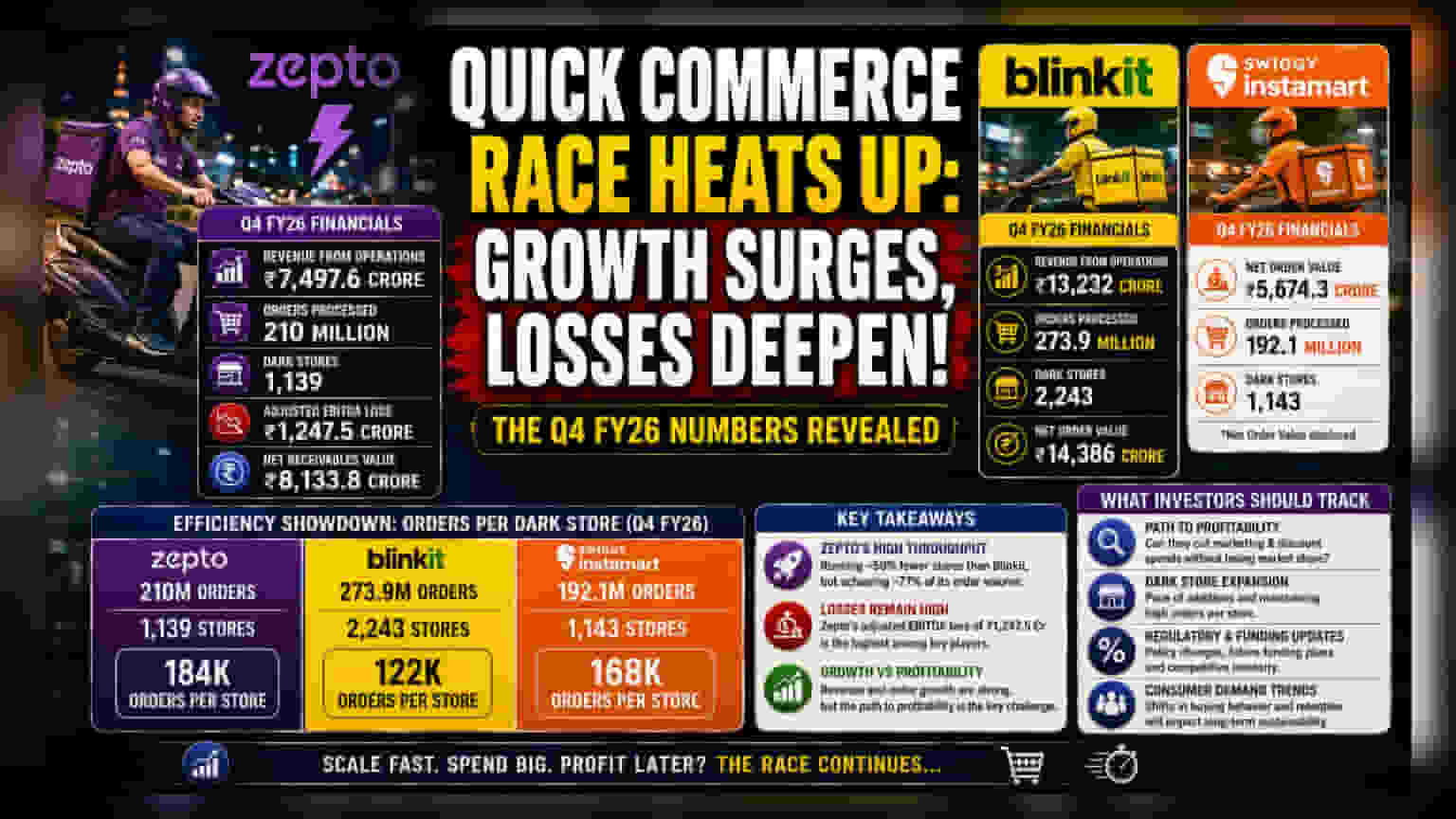


What Happened
Recent regulatory filing documents have provided a fresh look at the financials of India’s quick commerce sector for the quarter ending March 2026. The data highlights the ongoing competition between major players Zepto, Blinkit, and Swiggy Instamart. In the fourth quarter of FY26, Zepto reported revenue from operations of ₹7,497.6 crore. While this trails the market leader Blinkit, which clocked ₹13,232 crore in revenue, the gap is narrowing as Zepto continues its rapid expansion. The documents show that Zepto processed 210 million orders during the period, compared to 273.9 million orders handled by Blinkit.
Why This Matters For Investors
The quick commerce sector is currently characterized by a high-stakes race for market share. Companies are prioritizing rapid network expansion and customer acquisition, which requires significant capital. For investors, the data reveals a clear trade-off: while top-line revenue is growing quickly, the cost of scaling is substantial. Zepto’s ability to compete with an established player like Blinkit, despite operating a smaller network of dark stores, is a key point of interest. It suggests that the company is effectively capturing demand in key urban areas, but the sustainability of this growth model remains a central question for market observers.
The Efficiency Story
A critical metric in the quick commerce business is how much business each dark store generates. At the end of FY26, Zepto operated 1,139 dark stores. In comparison, Swiggy Instamart managed 1,143 stores, and Blinkit operated 2,243 locations. Despite having roughly half the number of dark stores as Blinkit, Zepto managed to generate order volumes that reached approximately 77% of Blinkit's total in the March quarter. This indicates high throughput, meaning each of Zepto's stores is handling a higher volume of transactions than the average peer store. This efficiency is a vital metric that investors track to determine if a company can eventually turn a profit as its network scales.
The Profitability Hurdle
While the growth numbers are significant, the financial cost of this expansion is high. Zepto reported an adjusted EBITDA loss of ₹1,247.5 crore for the quarter. This is the largest operational loss among the three major quick commerce players mentioned in the data. This high burn rate reflects the heavy investments required for quick-delivery infrastructure, discounts, and marketing to keep users coming back. For investors, the key challenge is assessing when this heavy spending will transition into sustainable profitability, especially as competition keeps pricing power in check.
How Investors May Read This
The comparison between Net Receivables Value and Net Order Value provides insight into the actual earnings retained after promotional expenses. Zepto reported a Net Receivables Value of ₹8,133.8 crore, compared to Swiggy Instamart's Net Order Value of ₹5,674.3 crore and Blinkit's ₹14,386 crore. As these companies prepare for potential public offerings or further funding rounds, investors will likely focus on whether the revenue growth can eventually outpace the high operational costs. The ability to maintain high throughput per store while reducing the current loss levels will be the primary measure of operational success in the coming quarters.
What Investors Should Track
Moving forward, the primary monitorable is the path to profitability. Investors will track whether the companies can lower their marketing and discount spending without losing market share. Additionally, the pace of dark store expansion and the ability to maintain high order throughput as the network grows will be essential. Changes in the regulatory environment, updates on future funding plans, and shifts in consumer demand patterns are also critical factors that could influence the financial health and valuation of these firms.