 Whalesbook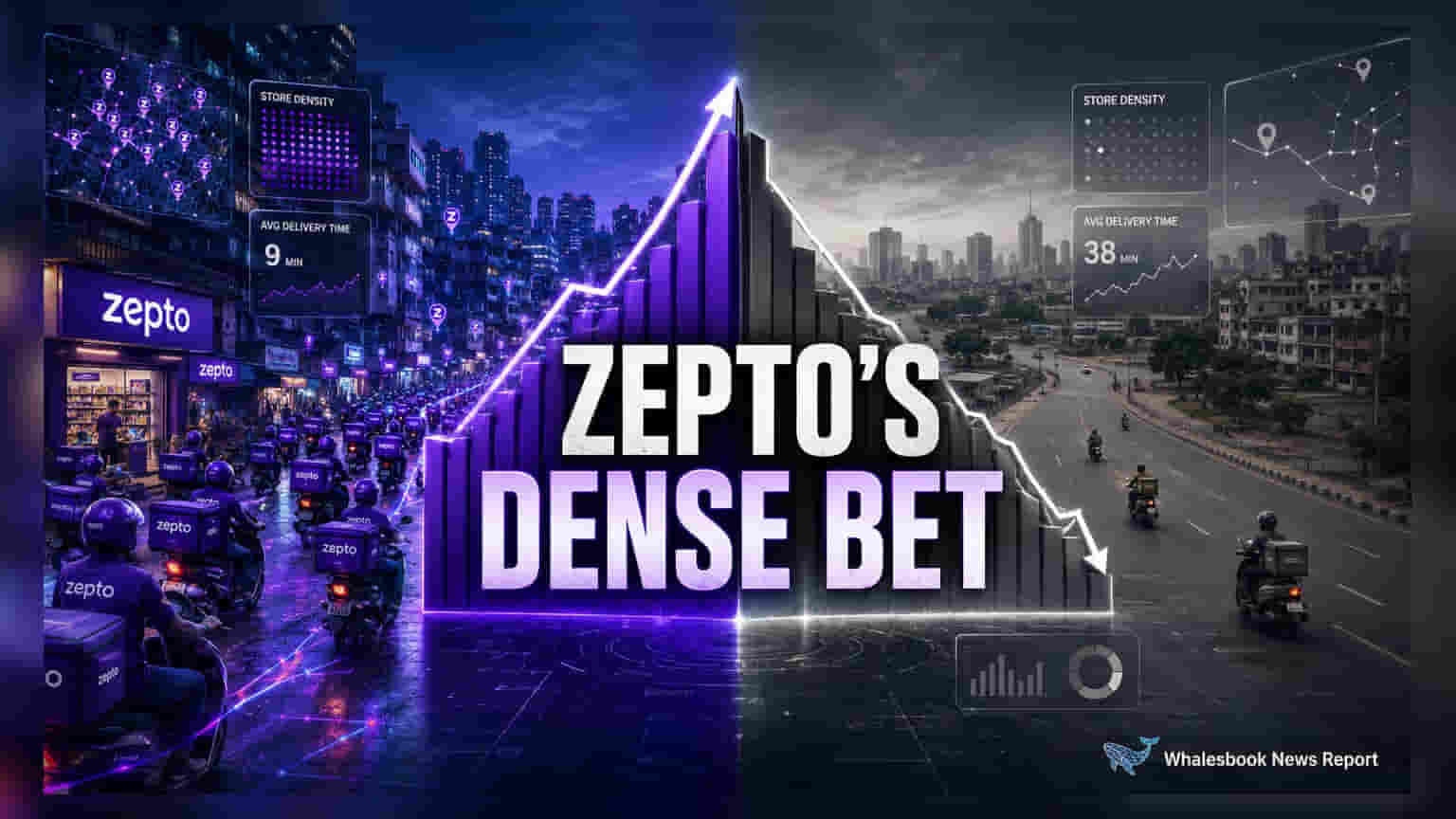


Zepto's Density Strategy Unpacked
Zepto's approach is a deliberate bet on density to achieve profitable unit economics in the highly competitive quick commerce market. While other companies are expanding their physical presence, Zepto is concentrating on maximizing efficiency within its current urban strongholds. The success of this focused strategy could significantly influence future industry directions.
The Advantage of Concentration
The company's strategy relies on a dense network of dark stores, operating an average of 21 stores per city, far more than Blinkit and Swiggy Instamart's average of nine. This concentration shrinks last-mile delivery distances, a major cost factor in quick commerce. In Bangalore, Zepto achieves deliveries under 10 minutes for 76% of its service area, dwarfing Blinkit's 21% reach for the same speed. This operational edge supports Zepto's deeper discounts, offering 22-26% basket discounts compared to Blinkit's 14-17%. Zepto also sees higher user engagement, with app opens around 10.5 times weekly versus Blinkit's 7.5 times.
Financial Health and Market Competition
Zepto has secured over $2.3 billion in funding, with a recent $300 million Series H round in October 2025. For fiscal year 2025, Zepto's revenue jumped 129% year-on-year to ₹9,668.8 crore, though its net loss widened to ₹3,367.3 crore. For comparison, Blinkit reported ₹5,206 crore in FY25 revenue, and Swiggy's Instamart recorded ₹2,252 crore. Blinkit's parent company, Eternal, has over ₹17,800 crore in cash reserves, and Swiggy holds about ₹15,053 crore. These financial strengths underscore the intense capital demands of the sector.
Challenges to Profitability and Growth
Despite its focused model, Zepto faces significant challenges. Bernstein analysts estimate variable and direct costs per order at ₹95-₹100, requiring similar revenue per order to break even on contribution margin, while competitors spend ₹116-₹118 per order. The ability to scale this high-density model to less populated, less affluent towns is uncertain. The quick commerce market is already concentrated, with 73% of dark stores located in the top four cities. Rising fuel costs, a 4% increase potentially adding ₹0.44 per order, also present operational pressure. Zepto's FY25 net loss was about 35% of its revenue, an increase from 29% in FY24, despite aiming for profitability before an IPO.
The Road Ahead
Zepto's path to profitability depends on optimizing its dense metro strategy. Strong user engagement and fast delivery in core markets are key advantages. However, high operational costs and fierce competition pose significant risks. If successful, Zepto's model could redefine quick commerce unit economics. The overall quick commerce market is projected to reach $6.64 billion by 2031, offering growth potential but demanding sustainable business models to capitalize on it.