 Whalesbook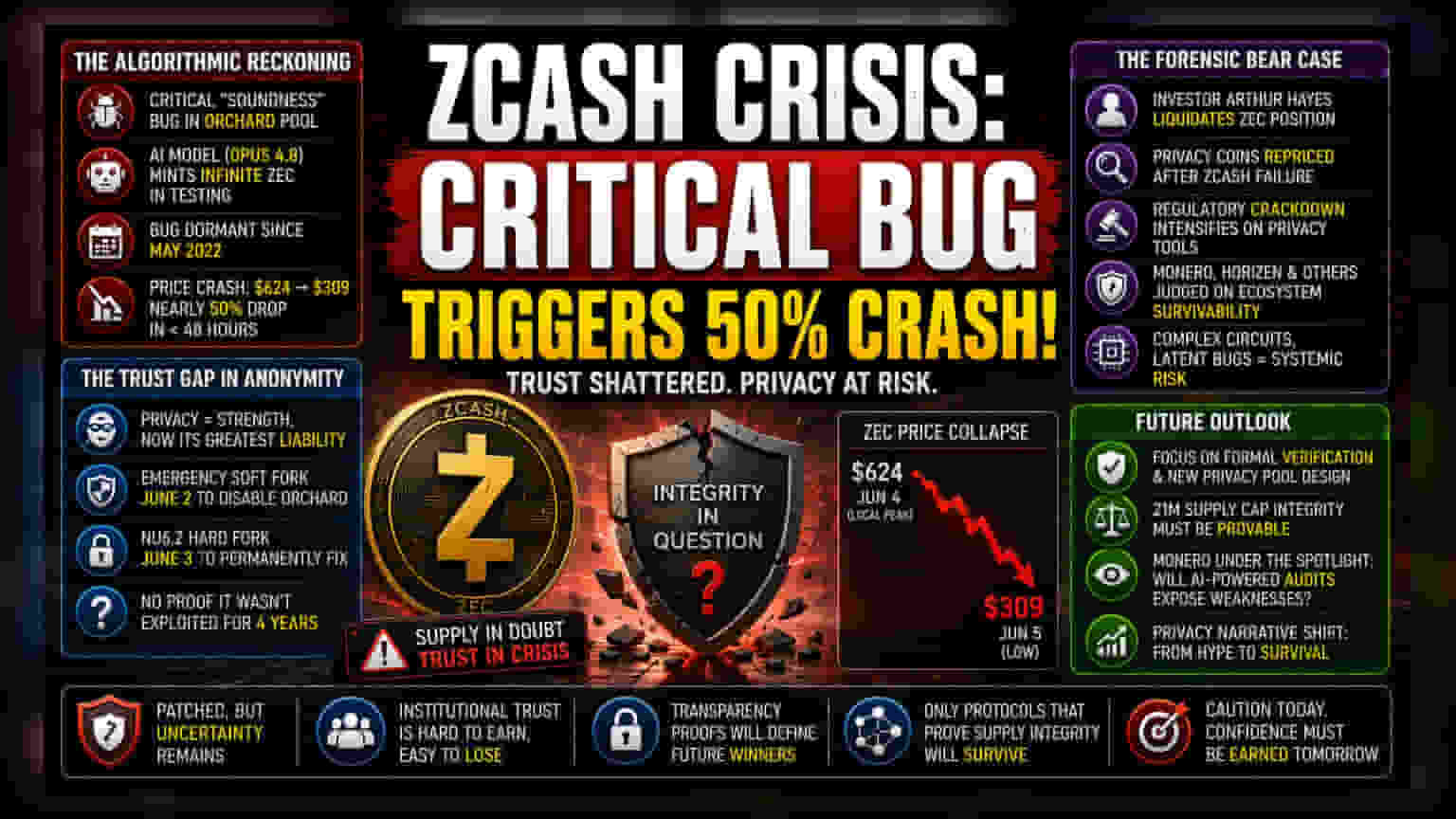


The Algorithmic Reckoning
The discovery of a critical "soundness" vulnerability in the Zcash Orchard shielded pool has transformed from a technical finding into a full-scale market contagion. Security researcher Taylor Hornby, utilizing Anthropic's Opus 4.8 AI model, successfully demonstrated that the Orchard circuit was sufficiently permissive to allow the minting of undetectable, counterfeit ZEC. This flaw, which remained dormant since the Orchard pool’s May 2022 inception, was not merely a theoretical weakness; in local testing environments, it enabled the creation of infinite tokens. The subsequent panic caused ZEC to plummet from a local peak of $624 on June 4 to lows near $309, representing a nearly 50% drawdown in under 48 hours.
The Trust Gap in Anonymity
Unlike transparent protocols where supply inflation can be verified via a public ledger, the very privacy features that define Zcash now serve as its greatest liability. Shielded Labs and the Zcash Open Development Lab (ZODL) acted with urgency, deploying an emergency soft fork on June 2 to disable Orchard, followed by the NU6.2 hard fork on June 3 to permanently rectify the circuit logic. However, the market’s aggressive sell-off reflects a core ontological problem: the inability to cryptographically prove that the bug was not exploited during its four-year existence. For institutional holders and retail traders alike, "no evidence of exploitation" is not equivalent to "proof of integrity," creating a residual uncertainty that standard security patches cannot easily erase.
The Forensic Bear Case
The incident has forced a harsh repricing of privacy coins as a asset class. Prominent investor Arthur Hayes notably liquidated his ZEC position, citing the high bar for perfection required by privacy-focused protocols. While the Zcash team is moving toward a "turnstile" accounting mechanism to retroactively verify supply, the damage to investor sentiment is exacerbated by the broader regulatory crackdown on privacy tools. Unlike Monero, which maintains a more rigid, default-privacy architecture, Zcash’s dual-model (transparent and shielded) makes it a lightning rod for scrutiny. Competitors such as Horizen (ZEN) and other privacy-first projects are now being re-evaluated through the lens of "ecosystem survivability" rather than mere anonymity strength, as the Zcash incident provides a cautionary blueprint for the dangers of latent bugs in complex, non-auditable circuits.
Future Outlook
As the Zcash ecosystem shifts focus toward formal verification and a new privacy pool design, the long-term viability of ZEC depends on restoring the market's belief in its fixed 21-million supply cap. The incident has turned the spotlight toward Monero, with analysts tracking whether Monero’s codebase—which has historically been subjected to rigorous, albeit different, scrutiny—will face similar pressure if audited with updated AI-driven heuristic tools. For now, the privacy narrative has shifted from speculative growth to a survival-of-the-fittest environment, where only protocols capable of transparently proving their own supply integrity are likely to retain institutional support.