 Whalesbook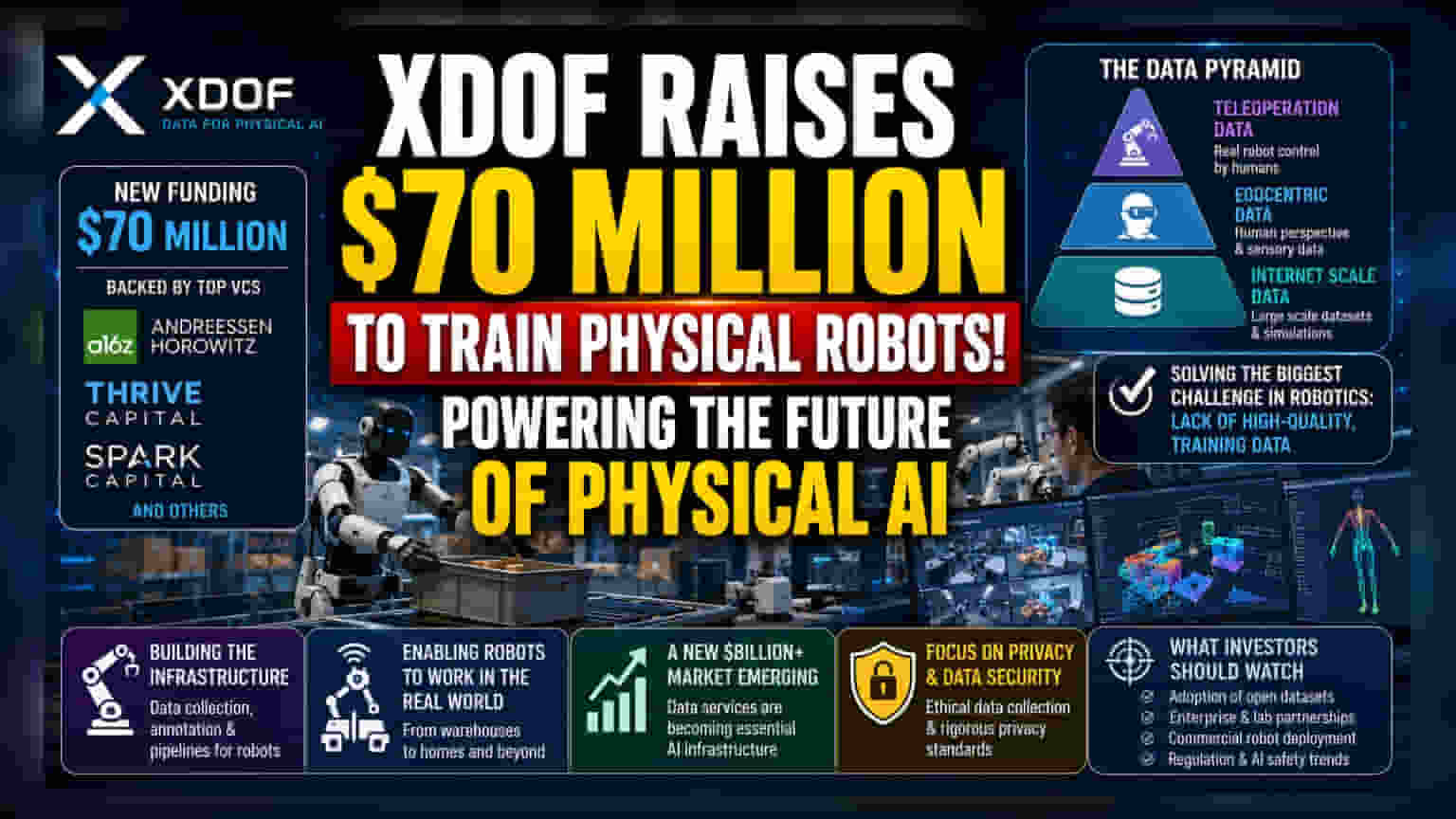


Startup XDOF has raised $70 million to build infrastructure for collecting and labeling data for physical robots. As AI moves from screens into real-world machines, the scarcity of high-quality training data has become a major industry bottleneck. This trend highlights the increasing value of specialized data collection and annotation services, a crucial monitorable for investors tracking the evolution of artificial intelligence and automation sectors.
What Happened
XDOF, a technology startup, has announced it secured $70 million in new funding to build the infrastructure needed to train physical robots. The company, which recently emerged from stealth mode, is focused on solving a major problem in the artificial intelligence sector: the lack of high-quality data for machines that interact with the physical world. The funding round included participation from venture capital firms such as Andreessen Horowitz (a16z), Thrive Capital, and Spark Capital, among others. XDOF is creating tools for data collection, annotation, and pipelines, aiming to bridge the gap that current robotics developers face when trying to teach machines to function in human environments.
Why This Matters For Investors
The artificial intelligence industry is increasingly moving beyond chatbots and text-based systems toward 'Physical AI,' which involves robots that can perform tasks in the real world. While large language models (LLMs) had the advantage of training on massive amounts of public text available on the internet, physical robots lack a similar repository of training data. Robot data is often scarce, difficult to capture, and requires specialized tools to annotate. By focusing on the 'data pyramid'—which includes teleoperation data from actual robots and egocentric data captured by human sensors—XDOF is positioning itself as a foundational provider in this new market. For investors, this signals that the AI boom is creating a secondary market for specialized data services, which may become an essential utility for robotics manufacturers and research labs.
How Investors May Read This
This development highlights the shift toward infrastructure-level investments in AI. While much of the initial investor focus was on companies developing the AI models themselves, the industry is now identifying the 'picks and shovels'—the essential infrastructure and data services required to make these technologies work. For Indian investors tracking the global tech landscape, this evolution suggests that companies capable of providing high-quality, scalable data annotation and curation will remain in high demand. As robots are deployed in warehouses, manufacturing plants, and eventually service environments, the need for data to train them will grow, potentially creating opportunities for businesses that specialize in synthetic data generation, sensor fusion, and complex data labeling.
The Execution And Data Privacy Risks
While the prospect of Physical AI is promising, the business faces clear execution risks. XDOF is in the early stages, and the success of its data ecosystem depends on whether it can scale its operations, including training and hiring a large global workforce of teleoperators and data labelers. There are also potential risks related to data privacy and security. Collecting egocentric data, which involves recording human movements or perspectives to train robots, requires rigorous privacy standards. If the company fails to manage data ethics or if the collected data proves difficult to integrate into various robotics platforms, it could face setbacks. Furthermore, the company faces intense competition, as other startups and internal teams at large AI labs are also racing to solve the robotics data problem.
What Investors Should Track
Investors interested in the AI and robotics space should monitor the broader adoption of standardized datasets, such as the ABC dataset which XDOF is releasing in collaboration with UC Berkeley. The success of such projects will indicate whether the industry is moving toward open standards for robot training or if it will remain fragmented. Additionally, watching how major AI research labs and robotics companies handle their data requirements—whether they continue to build in-house solutions or pivot to outsourcing to specialized providers like XDOF—will provide insight into the long-term viability of the data infrastructure business model. Monitoring the pace of commercial robot deployment and any changes in sector regulation regarding AI safety and data usage will also be important for gauging the long-term potential of this market.