

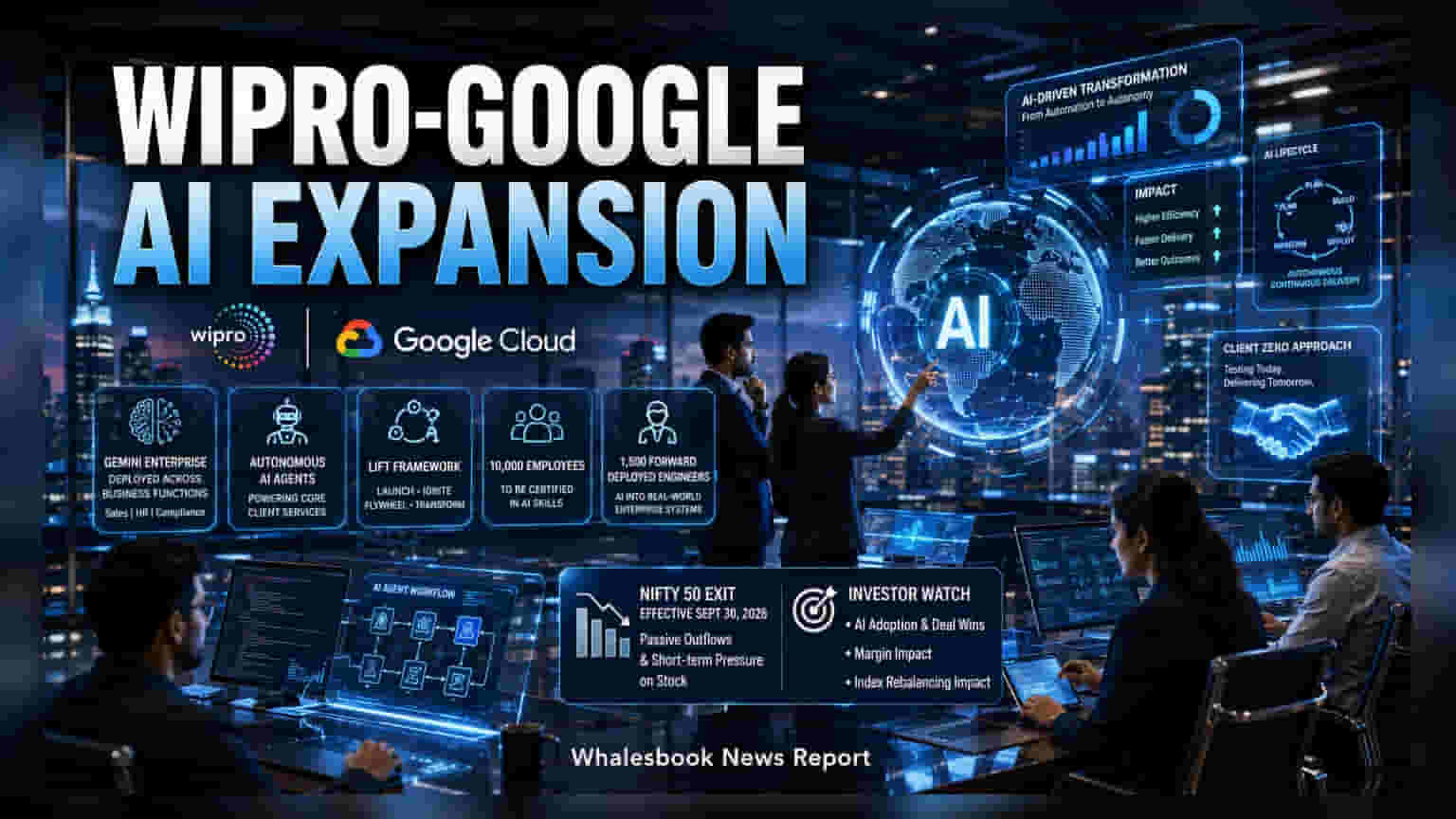
Wipro is expanding its partnership with Google Cloud to integrate Gemini Enterprise, aiming to build autonomous AI workflows. While this move seeks to boost long-term efficiency through a 10,000-employee upskilling program, the stock also faces technical pressure ahead of its scheduled exit from the Nifty 50 index on September 30, 2026.
Wipro is accelerating its transition into artificial intelligence by expanding its collaboration with Google Cloud. The company has announced the deployment of Google’s Gemini Enterprise across its internal business operations, including sales, human resources, and compliance. This move is part of a broader strategy to move beyond simple AI experiments and integrate autonomous AI agents into core client services.
To manage this transition, the company has introduced a new initiative called the LIFT framework, which stands for Launch, Ignite, Flywheel, and Transform. This framework is designed to work with Wipro’s existing software platforms to enable complex, multi-step business processes to be handled by AI with minimal human intervention. Essentially, the company is attempting to change how it delivers IT services by automating repetitive tasks and using AI to manage software development lifecycles, from planning to testing and maintenance.
Supporting this technological shift is a significant workforce development program. Wipro has committed to certifying 10,000 employees in specialized AI skills. A key part of this team will be 1,500 Forward Deployed Engineers, whose specific role is to move AI from the drawing board into real-world production systems for enterprise clients. The company is currently using its own internal teams to test these tools—a strategy it refers to as Client Zero—before rolling them out to customers.
While this partnership aims to improve efficiency and service delivery over the long term, investors are also balancing these developments against technical pressures. Wipro is scheduled to be removed from the Nifty 50 index on September 30, 2026. This is a significant event because many passive investment funds, such as ETFs and index funds, track the Nifty 50. When a stock is removed from an index, these funds are required to sell their shares, which can create temporary downward pressure on the stock price. Market estimates suggest that this rebalancing could lead to significant passive outflows, which traders are currently factoring into their positions.
Additionally, there are financial considerations to monitor. Large-scale upskilling and investments in AI infrastructure require substantial capital, which could lead to short-term pressure on profit margins. While the company aims for long-term growth, the immediate impact on profitability will depend on how quickly these AI investments can be converted into revenue-generating client contracts. The company’s ability to win large deals has faced timing challenges in recent quarters, making the execution of these AI-native strategies critical for future performance.
Moving forward, investors will likely watch two primary areas. First, they will monitor the actual adoption rates of these AI tools among enterprise clients and whether this translates into higher revenue or better profit margins. Second, they will track the stock’s performance through the September index rebalancing period to see how the market absorbs the anticipated passive selling from index funds.