

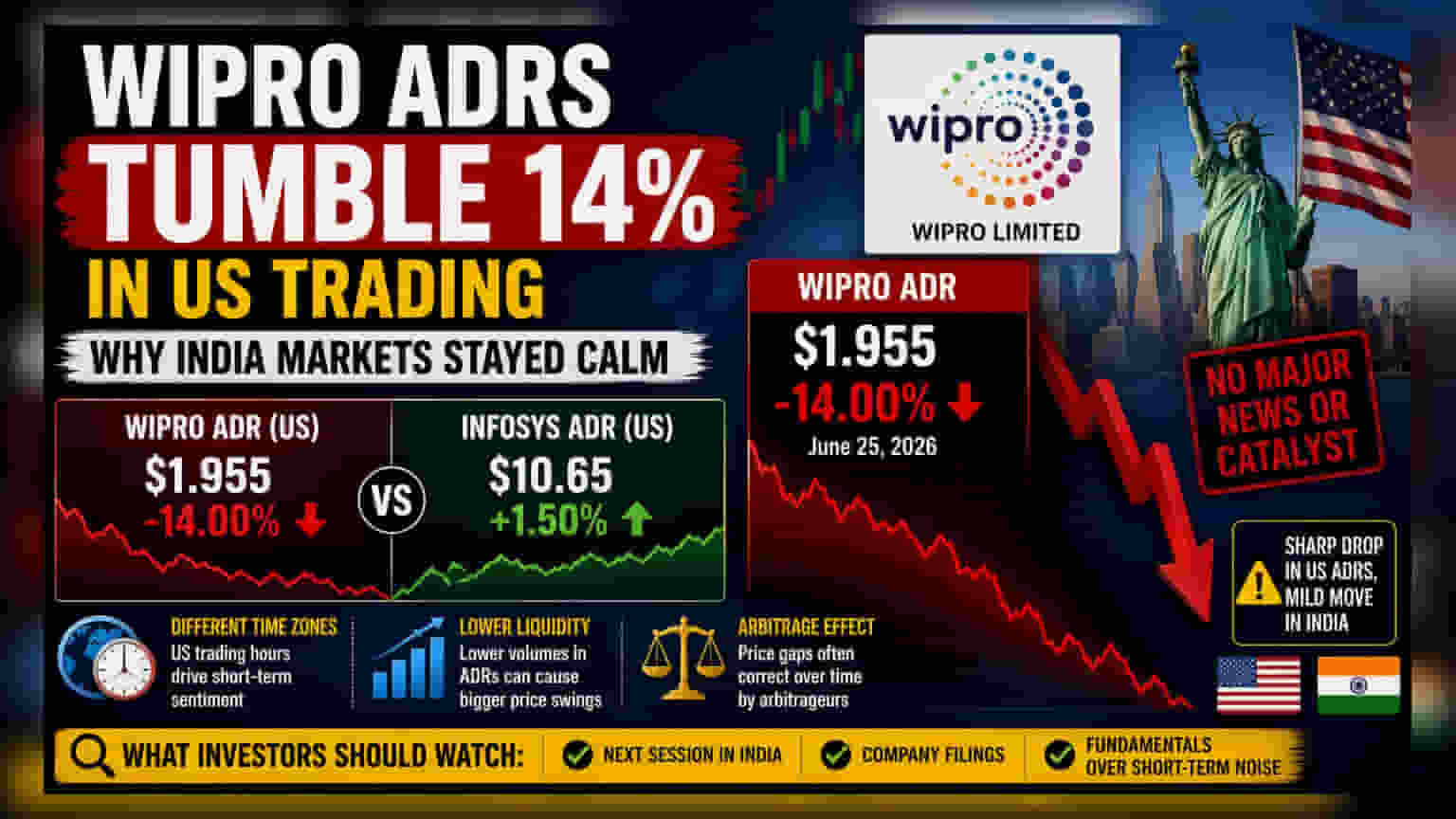
Wipro’s American Depository Receipts (ADRs) fell 14% on Wednesday in US markets, while the company’s stock on Indian exchanges showed a significantly smaller reaction. The sharp difference between the two prices highlights distinct trading dynamics between the US and Indian exchanges.
What Happened
Wipro Limited experienced a notable decline in its American Depository Receipts (ADRs) trading in the US on Wednesday. The securities fell 14% to $1.955 during the session. This sharp move occurred without any clear or immediate catalyst, such as a major corporate announcement or earnings report.
At the same time, the broader performance of its peer, Infosys, remained stable, with Infosys ADRs rising 1.5% to $10.65. Importantly, the heavy selling observed in the US-listed ADRs was not reflected in the stock’s performance on Indian exchanges, where the price movement was much milder during the regular trading session.
Why ADRs Often Move Differently
For Indian investors, it is important to understand why this gap exists. ADRs are certificates representing shares of a foreign company, traded on a US exchange. Because the trading volume in these ADRs is often much lower than the volume of the primary shares on the National Stock Exchange (NSE) or Bombay Stock Exchange (BSE), the ADR price can be more sensitive to individual trading patterns.
When US trading hours are active, even a small amount of selling pressure can sometimes cause larger price swings in ADRs than what would be seen in the much larger and more liquid Indian market. This creates a temporary "price disconnect" where the US-listed price does not perfectly track the Indian share price.
The Liquidity And Timing Factor
One reason for this divergence is that ADRs and Indian shares trade in different time zones and under different market conditions. US investors may be reacting to specific sentiments or trading strategies that do not exist among investors in India.
Additionally, arbitrageurs—traders who profit from price differences between two markets—usually work to close these gaps over time. If a stock falls significantly in the US without a fundamental business reason, the market often corrects this difference when the Indian markets open, as the two prices are tied to the same underlying company performance.
What Investors Should Track
Since there was no immediate business news or major event linked to this decline, the primary focus for investors is the next session in India. If the decline was driven by specific US market dynamics rather than a change in Wipro’s business fundamentals, the stock price in India may not follow the same downward path.
Investors may watch for any official exchange filings from the company to see if there is a specific reason for the unusual trading activity. Without such news, market participants generally view these sharp, unexplained ADR moves as temporary volatility rather than a shift in the company’s long-term outlook.