 Whalesbook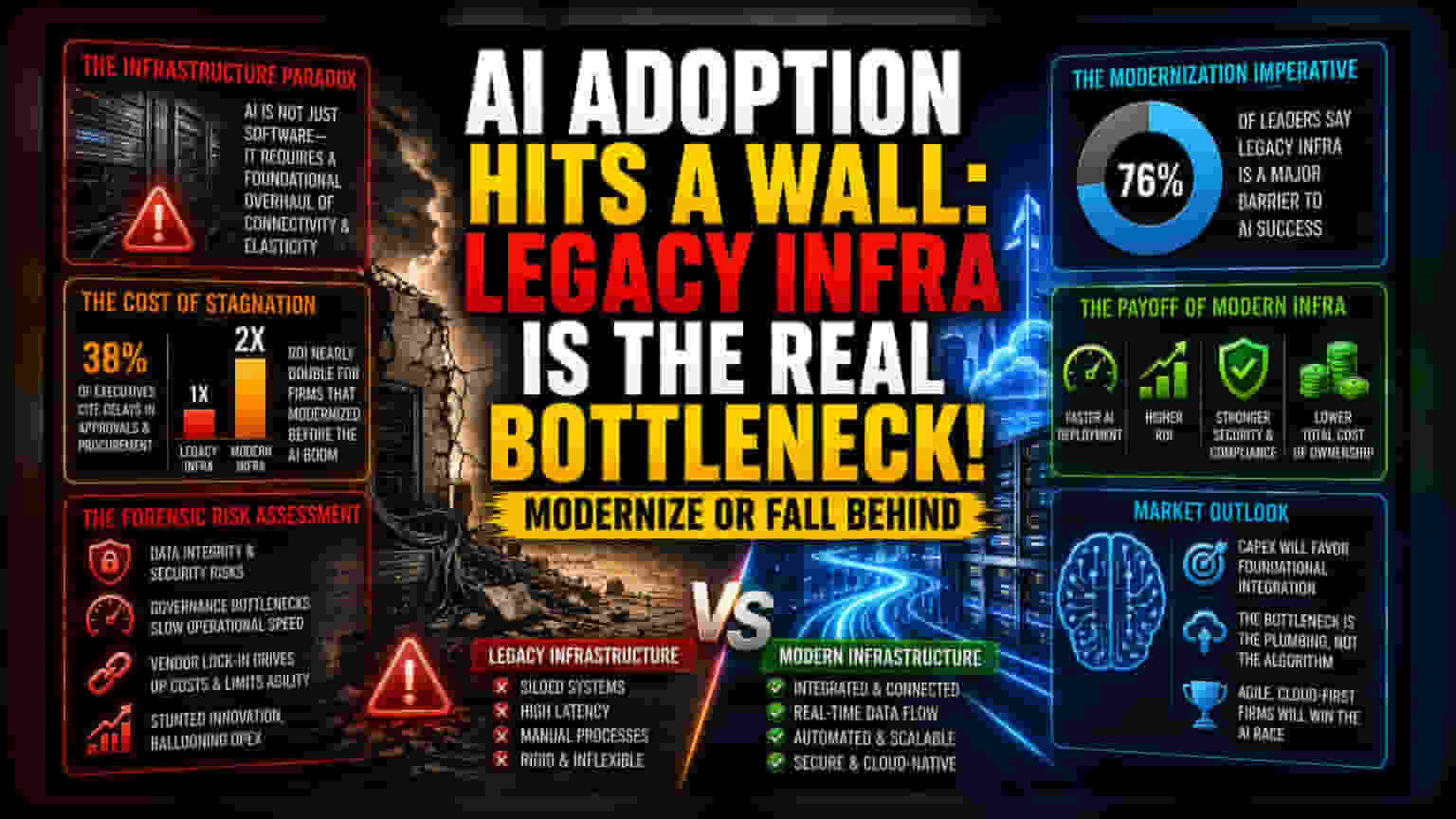


The Infrastructure Paradox
Corporate enthusiasm for artificial intelligence has collided with the reality of aging IT stacks. The prevailing narrative suggests that AI adoption is primarily a talent or budget challenge, but the friction currently stalling implementation is rooted in physical and logical architecture. Organizations that maintain rigid, monolithic data centers are discovering that generative AI is not merely a software layer to be deployed, but an intensive process requiring a foundational overhaul of network connectivity and hybrid cloud elasticity.
The Cost of Technical Stagnation
Beyond the raw compute requirements, the failure to modernize creates a persistent drag on capital efficiency. When infrastructure is evaluated in silos—security separate from connectivity, and data architecture separate from application deployment—the resulting latency prevents real-time data ingestion. This is precisely why nearly four in ten executives report that procurement and project approvals for AI initiatives are perpetually delayed. The market is witnessing a clear bifurcation: firms that modernized their data architectures prior to the generative AI boom are now seeing return-on-investment metrics nearly double those of their legacy-bound counterparts, who remain trapped in a cycle of retrofitting outdated systems.
The Forensic Risk Assessment
From a risk-mitigation standpoint, the reliance on legacy architecture introduces significant operational vulnerabilities. Organizations forcing high-velocity AI workloads onto legacy databases often face extreme risks regarding data integrity and security compliance. Because these systems were never designed for the granular access control required by large language models, the governance frameworks intended to provide safety often become the primary bottleneck for operational speed. Furthermore, the reliance on fragmented, proprietary legacy vendors locks firms into high-maintenance contracts, limiting their ability to pivot toward more efficient, cloud-native solutions. This vendor lock-in represents a hidden liability that rarely appears on balance sheets but manifests clearly in stunted innovation cycles and ballooning operational expenses.
Market Outlook and Strategic Shifts
As the industry moves away from the initial excitement of AI experimentation, the focus is shifting toward the 'plumbing' of the enterprise. Market intelligence suggests that capital expenditure in the coming fiscal quarters will likely favor companies that prioritize foundational integration over surface-level software implementation. Executives are increasingly realizing that the bottleneck is not the sophistication of the algorithm, but the durability and permeability of the underlying network. Companies that fail to address these structural deficits risk seeing their AI initiatives relegated to perpetual proof-of-concept states, ultimately ceding competitive ground to more agile, cloud-integrated market participants.