 Whalesbook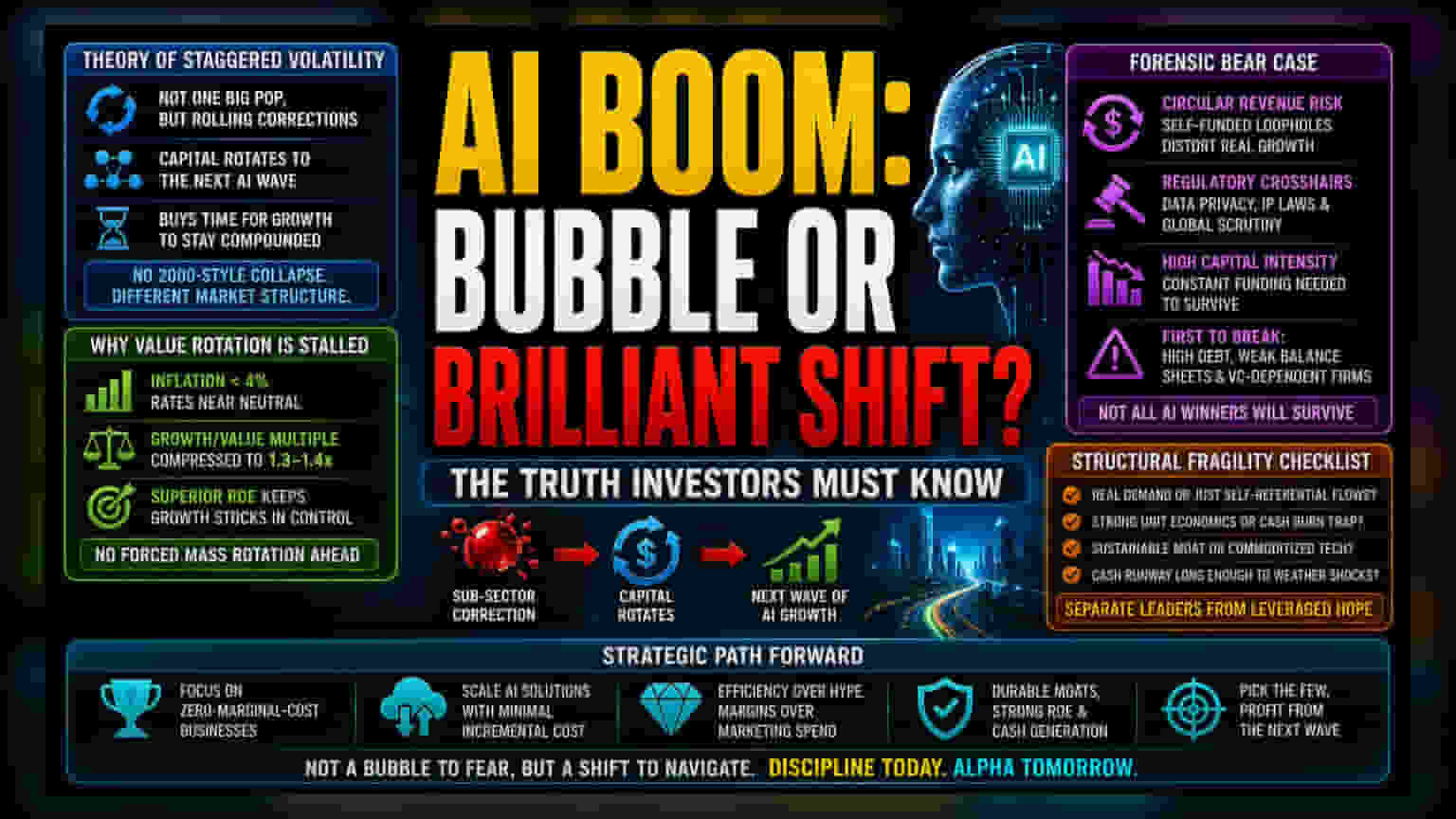


The Theory of Staggered Volatility
The prevailing fear that artificial intelligence represents a singular, overinflated bubble waiting for a definitive popping event may be fundamentally flawed. Rather than a monolithic collapse, the current market structure suggests a pattern of rolling, localized corrections. By the time one specific AI sub-sector faces a valuation reckoning, capital is likely already rotating into the next iteration of generative utility. This staggered progression prevents the total market paralysis witnessed during the 2000 tech wreckage, essentially buying time for growth-oriented capital to remain deployed.
Why the Value Rotation Remains Stalled
Investors hunting for a repeat of the 2022 pivot—where rising rates forced a mass migration into value stocks—are likely to be disappointed. The current macro environment differs significantly from the post-pandemic volatility that defined that era. With inflation metrics holding below the 4% threshold and central bank policy rates nearing a neutral baseline, the aggressive repricing mechanisms required to punish growth stocks are currently absent. Furthermore, the valuation spread between growth and value, now compressed to a range of 1.3 to 1.4 times, indicates that the market has already baked in much of the recovery potential for traditional, low-multiple assets. As long as growth firms maintain superior returns on equity, these companies will continue to command a liquidity premium that keeps value players sidelined.
The Forensic Bear Case: Structural Fragility
Despite the resilience of the overall trend, institutional skepticism persists regarding the sustainability of these growth metrics. The primary concern centers on the emergence of circular, self-referential revenue flows. When companies fund AI startups that, in turn, purchase services from the original corporate backers, the resulting growth appears robust but is ultimately hollowed out by a lack of genuine organic demand.
Regulatory friction also presents a non-trivial headwind. Unlike the early, loosely regulated internet era, AI sits in a crosshair of global legislative scrutiny regarding data privacy and intellectual property. The high capital intensity of these ventures necessitates constant, aggressive funding rounds. If the debt markets or public equity appetite cools, these companies face a potential solvency crisis. Firms carrying high debt-to-equity ratios or relying heavily on non-recurring venture capital will be the first to break, distinguishing them from the cash-rich, high-margin leaders that define the sector’s top tier.
Strategic Path Forward
The most lucrative opportunities are no longer found in defensive, sector-wide rotations. Instead, the focus has shifted toward companies capable of achieving the zero-marginal-cost curve, where scaling AI solutions requires minimal incremental expenditure. Investors are increasingly prioritizing entities that can demonstrate this efficiency rather than those simply burning cash for compute power.