

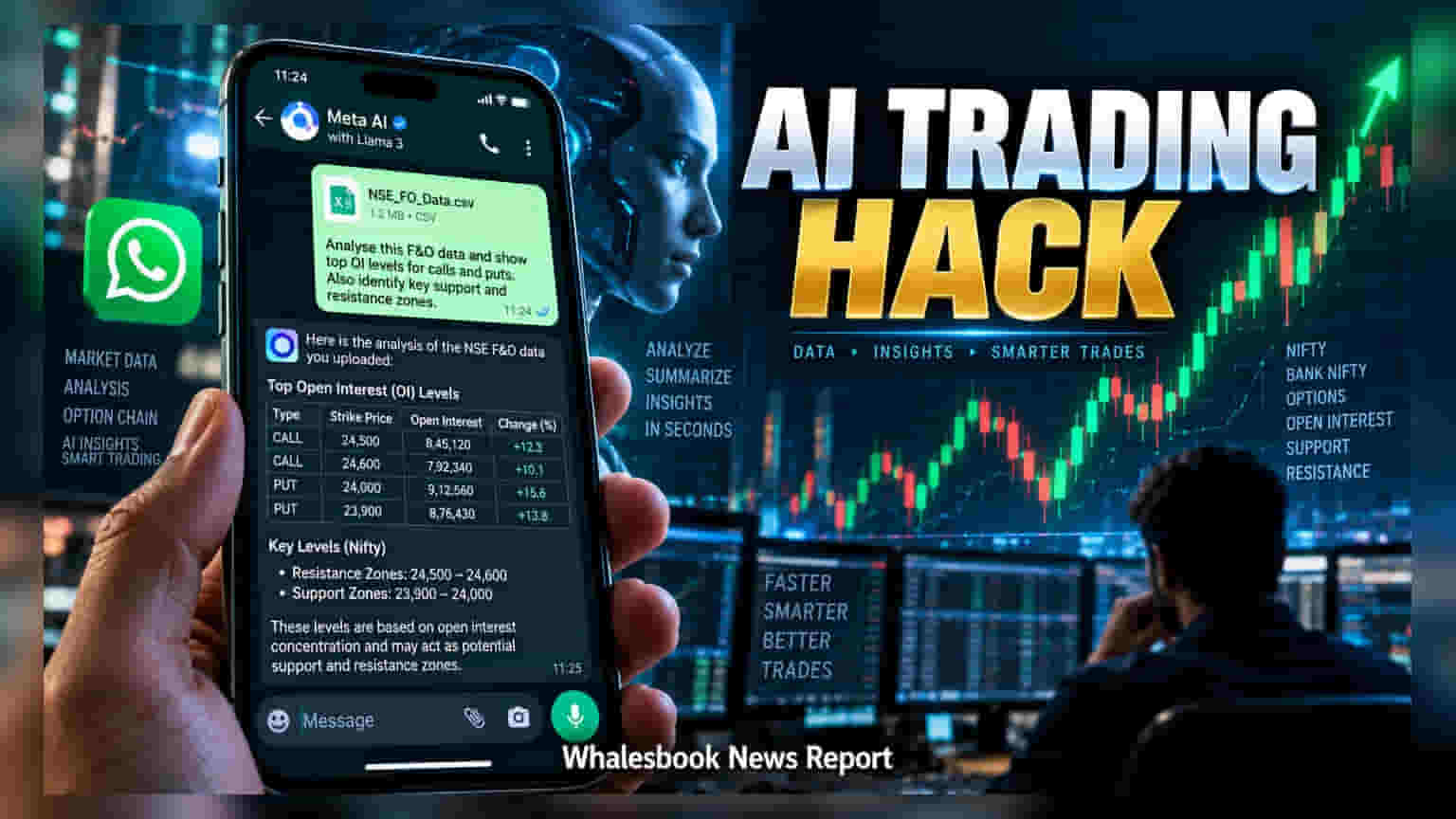
Retail traders can use Meta AI on WhatsApp to help analyze complex NSE F&O data. While it can identify open interest trends, investors must be aware of data privacy limits and the risk of inaccurate AI output when making trading decisions.
The integration of Artificial Intelligence into daily financial workflows has gained attention among retail traders who look for ways to simplify massive amounts of market data. A recent method involves using Meta AI on WhatsApp to process derivatives data from the National Stock Exchange (NSE). While the tool offers a way to parse through spreadsheets and identify market zones, it is essential for investors to understand the capabilities and limitations of this technology.
How the Workflow Works
Retail traders typically access the daily F&O market activity reports available on the official NSE website. By downloading these files and uploading them into a chat with Meta AI on WhatsApp, users can prompt the assistant to organize the information. Effective usage relies on specific instructions—such as asking the AI to sort data by contract type, identify top open interest levels for calls and puts, or arrange symbols alphabetically. This process aims to help users visualize liquidity zones, often interpreted by traders as potential support and resistance levels.
The Data Privacy Warning
One of the most important factors for users to consider is the difference between standard WhatsApp chats and interactions with Meta AI. While private messages on WhatsApp are end-to-end encrypted, conversations with Meta AI are not. When traders upload financial data files to the AI, this information may be stored and used by Meta to improve its systems and train its models. For those handling sensitive or proprietary trading strategies, sharing this data with an AI tool involves a trade-off in privacy that should be carefully considered before use.
Accuracy and Financial Risk
Beyond privacy, the accuracy of AI-generated analysis is a critical concern for investors. Large Language Models (LLMs) like the one powering Meta AI can sometimes misinterpret data, hallucinate figures, or provide inconsistent summaries. F&O trading involves significant capital risk, and relying solely on an AI assistant to identify market ceilings or floors can lead to incorrect conclusions if the underlying data is parsed incorrectly.
Investors should treat these AI tools as auxiliary assistants rather than financial advisors. Any data processed by an AI should be cross-verified against official exchange data and standard trading software. Furthermore, F&O trading is highly volatile, and the use of any external tool does not reduce the need for disciplined risk management, stop-loss strategies, and independent market analysis. The technology acts as a data-summarization aid, not a predictive oracle for market movements.