

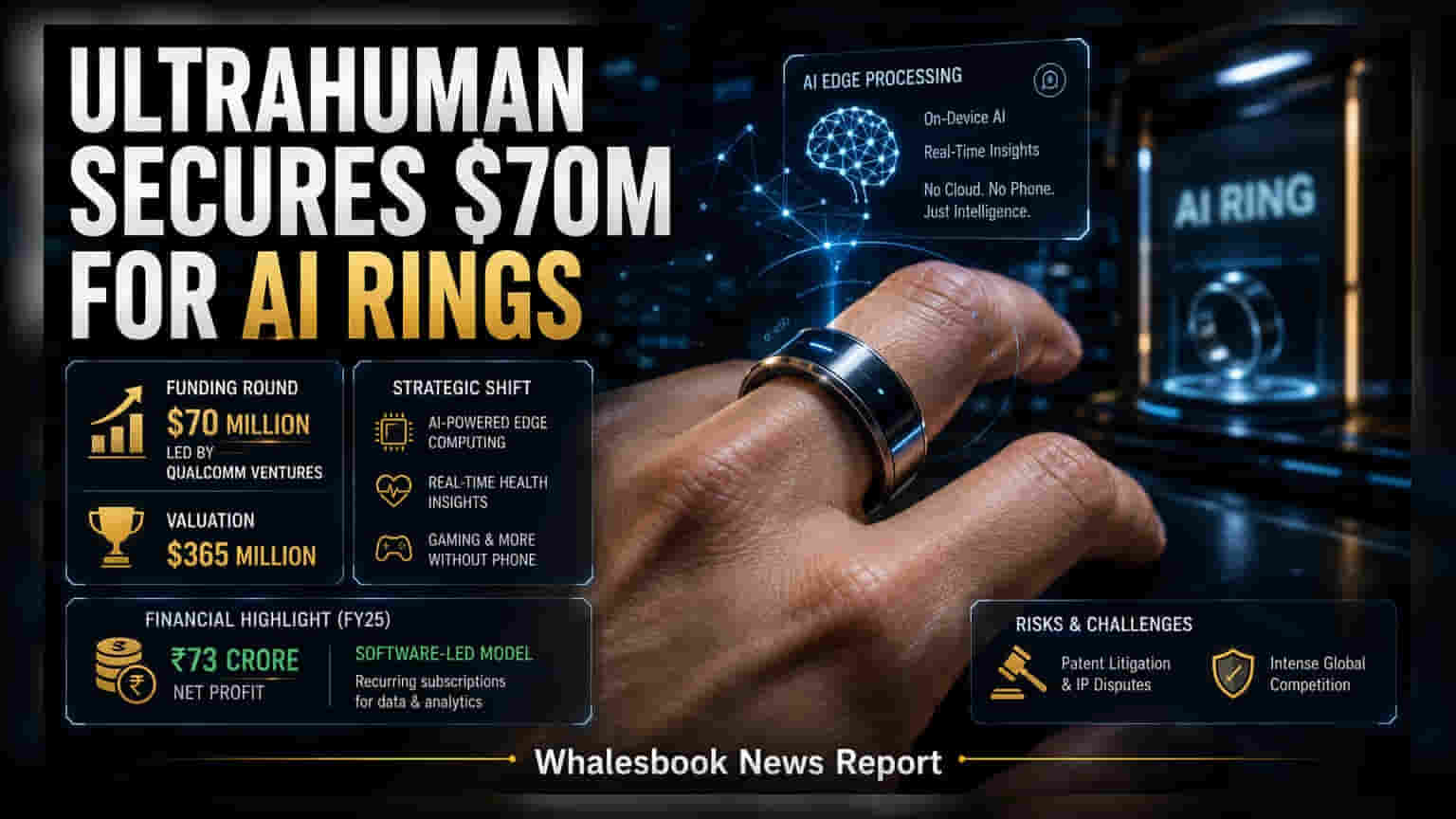
Bengaluru-based Ultrahuman has secured $70 million in funding led by Qualcomm Ventures at a $365 million valuation. The company plans to use the capital to transform its smart rings into AI-driven computers. While the firm turned profitable in FY25, it faces intense competition and past patent challenges in key markets like the U.S.
Ultrahuman, the Bengaluru-based health-tech startup, has secured $70 million in a new funding round led by Qualcomm Ventures. This capital injection values the company at approximately $365 million and marks a significant shift in its business strategy. The firm intends to move beyond simple fitness tracking, aiming to transform its smart rings into functional, AI-powered edge computing devices.
Moving Toward On-Device AI
At the core of this transition is a deeper partnership with Qualcomm. By integrating specialized chips into future hardware, the company plans to allow its rings to process complex health algorithms locally. Currently, most wearables rely on constant cloud synchronization or smartphone connections to analyze data. Moving this processing power to the ring itself could allow for real-time AI interactions and gaming capabilities without needing a phone nearby. For users, this means the device may become faster and more capable of providing immediate health insights.
Financial Position and Business Model
Unlike many high-growth technology startups that rely solely on burning cash for expansion, Ultrahuman has shown a focus on financial discipline. The company achieved profitability in the 2025 financial year, reporting a net profit of approximately Rs 73 crore. This pivot toward a software-led business model—where subscription services for deep health data and analytics provide recurring income—is a key factor in this performance. By focusing on higher-margin subscriptions alongside its hardware sales, the company is attempting to build a more stable long-term revenue stream than hardware sales alone would provide.
Navigating Risks and Legal Challenges
While the expansion plans are ambitious, investors and observers often track the company's legal and regulatory history. The wearable industry is highly competitive, and Ultrahuman has previously faced intellectual property challenges. Notably, the company encountered legal friction in the U.S. market due to patent litigation with rival Oura, which led to temporary import bans on some devices. Although the company has since redesigned its 'Ring Pro' and re-entered the U.S. market, these patent battles underscore a persistent risk in the sector. Any future intellectual property disputes could impact sales in major revenue markets like the United States.
What Lies Ahead
As a private company, Ultrahuman does not trade on public exchanges like the NSE or BSE, so there is no stock price for investors to track. However, its future growth will likely depend on its ability to successfully launch the new AI-capable hardware and maintain its momentum in global markets like the U.S. and the UAE. The key monitorable for the business will be its ability to balance the high costs of research and development for new chips with the need to protect its profit margins in a market dominated by larger, well-funded global players.