

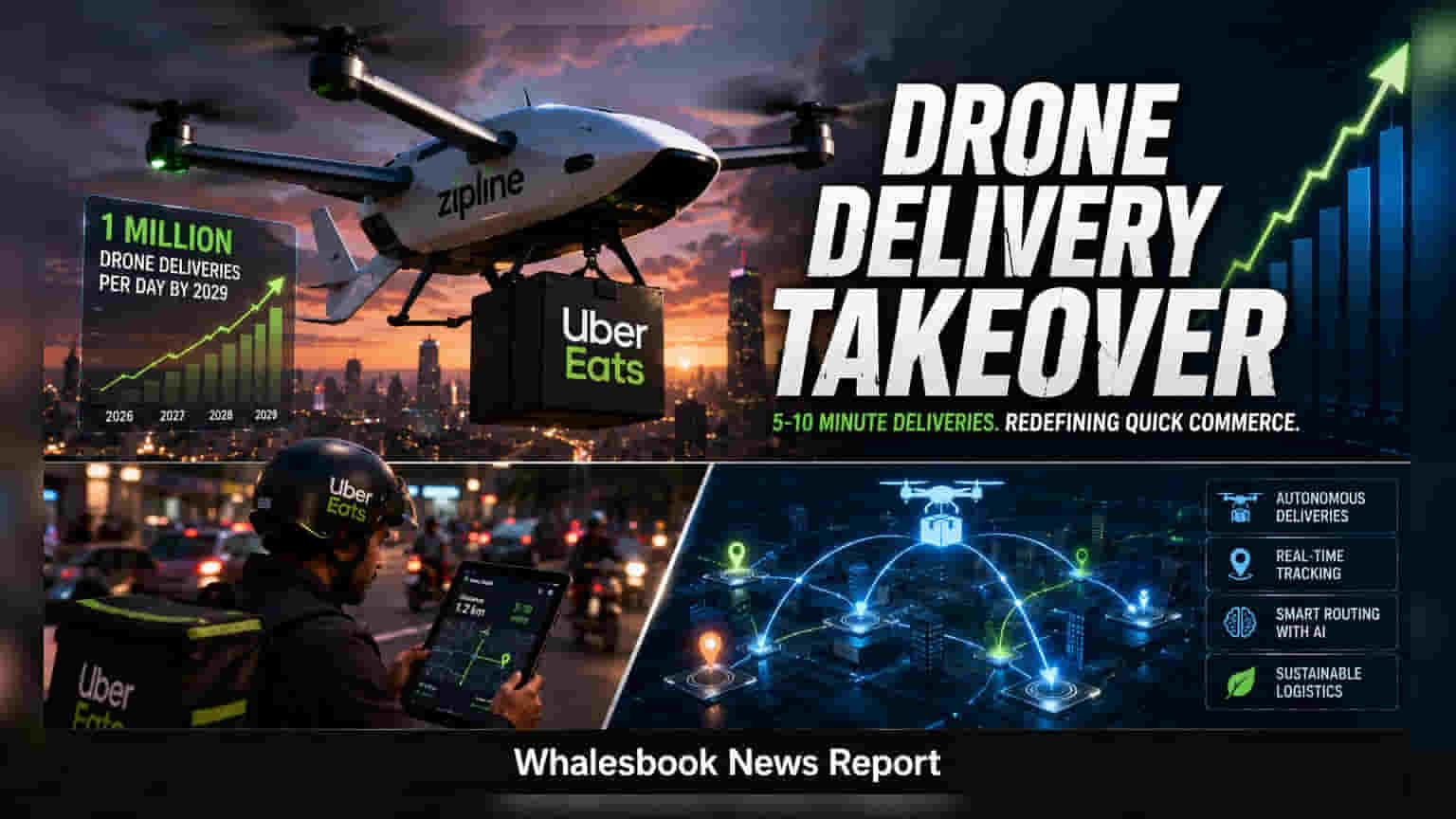
Uber Technologies has announced a strategic partnership and investment in drone delivery firm Zipline to scale its Uber Eats platform. The collaboration aims for one million drone deliveries daily by 2029. Investors should monitor how the company handles regulatory hurdles, urban logistics challenges, and intense competition in the autonomous delivery space.
On August 17, 2026, Uber Technologies, Inc. announced a strategic partnership and investment in the drone delivery company Zipline. The collaboration aims to significantly expand the capabilities of the Uber Eats platform by integrating autonomous aerial logistics. The stated goal for this initiative is to reach one million drone deliveries per day by the end of 2029, a move Uber believes will redefine the speed and efficiency of its quick commerce segment.
Scaling Autonomous Logistics
The partnership plans to begin initial drone delivery operations on the Uber Eats platform by the end of 2026. These services will launch in markets where Zipline already operates before expanding into numerous U.S. cities. For Uber, this aligns with its broader strategy of leveraging third-party technology providers to build a flexible delivery network. By investing in external developers like Zipline rather than building all drone capabilities in-house, the company is attempting to lower the financial risk associated with developing complex, new hardware.
Uber's leadership has positioned this as a key driver for its delivery business. The potential for fulfilling orders in five to ten minutes is seen as a way to capture more market share in the quick commerce sector, which executives view as a faster-growing opportunity than traditional food delivery.
Business Context and Valuation
Zipline, a San Francisco-based firm, recently completed a Series H funding round that valued the company at $7.6 billion. This investment from Uber adds capital to Zipline’s balance sheet, which is necessary for the expensive process of scaling fleet production and software development. For Uber, this is a continuation of a strategy seen in its autonomous vehicle segment, where the company has committed billions of dollars in partnerships and investments to secure future logistics advantages without owning the entire R&D pipeline.
Execution and Regulatory Risks
While the plan is ambitious, investors should remain aware of significant execution hurdles. The most immediate challenge is the regulatory landscape. Operating autonomous drones in dense urban environments requires rigorous approval from aviation authorities like the Federal Aviation Administration (FAA) in the United States. Any delay in receiving safety certifications or changes in municipal drone regulations could stall the planned rollout.
Furthermore, the sector is increasingly crowded. Competitors such as Alphabet’s Wing, DoorDash, and other drone delivery startups are also aggressively expanding their footprints. The company must prove that its drone network can operate reliably at scale without creating noise, safety, or privacy issues that often lead to public pushback in residential areas. Additionally, integrating third-party technology into the existing Uber Eats platform carries the risk of software compatibility issues or unforeseen operational costs.
The next key monitorable for investors will be the performance and reliability of the initial pilot programs scheduled for late 2026. Success in these early deployments will be critical in determining whether the company can realistically meet its target of one million daily deliveries by 2029 or if regulatory and infrastructure constraints will require a change in timeline.