 Whalesbook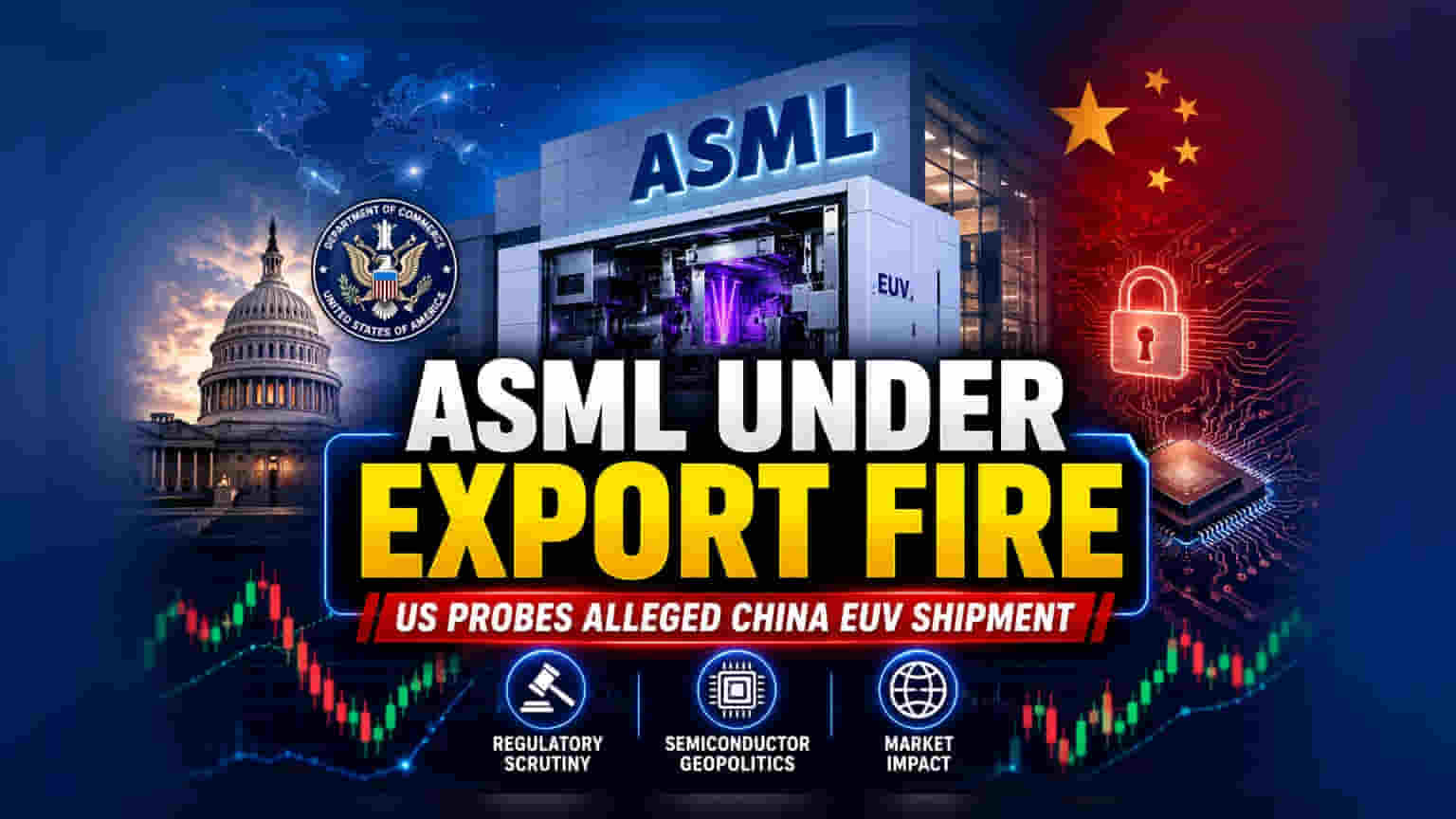
US commerce officials have flagged concerns to ASML, suggesting a high-end EUV chip-making machine may have reached China, violating export restrictions. ASML has denied the allegations. This event highlights the growing geopolitical pressure on the Dutch chip-equipment giant, which is a key supplier for global semiconductor manufacturing.
What Happened
The U.S. Commerce Department, led by Secretary Howard Lutnick, has engaged in discussions with senior leadership at ASML Holding NV regarding allegations that one of the company's advanced extreme ultraviolet (EUV) lithography machines may have been illicitly transferred to China. These systems are the most sophisticated tools in the semiconductor manufacturing process, essential for printing the circuit patterns on the world’s most powerful chips. U.S. regulations strictly prohibit the export of these specific high-end tools to China to prevent the advancement of its domestic chip capabilities.
ASML's Response and Official Stance
ASML has issued a firm denial of the claims, stating that no EUV machines have been shipped to China. The company emphasized that its EUV systems are colossal in size, highly complex, and require continuous, specialized maintenance by ASML technicians to function. Management maintains that they are fully compliant with all international and national export control regulations and that they engage in transparent dialogue with relevant government authorities.
Why This Matters For Investors
For investors, this development underscores the heightened regulatory risk surrounding ASML. As the sole provider of EUV lithography technology globally, ASML is at the center of the technological trade war between the U.S. and China. While the company’s business model relies on a global, open-market approach to sell its high-margin machines, increasing geopolitical pressure forces the company to navigate a shrinking path.
Any proof of a breach—or even persistent, unsubstantiated allegations—can lead to tighter legislative scrutiny. In the U.S., there is bipartisan interest in aligning restrictions on allies like the Netherlands more closely with domestic U.S. rules. If export controls are expanded to include more deep ultraviolet (DUV) immersion tools, or if regulatory compliance requirements become more stringent, it could impact ASML's revenue composition.
The Bigger Business Context
China has historically been a significant market for ASML, accounting for a notable share of its revenue. However, the company has recently communicated a "normalization" of its China business as trade restrictions prevent the shipment of advanced units. Management has previously signaled that China's contribution to total sales is expected to decline as the industry adapts to these limitations. The company remains focused on serving global demand for AI-driven chips, which requires high-end lithography capacity, but the uncertainty surrounding its ability to operate freely in major markets like China remains a core factor for valuation.
What Could Go Wrong
Investors may monitor the potential for increased compliance costs and delayed shipments if diplomatic relations between the U.S., the Netherlands, and China deteriorate. There is also the risk that prolonged regulatory pressure could create a more difficult operating environment, potentially affecting the company's ability to maintain its profit margins or secure future orders from Chinese customers. Any move to further restrict access to the Chinese market, which remains a key part of the semiconductor supply chain, could lead to volatility in the company’s backlog and future revenue projections.
What Investors Should Track
Moving forward, the primary monitorables include any formal announcements from the Dutch government or U.S. regulatory bodies regarding export policy. Investors should watch for ASML's management commentary in upcoming earnings calls, specifically regarding its order book, regional revenue breakdown, and any updates on compliance measures. The evolution of U.S.-led legislative efforts regarding chip-making equipment will also be critical to gauge the long-term impact on ASML’s market access and operational strategy.

