

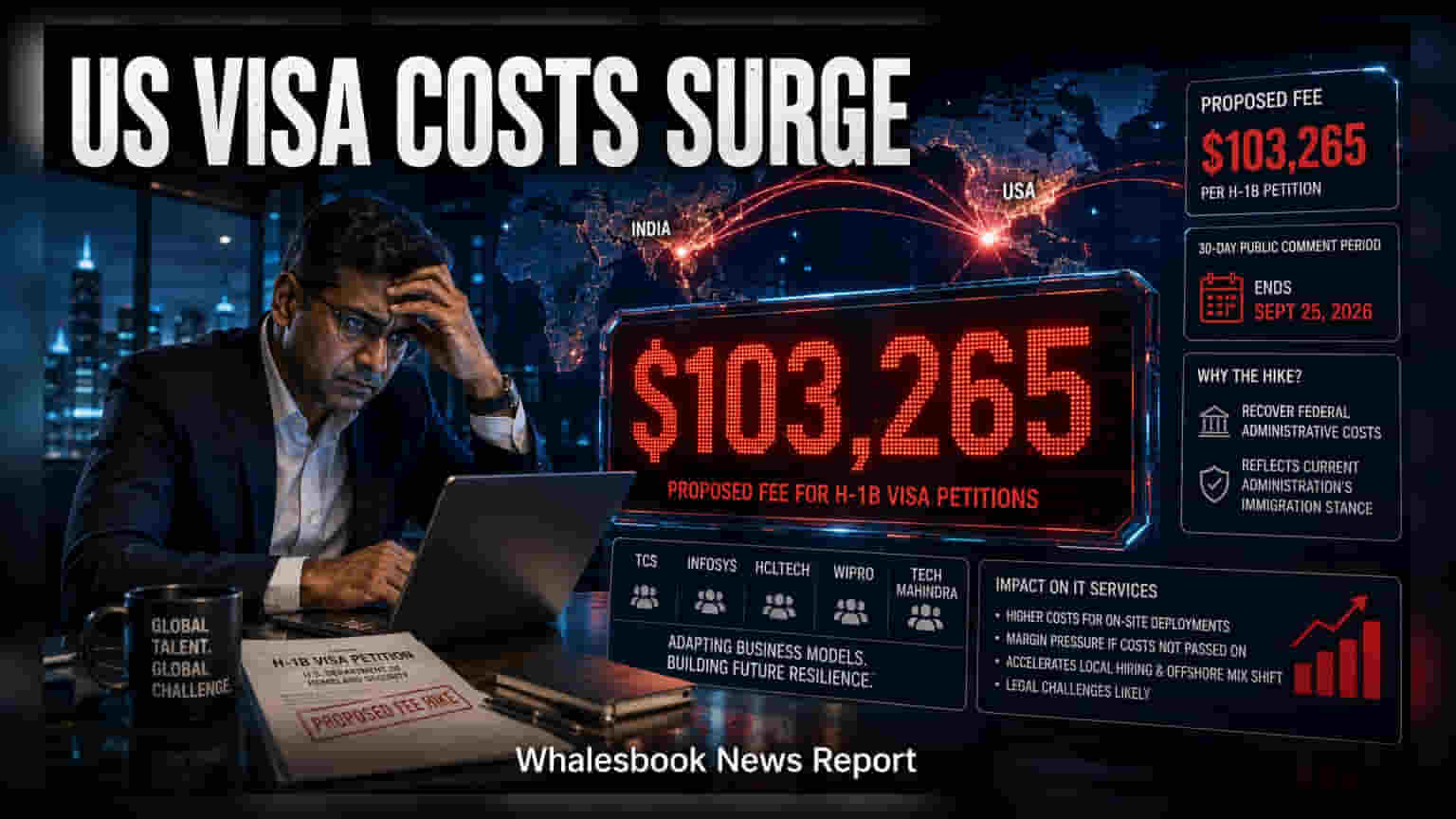
The US Department of Homeland Security has proposed a $103,265 fee for H-1B visa petitions, creating uncertainty for Indian IT firms. While the rule is currently in a public comment phase and likely to face legal challenges, the potential cost escalation adds pressure to the traditional hiring model. Investors should monitor how companies manage these rising talent costs and their ongoing shift toward local hiring in the United States.
The United States Department of Homeland Security (DHS) has introduced a proposal to set the fee for H-1B visa petitions at $103,265. This move, which comes amid a broader debate over immigration and foreign labor in the US, has drawn immediate attention from global technology firms, particularly those in the Indian IT services sector that have historically utilized the visa program to deploy talent on-site at client locations.
This proposal, which was published in late August 2026, is currently in a 30-day public comment period. It aims to recover federal administrative costs and reflects the current administration's stance on foreign labor. For shareholders of major Indian IT companies like Tata Consultancy Services (TCS), Infosys, HCLTech, Wipro, and Tech Mahindra, the update highlights a potential shift in the cost of doing business in the US.
Impact on IT Services Business Model
The traditional model for Indian IT services often involves sending skilled professionals to work at client sites in the US for specific projects. This model has already been changing over the last decade. Large IT firms have been actively reducing their dependence on H-1B visas by increasing local hiring in the US and shifting more work back to India, a process known as increasing the 'offshore' mix.
If the proposed $103,265 fee were to become law, it would represent a massive jump from the current visa costs, which typically range in the low thousands of dollars. Such a steep increase would force firms to rethink their on-site project strategies. If companies cannot pass these additional costs on to their US clients, their profit margins could come under pressure. However, it is important to note that many IT giants have already significantly diversified their talent pools, meaning the impact of such a fee would likely be smaller today than it would have been ten years ago.
Legal and Regulatory Uncertainty
Investors should keep in mind that this is a proposal, not a final law. The US regulatory environment for H-1B visas has been volatile. Earlier in 2026, a federal judge blocked a similar attempt to impose a $100,000 fee, ruling it an unlawful tax. The current proposal is designed to address those legal concerns by following a more formal rule-making process rather than relying on executive action.
Despite this, industry bodies and advocacy groups are expected to challenge the new proposal. A lengthy legal battle is highly probable, which could delay or even prevent the fee from being implemented. The current situation remains fluid, and the primary risk for investors is the uncertainty rather than an immediate financial hit.
What Investors Should Track
For investors, the most critical factor will be management commentary in the coming quarters. Companies will likely address how they view this proposal, their current level of H-1B dependency, and their plans for further localizing their US workforce. Analysts will be watching to see if firms mention the need to renegotiate client contracts to protect margins from potential visa fee hikes.
Additionally, monitoring data on visa registrations and the percentage of local versus imported staff will provide a clearer picture of how 'future-proof' these companies are against potential changes in US immigration policy. While the headlines regarding such fees can cause short-term stock price volatility, the long-term impact will depend on the ability of these IT firms to continue delivering high-value services while maintaining their profit margins through efficient global talent management.