

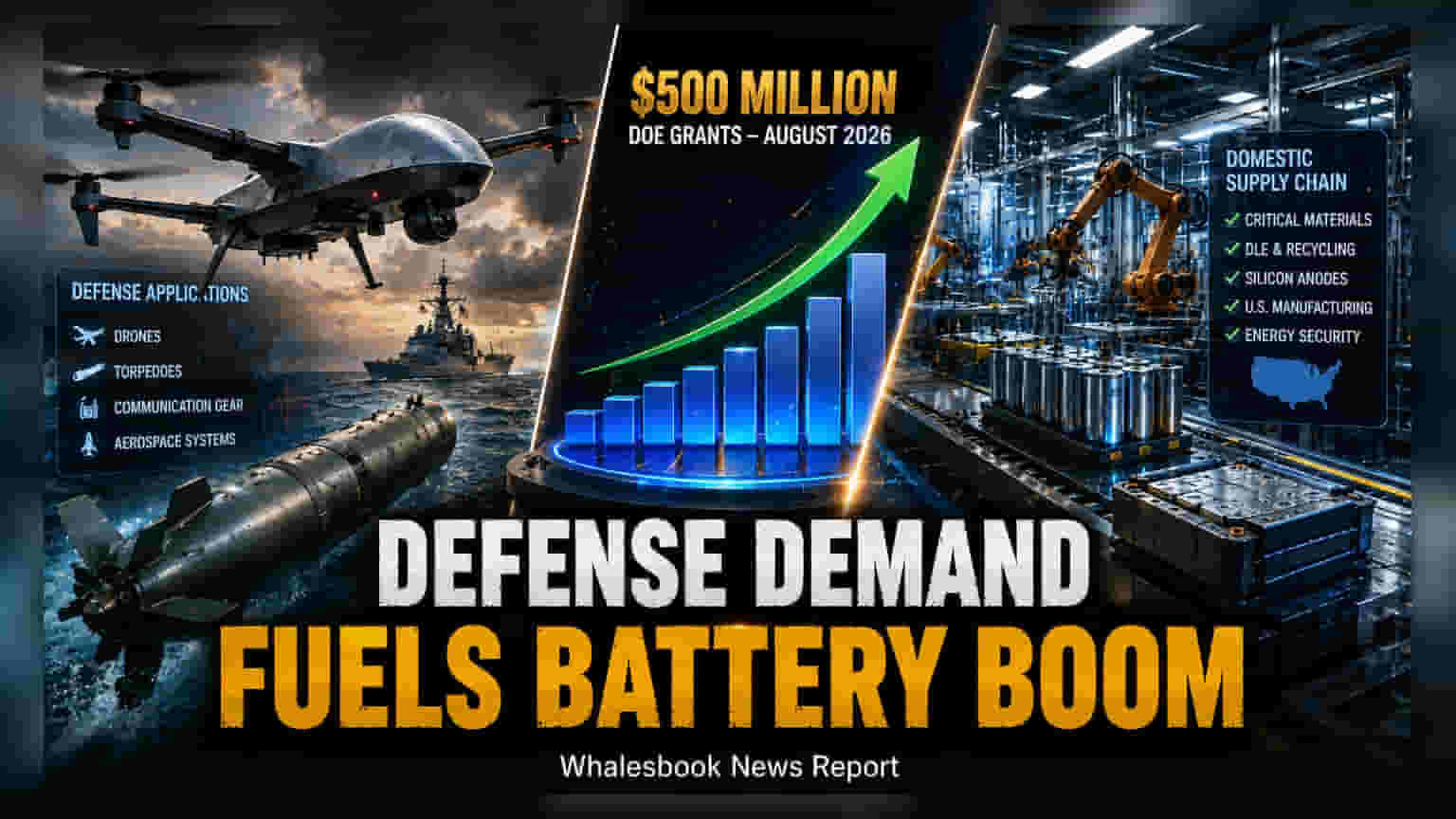
The US Department of Energy has awarded $500 million in grants to seven battery startups to strengthen domestic supply chains. These private companies are shifting focus from the cooling EV market toward defense applications, driven by national security goals. This move highlights the capital-intensive nature and policy-driven growth of the emerging battery tech sector.
In August 2026, the U.S. Department of Energy (DOE) announced $500 million in grants to seven companies aimed at bolstering the domestic battery supply chain. This funding marks a pivot for several prominent battery technology startups, which are increasingly prioritizing defense applications alongside their existing focus on electric vehicles (EVs).
The strategic shift follows adjustments in EV subsidies and a broader government push to reduce reliance on foreign-sourced critical minerals and materials. By targeting the defense sector—which requires reliable batteries for drones, portable communication equipment, and advanced aerospace systems—these firms are looking to secure a more stable revenue stream than the volatile automotive market currently offers.
Key recipients of the DOE support include companies like Coreshell Technologies, which received $50 million for silicon-anode manufacturing, and Lilac Solutions and Nth Cycle, which received $100 million each for projects in direct lithium extraction and battery material recycling, respectively. These startups are private entities and are not traded on public stock exchanges like the NSE or BSE. For investors tracking the sector, this means exposure to these specific companies is limited to private equity or venture capital channels rather than retail stock markets.
The reliance on federal funding highlights the capital-intensive nature of the battery industry. Scaling technologies such as direct lithium extraction (DLE) and black mass recycling from laboratory or pilot stages to full commercial operation remains a significant challenge. Investors tracking this sector should note that while these grants provide necessary initial capital, the long-term success of these firms will depend on their ability to complete these facilities on time and at scale by their targeted operational dates, such as 2028.
From an industry perspective, the move reflects a growing trend where government policy is directly shaping the business models of deep-tech firms. While defense demand provides a floor for growth, these companies face the inherent risk of policy uncertainty and the high cost of building manufacturing infrastructure. A key monitorable for the sector will be whether these startups can successfully navigate the transition from grant-funded development to profitable, large-scale commercial production, or if they will remain dependent on continued government support to maintain operations.