

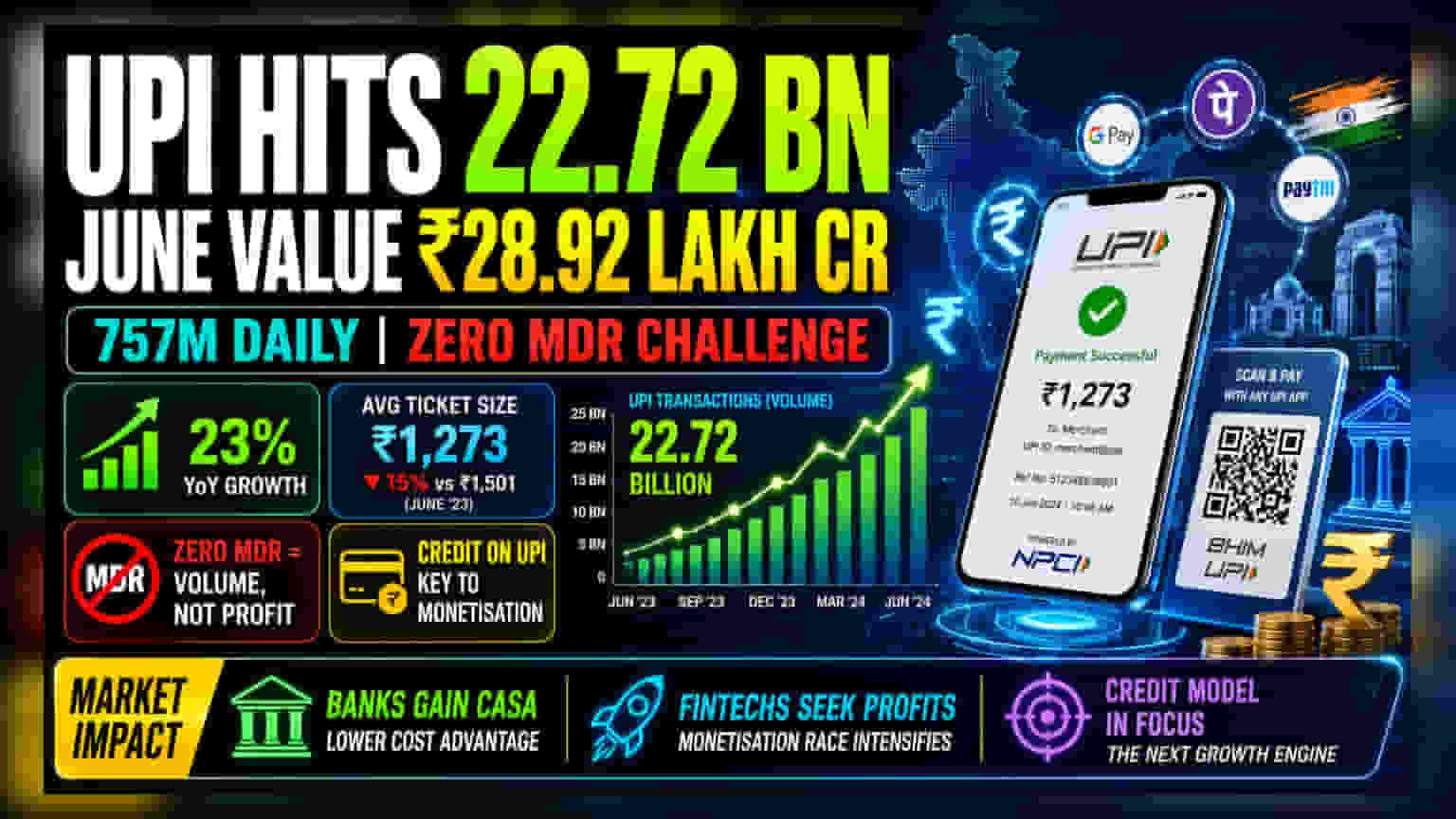
India's UPI processed 22.72 billion transactions in June 2026, a 23% year-on-year rise. While adoption for small-ticket daily payments continues to grow, the declining average transaction size highlights the ongoing monetization challenge for payment firms under the Zero MDR regime.
What Happened
The Unified Payments Interface (UPI) processed 22.72 billion transactions in June 2026, according to data from the National Payments Corporation of India (NPCI). This represents a 23% increase compared to June 2025. The total value of these transactions touched ₹28.92 lakh crore, marking a 20% year-on-year growth. The platform also recorded its highest-ever daily average, with 757 million transactions occurring each day, signaling that UPI is now deeply integrated into the daily financial habits of Indian consumers.
The Monetization Dilemma
For stock market investors, the headline volume numbers are only part of the story. A critical trend emerging from the data is the drop in average ticket size, which fell from ₹1,445 in June 2024 to ₹1,273 in June 2026. This shift confirms that UPI is increasingly used for small, frequent, retail purchases rather than large-value transfers.
This trend creates a significant business challenge known as the 'Zero MDR' issue. In India, the Merchant Discount Rate (MDR)—the fee merchants pay to accept a digital payment—is currently zero for UPI. This means payment service providers (like fintech apps) do not earn a direct processing fee on these billions of transactions. Consequently, high volume does not automatically translate into high revenue for digital payment companies.
Impact on Banks and Fintechs
The impact of UPI expansion varies across the financial sector. For large banks, UPI is a customer acquisition and engagement tool. While they may not earn transaction fees, they benefit from increased customer deposits (CASA) and the ability to cross-sell other financial products like loans, credit cards, and insurance to a verified, digitized user base.
For specialized fintech companies, the business model is more complex. Without transaction fees, these companies must rely on secondary revenue streams. This includes charging for value-added services, selling financial products (like mutual funds or insurance), or using UPI as a gateway to offer credit products. The challenge for these firms is proving that they can generate sustainable profits despite the high cost of maintaining the infrastructure required to process billions of transactions.
Why Credit on UPI Matters
The industry is banking on 'Credit on UPI' and credit card linking to change the revenue math. By allowing users to access credit lines directly through their UPI apps, companies are moving toward higher-value transactions that can potentially attract different fee structures or interest-based revenue. Investors often track this segment as the most likely path to profitability for companies heavily exposed to the payment ecosystem.
Risks to Watch
Investors should be aware of several risks inherent in the digital payments sector. First, the lack of transaction fees remains a structural headwind for profitability. Second, competition is intense, with major private sector banks, public sector banks, and well-funded fintech apps all vying for the same user base, which can drive up customer acquisition costs. Third, regulatory scrutiny regarding data privacy, fraud prevention, and system stability is high, as the government continues to treat UPI as a critical national utility.
What Investors Should Monitor
Going forward, the key monitorables for investors include:
- Profitability Metrics: Whether fintech firms can successfully pivot from payment processing to credit-based revenue models.
- Regulatory Changes: Any updates on MDR or changes in government policy regarding digital payment charges.
- Credit Adoption: The pace at which users adopt 'Credit on UPI' and whether it leads to higher average transaction values.
- Market Share Shifts: Any significant changes in market share between large bank-led apps and independent fintech players.