

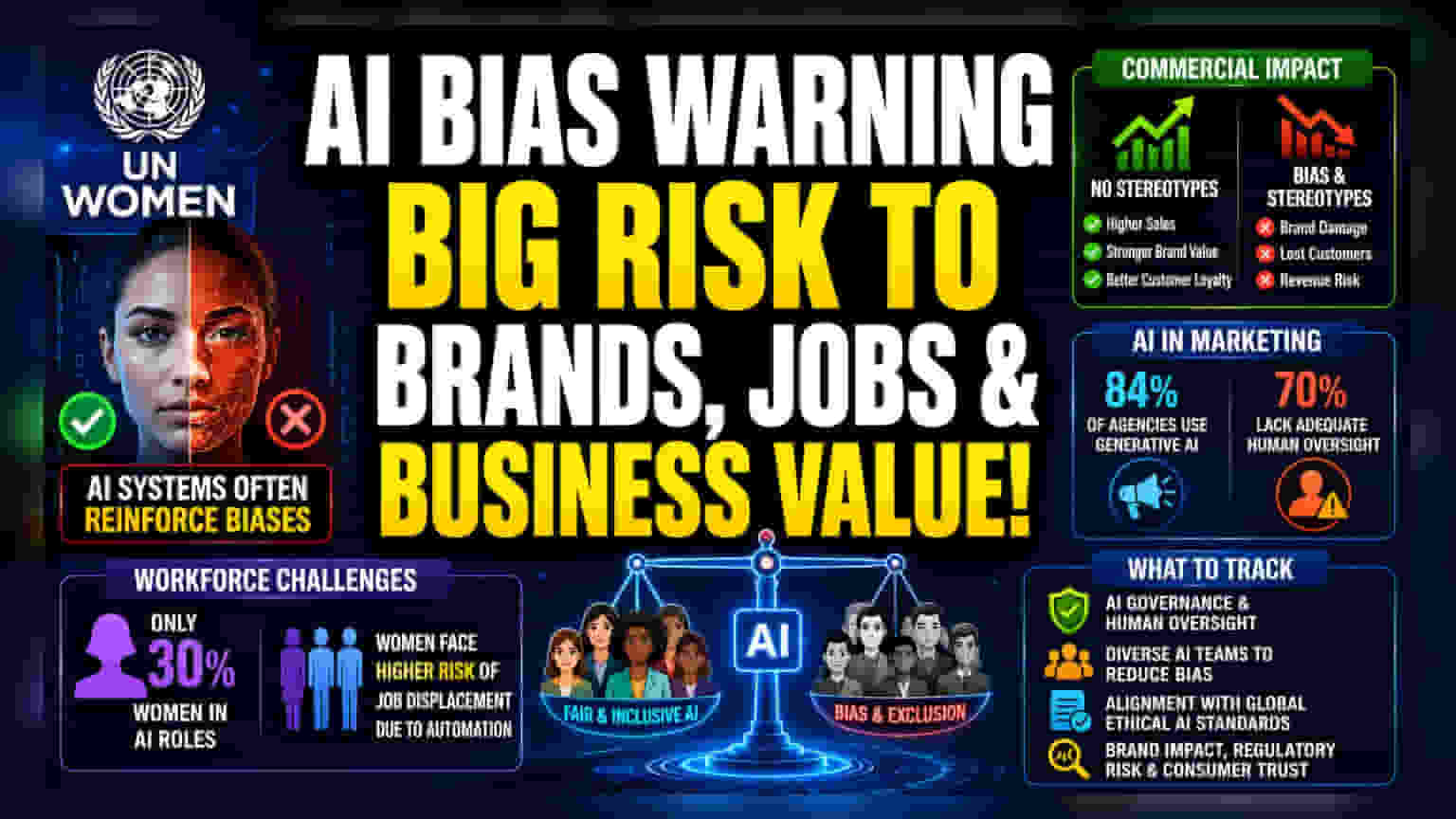
UN Women has warned that AI systems often perpetuate gender stereotypes and online harassment, creating significant risks for businesses. The report highlights challenges in AI-driven marketing, workplace automation, and governance. For companies, this necessitates stronger human oversight and ethical AI frameworks to protect brand value and maintain investor trust.
What Happened
UN Women has issued a strong warning ahead of major international AI discussions, highlighting that artificial intelligence systems are frequently reinforcing gender and racial biases. The agency stated that these biases are not just technical errors but are influencing how AI models generate content, manage online platforms, and automate workforce decisions. The warning comes as global reliance on generative AI grows, with the agency emphasizing that failing to incorporate gender equality into AI design poses both social and commercial risks.
The Commercial Risk for Companies
For investors and corporate leaders, the report highlights a clear link between ethical AI use and business performance. UN Women noted that advertising and marketing campaigns free from gender stereotypes often see improved sales, higher brand value, and stronger customer loyalty. Conversely, AI models that default to biased, sexist, or stereotypical content can damage brand reputation and alienate consumer segments. As companies increasingly integrate generative AI into their customer-facing communication, the potential for public backlash and loss of consumer trust is becoming a material business risk.
AI in Marketing and Oversight
Generative AI has become a standard tool in media and advertising. Research cited by the agency shows that a large majority of advertising and media agencies are already using generative AI. However, a significant portion of these firms operate without sufficient human oversight to check AI-generated content before it reaches the public. This creates a vulnerability where biased, offensive, or inaccurate content can be distributed inadvertently. Businesses that lack rigorous review processes for AI-generated materials may face regulatory scrutiny or reputational damage.
Workforce and Automation Challenges
Beyond marketing, the report flags significant concerns regarding workforce representation and automation. Women remain underrepresented in the global AI development workforce, holding only about 30 percent of these roles. This lack of diverse perspective in development teams often leads to algorithms that inadvertently exclude or disadvantage certain groups. Furthermore, the report suggests that women outside the AI sector face a higher risk of job displacement due to automation compared to men. Companies must manage these human capital risks carefully as they restructure roles to integrate AI technologies.
What Investors and Companies Should Track
Investors may want to watch how companies build their AI governance frameworks. Key monitorables include whether companies have established human-in-the-loop oversight for AI-generated content, how they are diversifying their technical talent pools to reduce algorithmic bias, and whether their internal AI policies align with emerging global ethical standards. Companies that proactively address these gaps are better positioned to mitigate the risks of brand erosion and regulatory penalties as global scrutiny of AI usage intensifies.