

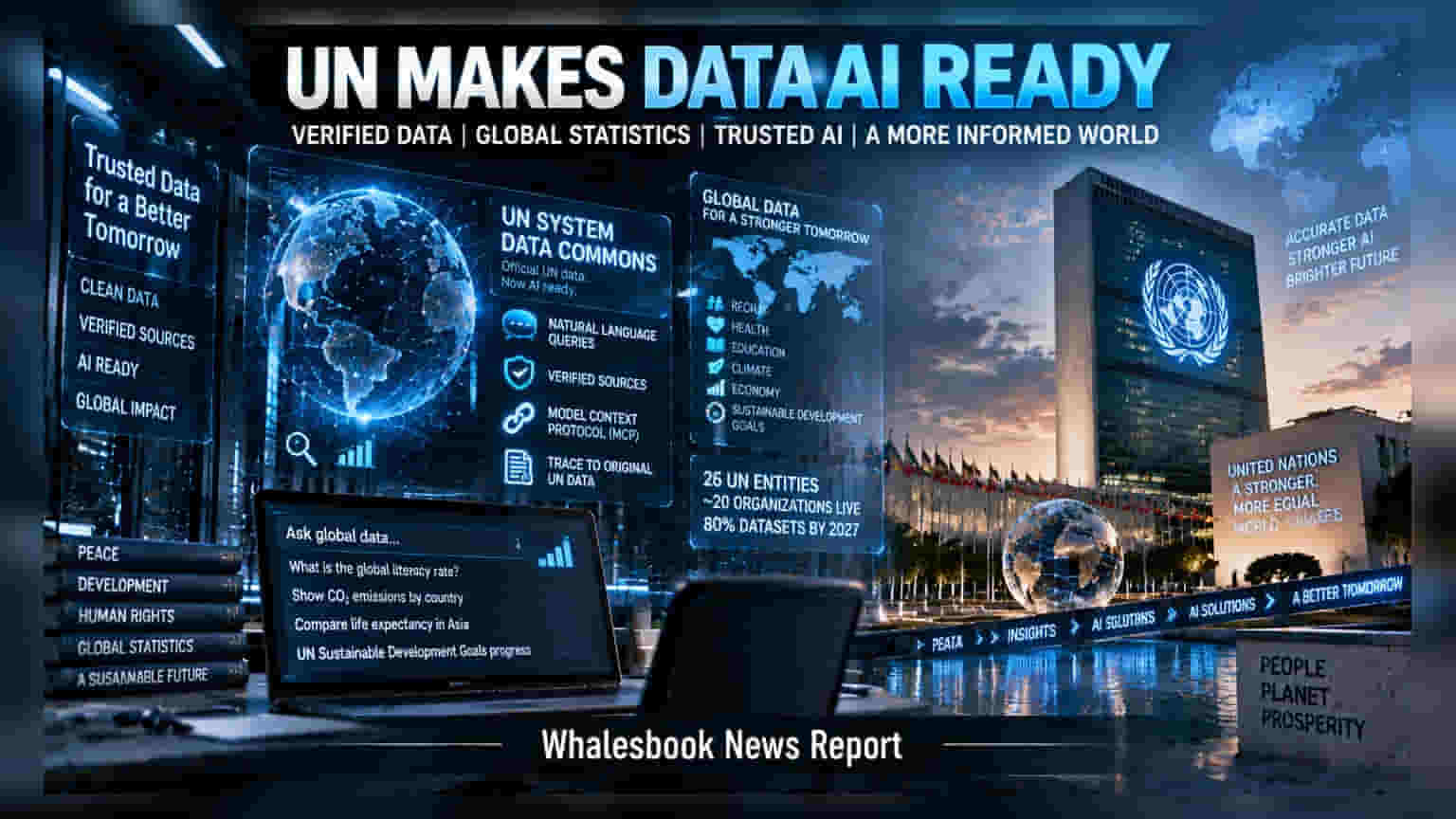
The United Nations and Google have launched the UN System Data Commons to make global statistics readable by AI systems. By providing direct access to structured data, the initiative aims to reduce AI hallucinations and errors, which have been a major barrier to the technology's use in economic and development research.
The United Nations, in collaboration with Google, has introduced the UN System Data Commons, a new initiative designed to make official global statistics accessible and verifiable for artificial intelligence systems. This platform aims to replace the older UNData portal and addresses the critical issue of AI reliability, where models frequently misinterpret facts or hallucinate answers due to a lack of structured, verified data.
The project uses Google’s open-source Data Commons technology to allow AI systems to retrieve statistics through natural-language queries. A key feature is the support for the Model Context Protocol (MCP), a technical standard that enables AI models to connect directly to official datasets. By doing so, the system allows users to trace every statistic back to its primary United Nations source, ensuring that the information used by AI is accurate and verifiable.
The need for this initiative is underscored by recent testing on AI reliability. According to UNICEF, an analysis of six leading large language models revealed that they produced an average accuracy score of just 21.2% when answering questions about global development indicators. In many instances, these models either returned inconsistent data or failed to provide usable numerical answers altogether, highlighting the significant risks of using unverified AI for critical decision-making.
Twenty-six United Nations entities are participating in the project, with data from nearly 20 organizations already available at launch. The United Nations has set a target to migrate approximately 80% of its statistical datasets to this new platform by 2027. Google.org has supported the project with $2 million in funding and technical assistance. While the platform is currently hosted on infrastructure governed by the UN, the intent is for it to transition toward independent operation over time.
For investors and the broader technology sector, this initiative highlights a growing trend toward 'Trusted AI.' As financial institutions and governments in India and globally look to integrate AI, the ability to source accurate, auditable data is becoming a critical competitive advantage. Indian IT services companies, which are currently investing heavily in generative AI solutions for global enterprise clients, will likely watch these developments closely. Reliable data feeds are essential for reducing the costs associated with AI errors and hallucinations in professional applications.
Despite the improved access to data, United Nations officials emphasized that the technology is not a substitute for human analysis. AI models can still misinterpret context even when they have access to accurate information, meaning that human oversight remains a mandatory step for high-stakes research and economic forecasting. The platform's success will ultimately depend on how effectively these tools can be integrated into existing research workflows over the next few years.