 Whalesbook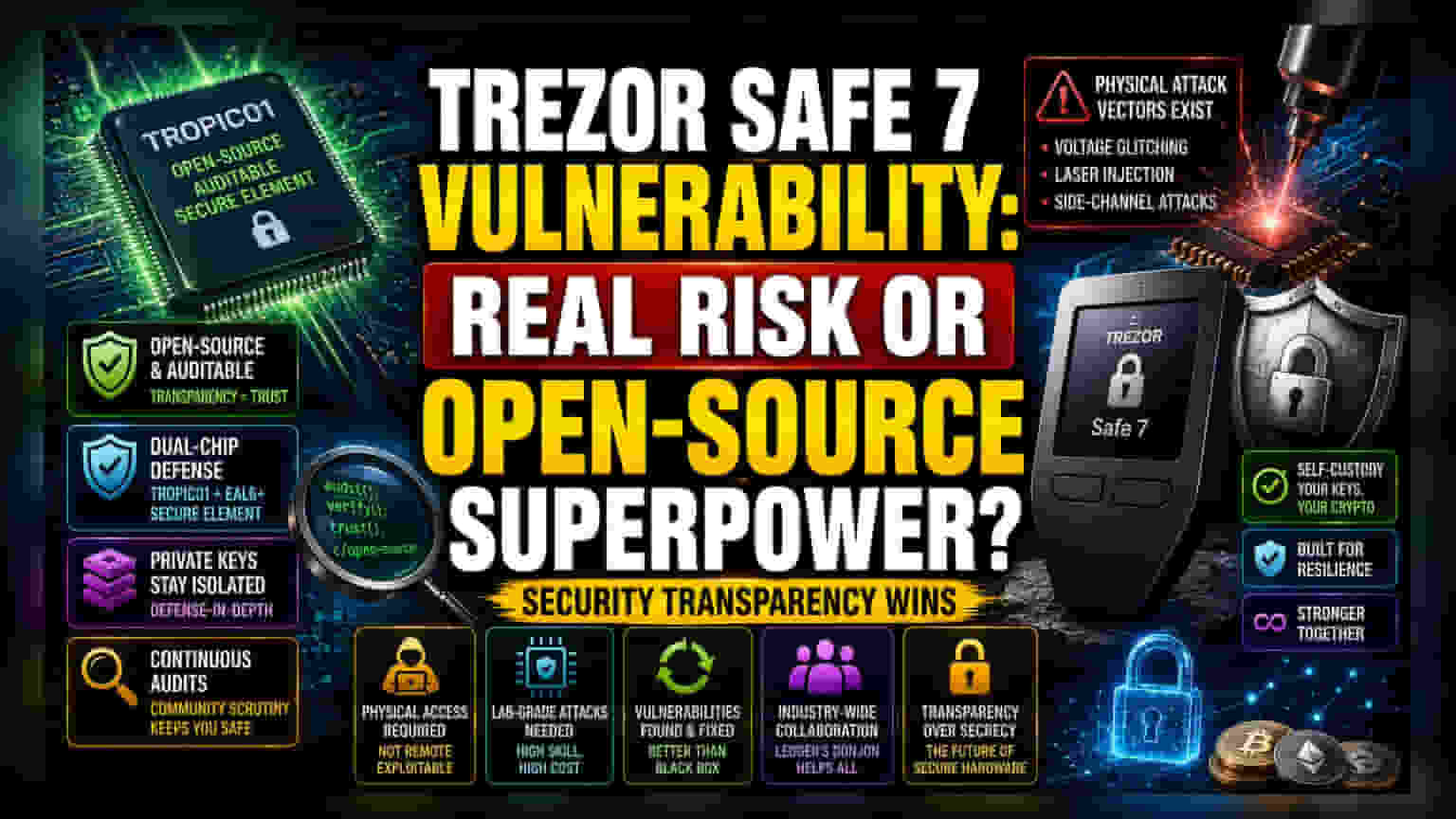


The Security Architecture Defense
The reported vulnerability within the TROPIC01 secure element highlights the inherent tension in hardware wallet design: the trade-off between absolute transparency and physical fortification. Unlike traditional, closed-source secure elements often protected by non-disclosure agreements, the TROPIC01 chip—developed by SatoshiLabs subsidiary Tropic Square—is built on an open-source, auditable architecture. While the recent discovery by Ledger’s Donjon research unit demonstrates a potential weakness, Trezor’s design philosophy relies on a "defense-in-depth" strategy. The Safe 7 utilizes a dual-chip configuration, pairing the TROPIC01 with an additional, independent EAL6+ certified secure element. Even if the TROPIC01 chip is manipulated via physical voltage glitching or laser injection, the secondary chip acts as a critical silo, ensuring that private keys and sensitive recovery material remain isolated.
Auditability vs. The "Black Box" Risk
This incident underscores a broader shift in the hardware wallet sector. Trezor’s transition toward fully auditable silicon is a reaction to the industry's historical reliance on "security by obscurity." By opening the design of the TROPIC01, Trezor invites scrutiny from the entire security community, including its most prominent competitor, Ledger. While some observers might perceive this disclosure as a failure, it validates the company’s push for verifiable trust. Historical context shows that hardware wallets, including previous Trezor Safe models and competitor devices, have often been subjected to similar research by the Donjon team. The ability to identify and patch these vectors, rather than leaving them hidden in proprietary firmware, is the cornerstone of the open-source movement in self-custody.
The Forensic Bear Case
Despite Trezor's assurances, the risks associated with this vulnerability are not entirely academic. The primary concern remains physical exposure: an attacker who gains possession of the device, coupled with laboratory-grade hardware and specialized knowledge, could theoretically perform side-channel or fault-injection attacks. Furthermore, the reliance on a two-chip architecture introduces complexity; if an adversary finds a way to bypass the secondary secure element, the device's entire security model could be undermined. Critics have long argued that hardware-level vulnerabilities in microcontrollers are notoriously difficult to fix through firmware updates, potentially leaving a persistent attack surface for devices currently in circulation. Users should consider that while the TROPIC01’s transparency is an asset, it also provides a roadmap for attackers to study the hardware’s internal logic in granular detail.
Future Outlook
The hardware wallet market continues to prioritize physical resistance to tampering as the gold standard for self-custody. Industry analysts expect that as quantum-computing threats evolve, firms like Trezor will continue to face pressure to balance post-quantum cryptographic upgrades with the practical, everyday durability required by consumer hardware. The collaboration between competitors in the audit process marks a maturation of the ecosystem, suggesting that moving forward, the industry’s strength will rely on collective transparency rather than guarded, proprietary secrets.