

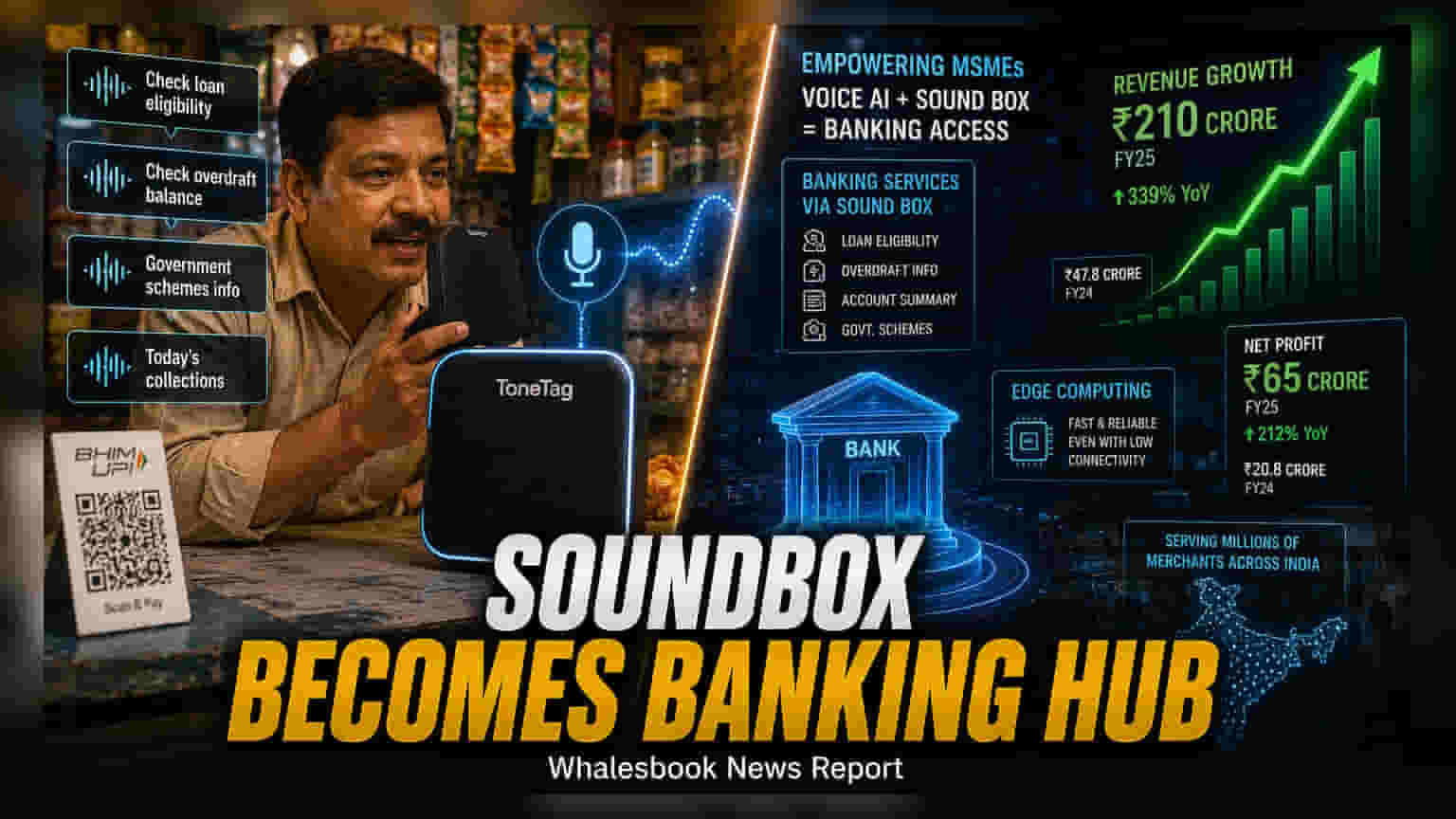
Fintech startup ToneTag is transforming payment soundboxes into voice-activated banking assistants through its new 'eKosha' platform. This shift aims to provide small merchants with direct access to credit, overdrafts, and government schemes. As a private company, ToneTag’s expansion into AI-driven financial services highlights the evolving competition in India's digital payment infrastructure.
Bengaluru-based fintech ToneTag, operating under Naffa Innovations Pvt. Ltd., is expanding the utility of the ubiquitous payment soundbox. The company is deploying its 'eKosha' platform, which integrates voice-enabled artificial intelligence into existing merchant payment hardware. This move allows small shop owners to perform banking tasks—such as checking loan eligibility, managing overdrafts, and accessing government scheme information—directly through the device, without needing to visit a bank branch or use a mobile application.
Expanding Beyond Payments
ToneTag’s core business relies on sound-wave data exchange technology, which allows for secure transactions between payment apps and merchant devices. By moving into banking services, the company is attempting to position itself as a key data and infrastructure layer for micro, small, and medium enterprises (MSMEs). The platform uses edge computing to process voice interactions locally, which the company claims makes the service faster and more reliable even with limited internet connectivity.
Financial records indicate that the company has seen significant growth in recent years. For the fiscal year ending 2025, Naffa Innovations reported revenue of approximately ₹210 crore, up from ₹47.8 crore in the previous year. Profitability also improved during this period, with net profit reaching ₹65 crore compared to ₹20.8 crore in the prior year. The company generates revenue primarily through its data and infrastructure services rather than acting as a traditional payment processor.
Market Context and Risks
While the expansion into voice-enabled banking offers a new service avenue, the business model faces specific industry risks. A primary monitorable for this sector is potential regulatory action regarding the Merchant Discount Rate (MDR) for UPI transactions. Changes in government policy on merchant fees could significantly impact the revenue models of companies providing payment hardware and associated services.
Additionally, the company operates in a highly competitive digital payments environment. The success of this strategy depends on merchant adoption of the new voice features and the ability to maintain partnerships with traditional banks, which ultimately provide the underlying credit and financial services. There is also the operational challenge of ensuring consistent hardware performance across millions of merchant locations.
It is important for investors to note that ToneTag is a private company and is not listed on stock exchanges like the NSE or BSE. As such, there is no public stock price or liquidity available for retail investors. The company’s continued growth will depend on its ability to scale its AI-banking services while managing potential regulatory hurdles in the fintech landscape.