 Whalesbook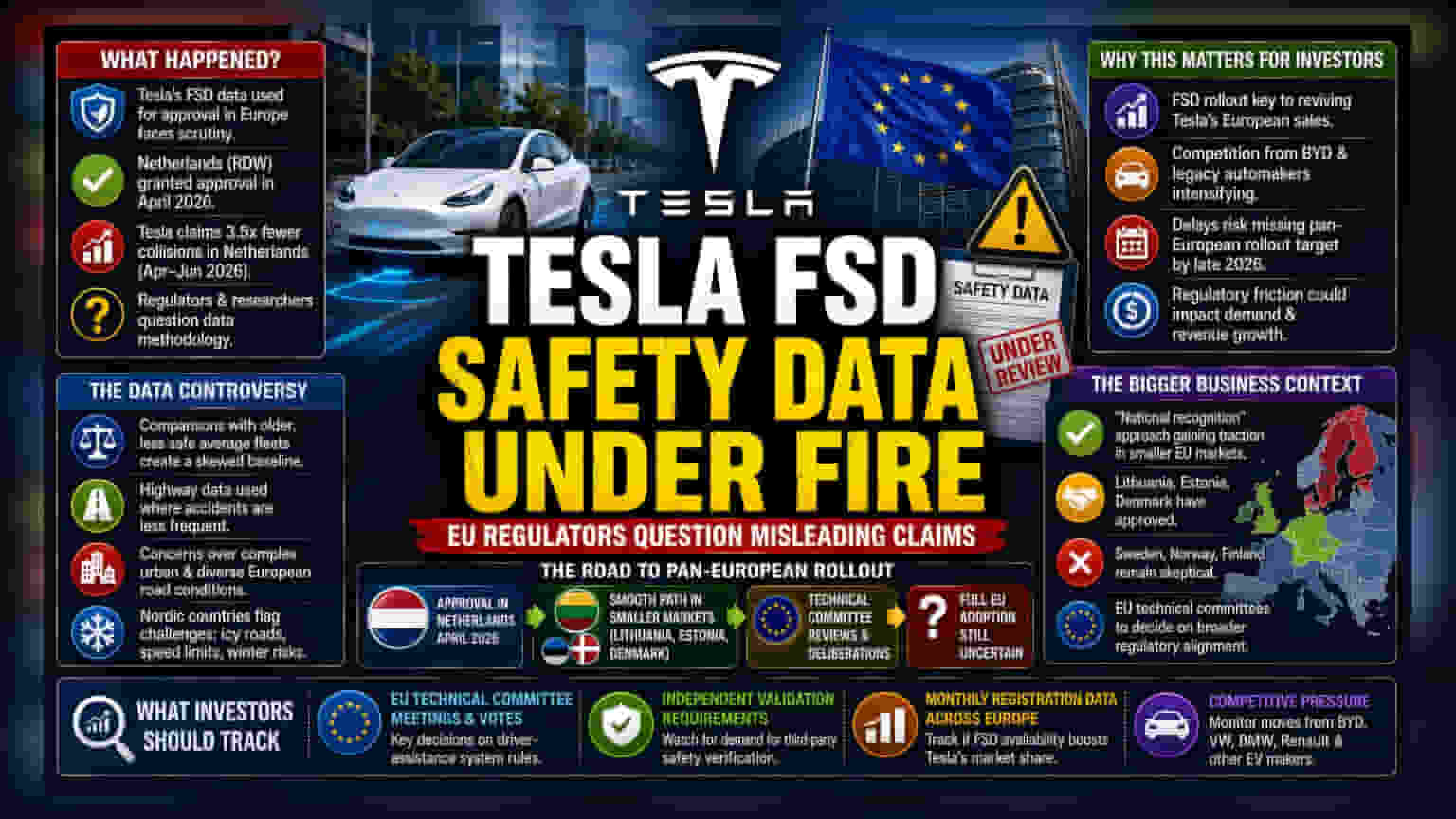


Tesla’s expansion of its 'Full Self-Driving' (Supervised) system in Europe faces new challenges as regulators and researchers question the safety data used to support its approval. The controversy comes as Tesla works to regain market share in the region.
What Happened
Tesla is facing increased scrutiny from European regulators and safety researchers regarding the data it used to secure approval for its "Full Self-Driving" (FSD) system. The company, which is aggressively pushing to roll out FSD Supervised across Europe, has reportedly presented safety statistics that critics argue are misleading. These figures were used in submissions to authorities in the Netherlands and Sweden, among others, to support the argument that the system is significantly safer than human drivers.
While the Dutch vehicle authority (RDW) granted type approval for FSD Supervised in April 2026, subsequent reports and investigations have highlighted methodological concerns. Researchers and regulators are questioning whether Tesla’s internal data—which claims the system recorded 3.5 times fewer collisions than manual driving in the Netherlands between April and June 2026—adequately accounts for real-world variables or relies on flawed comparisons.
Why This Matters For Investors
For Tesla, European regulatory approval is a major strategic pillar. The company has struggled with slowing deliveries and intensifying competition in Europe over the last 18 months, with traditional automakers and Chinese rivals like BYD capturing market share. The FSD software is viewed not just as a technology upgrade but as a commercial catalyst that could help differentiate Tesla’s offerings and boost consumer demand.
However, the ongoing friction with regulators in key markets like Sweden, Norway, and Finland—and the questions surrounding its safety data—could create a multi-track regulatory environment. If major EU markets remain skeptical or if the European Commission requires stricter, independent verification, Tesla’s goal of achieving a pan-European rollout by late 2026 could face delays. For investors, the speed of this rollout is tied directly to the company's ability to revitalize its European sales volume.
The Data Controversy
The core of the dispute centers on how Tesla measures safety. Independent traffic-safety researchers have pointed out several issues with the data Tesla provided to regulators. One key concern is the comparison between FSD-equipped vehicles—which are typically newer and feature advanced safety tech—and the broad, aging average fleet on U.S. roads. Critics argue this comparison creates an uneven baseline.
Furthermore, researchers have questioned the use of highway driving data, where accidents are statistically less frequent than in complex urban environments, to justify the safety of the entire system. While Tesla’s Dutch FSD data showed significant performance gains on highways, critics argue that the system must demonstrate equivalent safety in the diverse, congested, and often unpredictable road conditions prevalent across different European nations. European regulators, particularly in Nordic countries, have also voiced concerns about the system's ability to handle specific local challenges like icy roads and speed limits.
The Bigger Business Context
Tesla’s European expansion strategy relies on a "national recognition" approach, where approval in one EU country (like the Netherlands) encourages others to follow suit. While this has worked in smaller markets like Lithuania, Estonia, and Denmark, the skepticism from larger regulatory bodies suggests that the path to full, unified European adoption remains complex. The European Commission’s technical committees are expected to deliberate further, and their future votes will be a significant test for the company's regional growth.
What Investors Should Track
Investors should monitor the upcoming European Commission Technical Committee meetings, where broader regulatory alignment for driver-assistance systems will be discussed. Key monitorables include whether major markets like Germany, France, or Italy demand independent, third-party validation of Tesla’s safety claims before granting approval. Additionally, tracking monthly vehicle registration data across Europe will remain essential to see if the availability of FSD Supervised is actually translating into a sustained recovery in Tesla's market share or if competitive pressures from local and international EV makers continue to weigh on performance.