

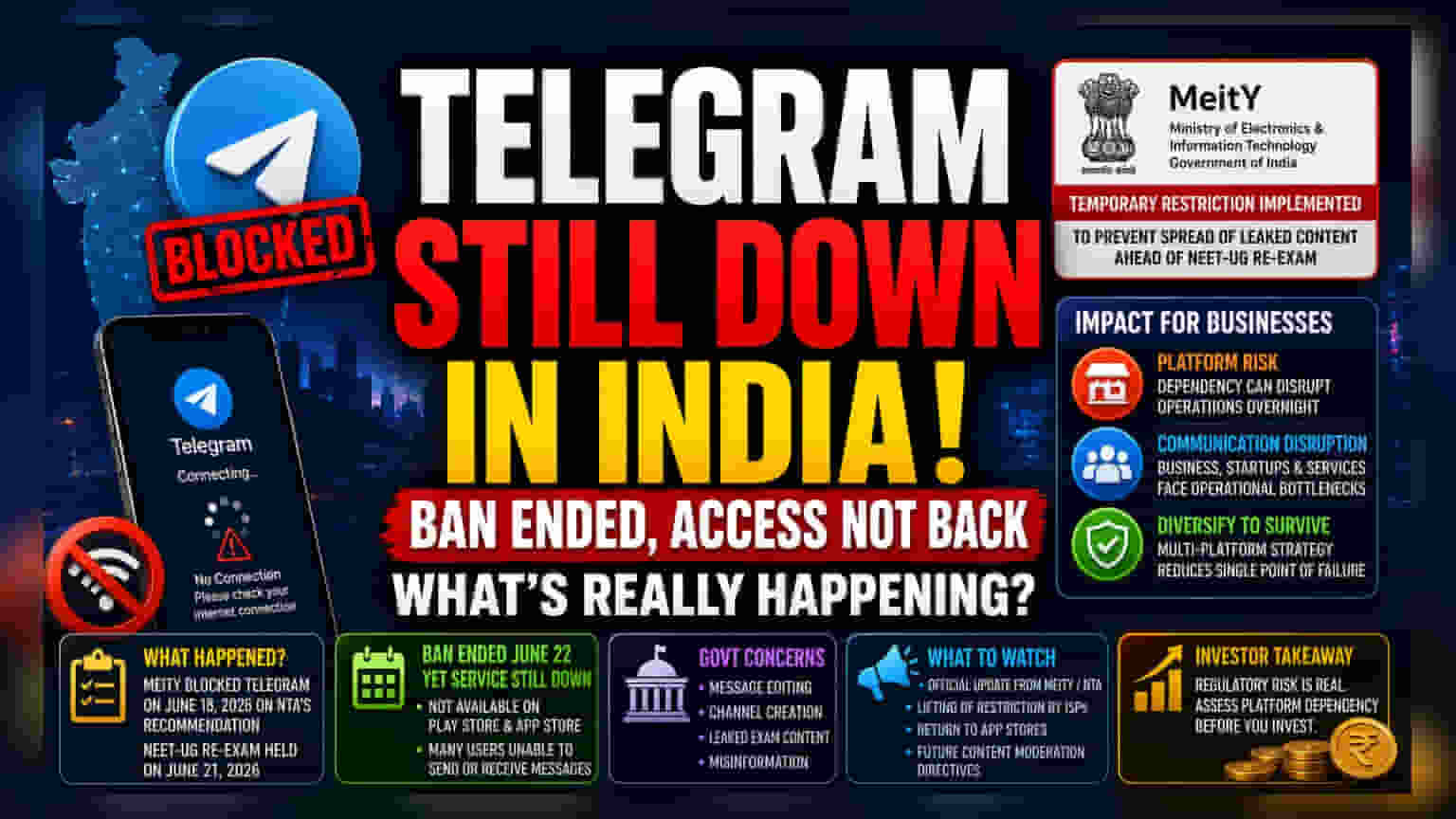
Despite the temporary ban on Telegram expiring on June 22, users across India continue to report service outages on June 23. The app remains unavailable on major app stores, leaving businesses and users in uncertainty. This highlights the operational risks of relying on third-party digital platforms that are subject to abrupt government regulations.
What Happened
Telegram users across India are facing ongoing service disruptions on June 23, 2026, even though the government-mandated temporary restriction was scheduled to end on June 22. The messaging application remains unavailable for download on major platforms like the Google Play Store and Apple App Store, and many existing users are unable to send or receive messages. The initial restriction was implemented by the Ministry of Electronics and Information Technology (MeitY) following recommendations from the National Testing Agency (NTA). The government aimed to prevent the circulation of leaked content ahead of the NEET-UG re-examination held on June 21, 2026.
The Regulatory And Operational Context
The government's move to block access to the platform was driven by concerns over exam integrity. Authorities alleged that the app's features—specifically its message-editing and channel-creation capabilities—were being exploited by groups to spread misinformation regarding exam papers. While the temporary block was intended to curb these activities until the re-exam concluded, the continued lack of service on June 23 has raised questions about whether the restriction has been extended or if technical delays in restoring access are occurring. There has been no official confirmation regarding an extension of the ban as of this morning.
Why This Matters For Business Investors
While Telegram is a privately held company and not a publicly traded stock, this event serves as a critical case study for investors in the digital economy. Many businesses, startups, and service providers increasingly rely on third-party platforms for customer communication, marketing, and operational support. This situation highlights the inherent "platform risk"—the vulnerability of business operations to policy changes, regulatory interventions, or platform-wide outages that are entirely outside of a company's control.
For investors, this underscores the importance of assessing platform dependency when evaluating technology or consumer-facing companies. Businesses that lack a diversified communication or engagement strategy may face significant operational bottlenecks if a key platform is suddenly restricted or taken offline. Companies that build their own digital infrastructure or maintain multi-platform presence are often better positioned to mitigate such sudden shocks.
The Risk of Platform Dependency
The reliance on closed digital ecosystems for critical business functions can create a single point of failure. When a platform is delisted from app stores or blocked by regulators, it does not just affect the platform itself; it disrupts the entire ecosystem of users and businesses that depend on it for daily operations. This event acts as a reminder that regulatory compliance and political stability are just as important as technical capability when assessing the long-term viability of digital business models.
What To Watch Next
Investors and users should track official updates from the Ministry of Electronics and Information Technology (MeitY) or the National Testing Agency regarding the status of the platform. The primary monitorables include the formal lifting of the restriction by internet service providers, the return of the app to official stores, and any further directives from the government regarding content moderation features, such as the message-editing function that was specifically targeted by authorities.