 Whalesbook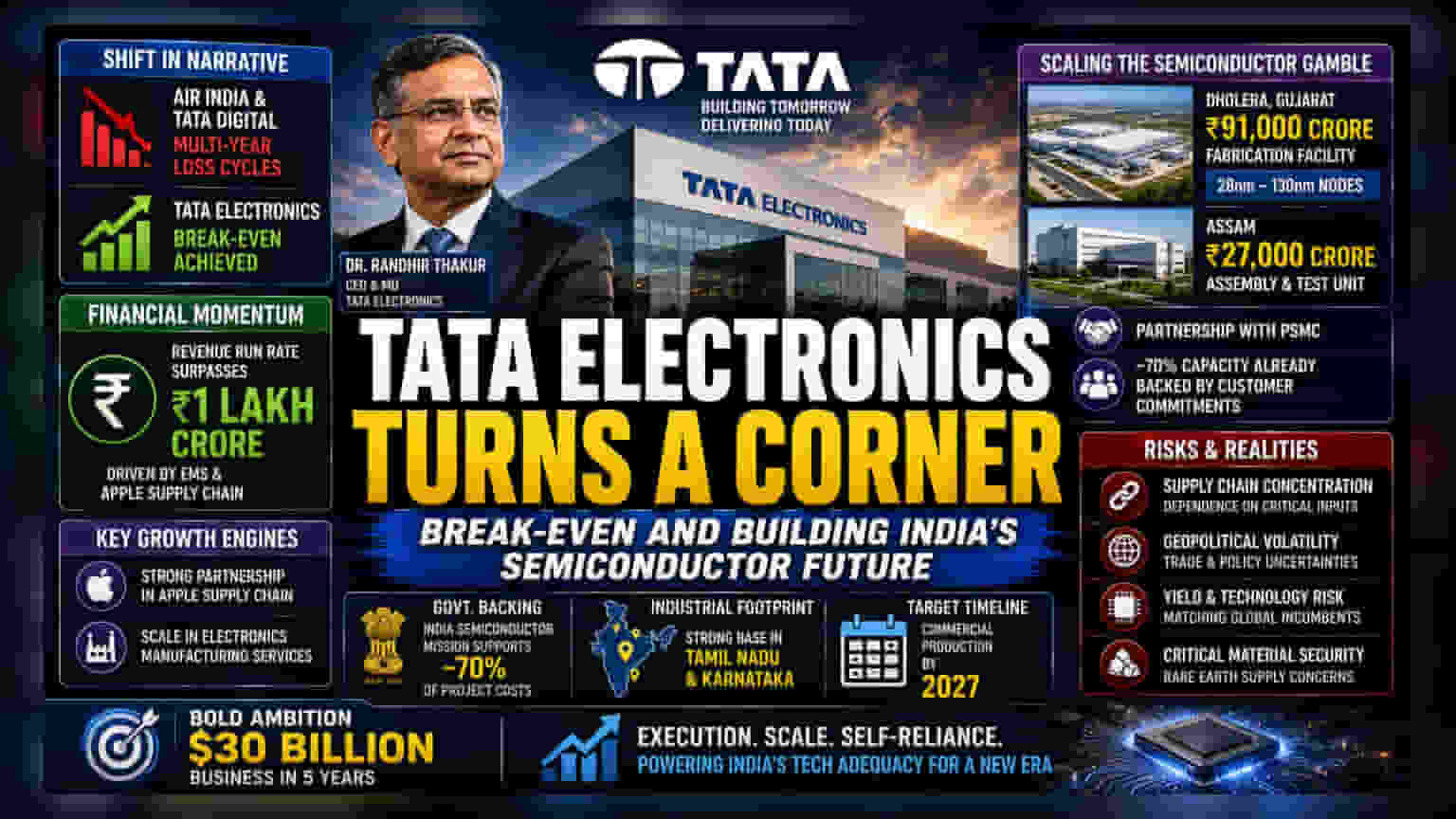


The Shift in Operational Narrative
Recent internal board reviews at Tata Sons have underscored a sharpening divide between the conglomerate’s new business initiatives. While high-profile bets like Air India and Tata Digital remain mired in multi-year loss cycles, Tata Electronics has transitioned into a consolidator of group growth. Having achieved break-even at the consolidated level, the company has effectively shifted the narrative from mere capital burn to execution-driven scale. This milestone is supported by a revenue run rate that has surged past the ₹1 lakh crore mark, reflecting the successful integration of its electronics manufacturing services and Apple supply chain participation.
Scaling the Semiconductor Gamble
The company’s strategic trajectory is anchored by one of the largest industrial capital deployments in Indian history: a ₹91,000-crore fabrication facility in Dholera, Gujarat, and a ₹27,000-crore assembly and test unit in Assam. Under CEO and Managing Director Dr. Randhir Thakur, a veteran with deep experience at Intel and Applied Materials, the firm is moving to bypass traditional organic growth timelines. By leveraging partnerships with entities like PSMC, the organization is targeting mature semiconductor nodes—28nm to 130nm—which serve the bulk of global demand in the automotive and artificial intelligence sectors. Approximately 70% of the capacity at the Dholera site has already secured customer commitments, providing a vital buffer against the inherent risks of greenfield semiconductor projects.
The Forensic Bear Case: Risks and Realities
Despite the positive sentiment, the company’s path is not without structural friction. Semiconductor fabrication is notoriously unforgiving, characterized by long gestation periods and extreme sensitivity to technological obsolescence. The firm faces three primary threats: supply chain concentration, geopolitical volatility, and the challenge of yield management. Although the government’s India Semiconductor Mission provides substantial fiscal backing, covering approximately 70% of project costs, long-term sustainability depends on the facility's ability to match the yield efficiencies of incumbents in Taiwan and South Korea. Furthermore, internal concerns have surfaced regarding the security of supply for rare earth and critical elements, which are essential for chip fabrication and remain vulnerable to global market disruptions. Unlike consumer-facing platforms that can pivot, the capital-intensive nature of this venture leaves little room for operational error.
Future Outlook
Management has articulated a bold ambition to evolve into a $30-billion business within the next five years. Achieving this will require maintaining the momentum established through its contract manufacturing footprint in Tamil Nadu and Karnataka, while successfully bringing the Dholera and Assam plants to commercial production by the 2027 window. The company’s ability to navigate these capital-heavy commitments while managing the rising expectations of the Tata Sons board will be the ultimate measure of its success as a cornerstone of India’s industrial self-reliance strategy.