

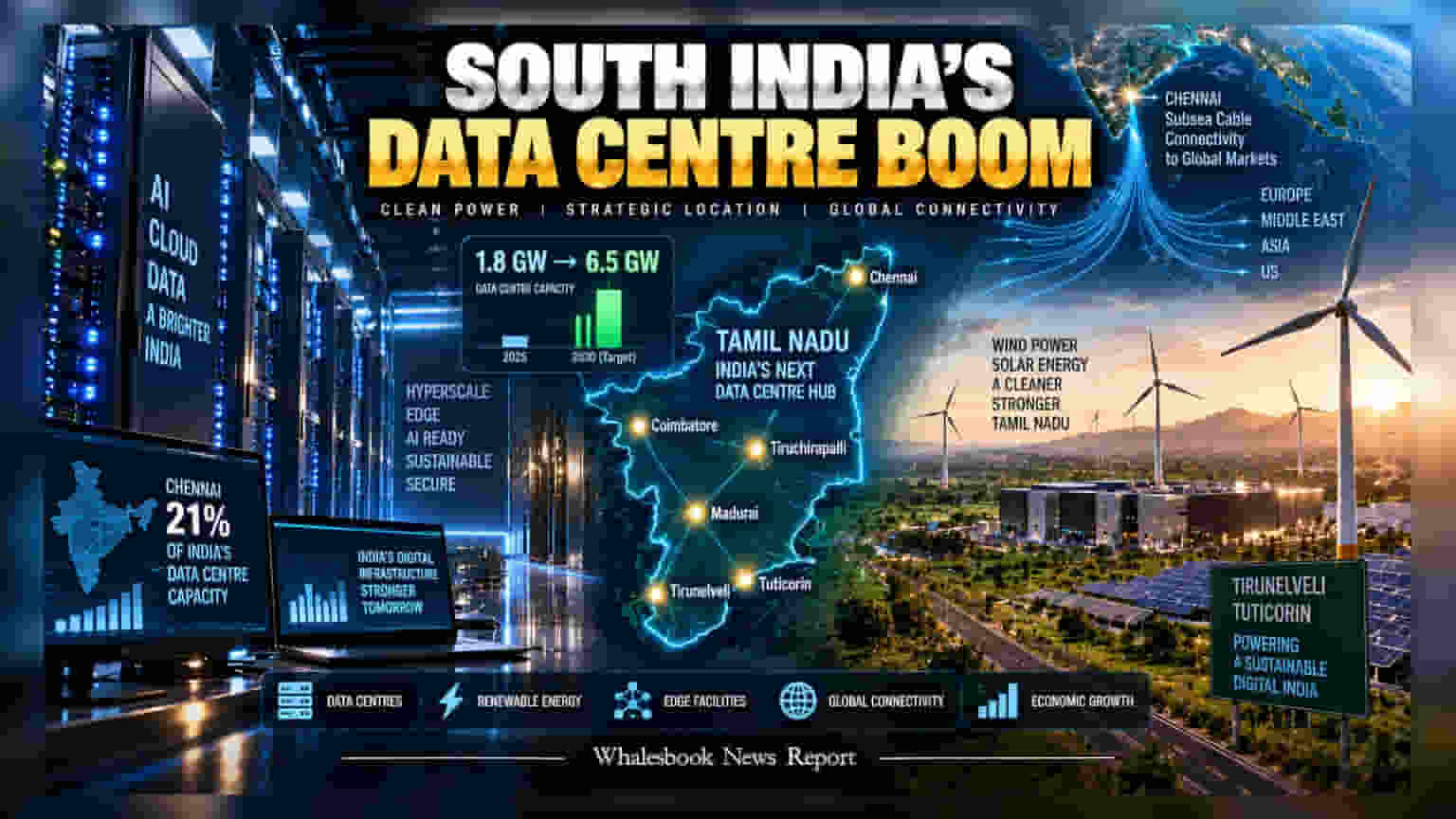
Tamil Nadu is positioning itself as a key data centre destination, leveraging abundant renewable energy and strategic subsea connectivity. With Chennai already holding 21% of India’s capacity and southern districts attracting hyperscale investment, the state is central to the national goal of reaching 6.5 GW by 2030.
Tamil Nadu is rapidly transforming into a primary data centre corridor, moving beyond established hubs like Mumbai and Bengaluru. While Chennai currently accounts for approximately 21% of India’s operational data centre capacity, the state's growth strategy now extends into southern districts, including Coimbatore, Madurai, Tirunelveli, and Tuticorin. These regions are increasingly viewed as ideal locations for a mix of large hyperscale data centres and smaller edge facilities, supported by significant industrial land availability and specialized infrastructure.
The Strategic Advantage of Renewable Energy
Access to power is currently the most critical bottleneck for the data centre industry, especially with the high energy demands of artificial intelligence workloads. Modern data centres often require racks that consume 30-50 kW, placing pressure on traditional power grids. Tamil Nadu holds a distinct advantage here due to its leadership in wind power and solar generation capacity. By positioning new facilities close to these renewable energy zones, operators can better secure the high-percentage green energy supply required by global clients, potentially reducing long-term energy costs and improving sustainability rankings.
Distributed Network Model
Industry experts and operators, including firms like AdaniConneX, Yotta, STT Global Data Centres, and Nxtra, are looking at a distributed model to manage scale. In this setup, a central Tier-4 hyperscale facility near Chennai handles the bulk of heavy processing, while smaller 10-20 MW edge facilities are deployed in growing cities like Coimbatore and Madurai. This design reduces latency for 5G and enterprise workloads, allowing companies to serve data demands more efficiently across the southern region.
Risks and Infrastructure Challenges
While the expansion potential is significant, investors should remain aware of potential challenges. The sector is highly resource-intensive; for instance, high water consumption for cooling systems can pose environmental concerns, particularly in water-stressed areas. Furthermore, there is a heavy reliance on imported specialized cooling and server equipment, which exposes project costs to supply chain volatility and global price fluctuations.
From a regulatory standpoint, while state-level policies like land subsidies and single-window clearances are helping, there are broader grid constraints. Procuring renewable energy across state lines remains complex, and there is a continued dependency on centralized transmission planning. As India moves toward a 6.5 GW capacity target by 2030—requiring an estimated $80-100 billion in investment—the ability of operators to navigate these power and land logistics will be the primary measure of their long-term viability. The sector's actual performance will depend not just on initial construction, but on consistent project execution and the ability to maintain profitability amidst these operational pressures.