 Whalesbook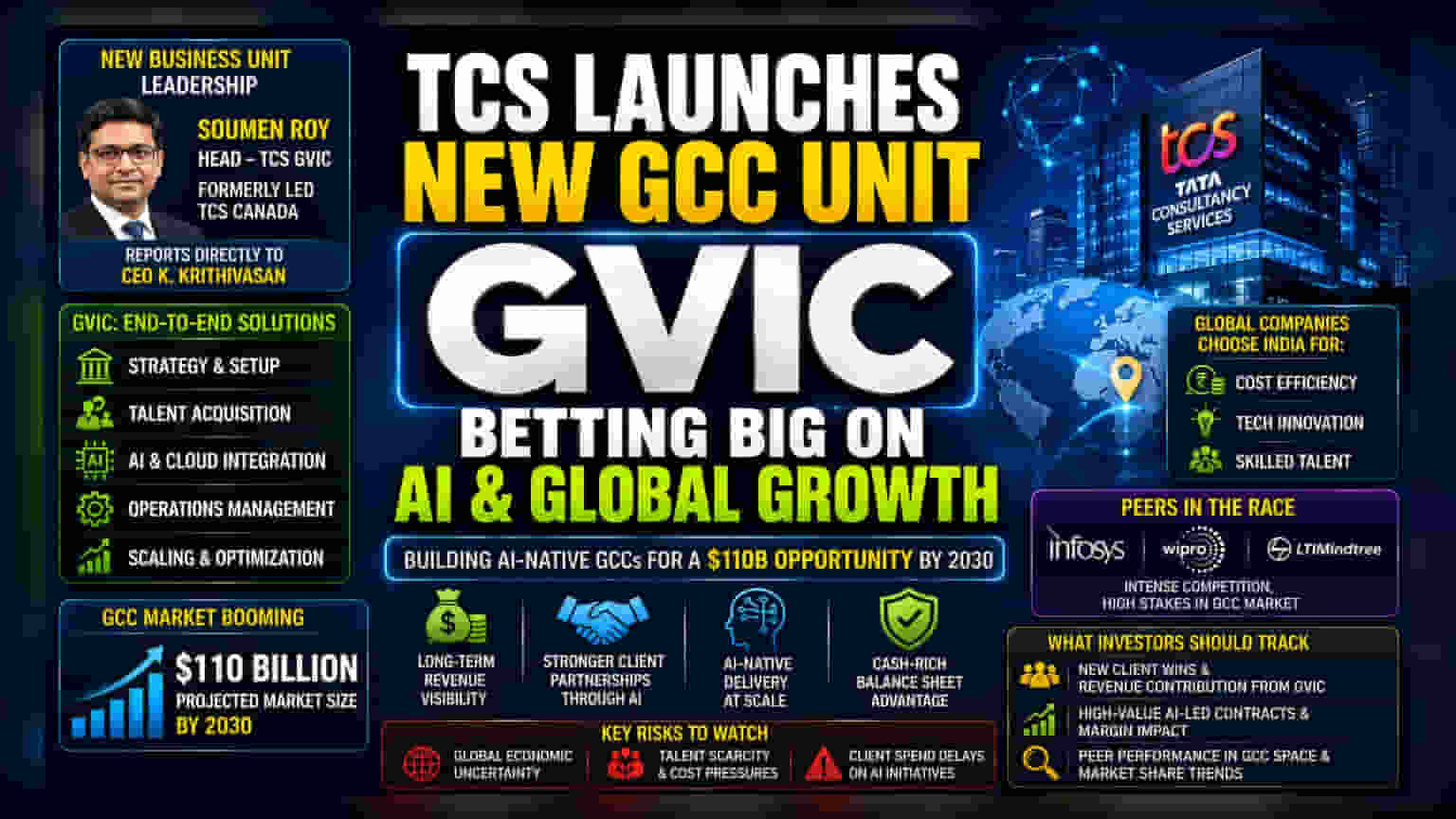


What Happened
Tata Consultancy Services (TCS) has officially launched a new business unit, the TCS Global Value & Innovation Centres (GVIC). This division will focus specifically on helping global companies establish and scale their Global Capability Centres (GCCs) in India, with a heavy emphasis on AI-native solutions. Soumen Roy, who previously led TCS operations in Canada, has been appointed to lead this new unit, reporting directly to the company's CEO, K. Krithivasan.
The initiative is designed to offer a complete package for international firms looking to set up shop in India, covering everything from initial setup and talent acquisition to integrating AI and managing day-to-day operations. By standardizing its approach to AI, cloud, and engineering, TCS intends to make the process of setting up these centers faster and more efficient for its clients.
Why This Matters For Investors
The Global Capability Centre market is one of the fastest-growing segments in the Indian IT services landscape. With the sector projected to reach $110 billion in value by 2030 according to industry data, TCS is positioning itself to capture a significant portion of this capital. For long-term investors, the launch of GVIC is a strategic attempt to move away from traditional service models and toward higher-value, AI-led partnerships.
Because GCCs often act as long-term innovation hubs for multinational companies, winning these contracts can provide IT firms with stable, multi-year revenue streams. If TCS can successfully prove that its AI-ready operating model delivers better results than standard service setups, it could help improve their competitive standing in a market where clients are increasingly demanding AI integration.
Peer and Sector Check
TCS is not alone in this race. Other major Indian IT players, including Infosys, Wipro, and LTIMindtree, have all recognized the potential of the GCC market and have established dedicated units to service it. The industry as a whole is seeing a surge in demand, as global enterprises look to India not just for cost savings, but for technical innovation and AI development.
For investors, this means the sector is becoming crowded. The success of GVIC will rely heavily on whether TCS can offer something unique compared to its peers. While competitors have also rolled out similar "as-a-service" models, TCS is betting on its scale and its long-standing experience in engineering and operations to differentiate itself.
Business Context and Risks
While the growth potential is clear, this expansion is not without risks. The primary challenge for any IT firm in this space is execution. Designing and building AI-native centers is complex. Clients may be cautious about their spending due to global economic uncertainty, which could delay the rollout of new GCCs or cause firms to hold back on ambitious AI projects.
Additionally, there is a constant war for talent. Building an AI-native center requires skilled professionals who are well-versed in both data science and engineering. If TCS faces difficulties in scaling this specific team or if costs for top-tier talent rise, it could put pressure on the profit margins of this new unit.
However, from a financial standpoint, TCS remains one of the most cash-rich companies in the sector. Unlike smaller competitors who might need to borrow heavily to fund such expansion, TCS has the financial flexibility to invest in new units without stressing its balance sheet.
What Investors Should Track
Moving forward, investors may want to track how quickly TCS secures new clients for the GVIC unit. Management commentary on the revenue contribution from this segment in upcoming quarterly earnings calls will be a key indicator of success.
Another important monitorable is the type of contracts the unit wins. Investors should watch for signs that these centers are focusing on high-value AI work rather than basic operational support, as the former is more likely to boost profit margins in the long run. Finally, observing how peers like Infosys and Wipro perform in the GCC space will help determine if the entire sector is growing or if market share is merely shifting between the major IT players.