

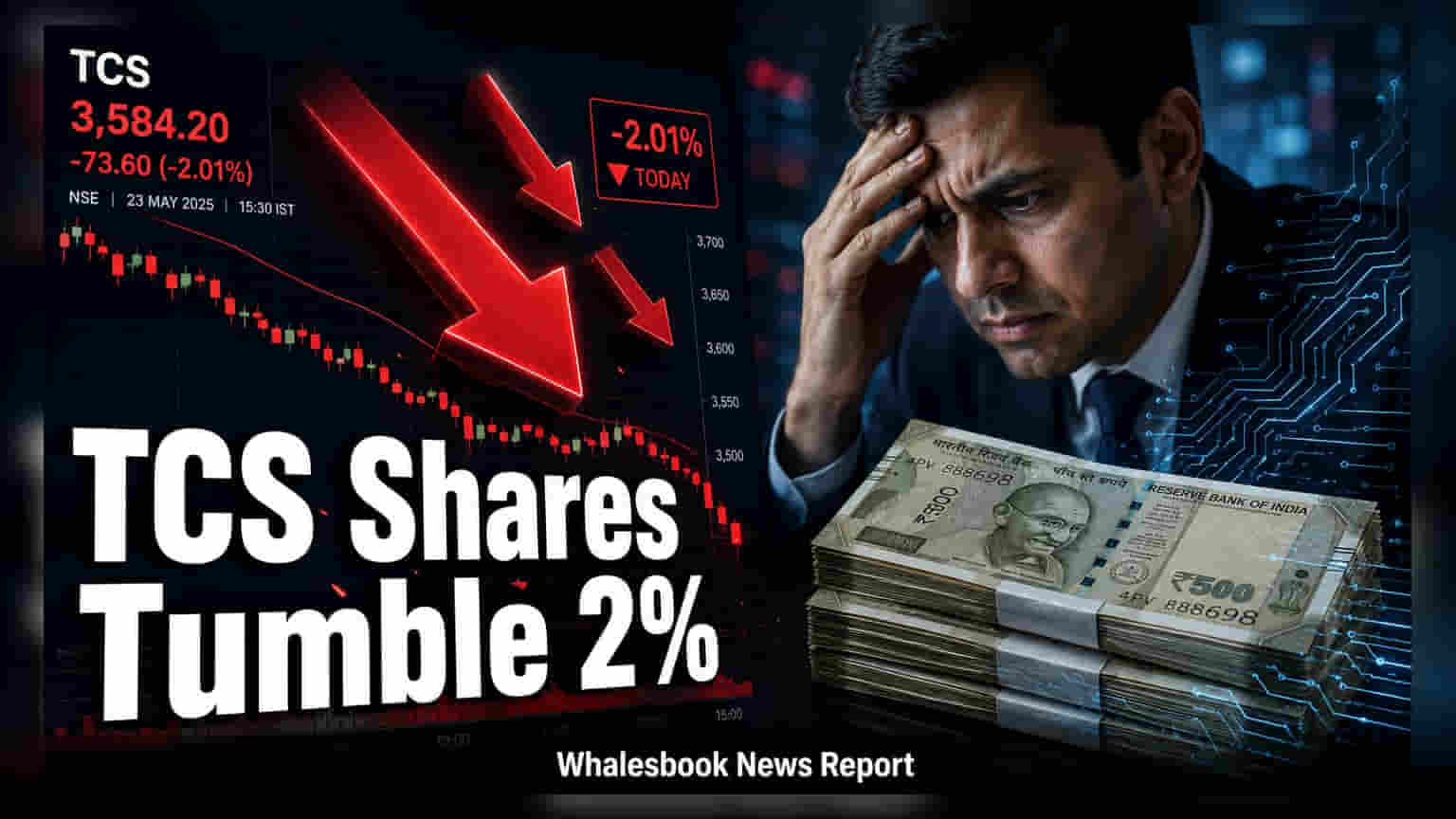
Tata Consultancy Services shares traded about 1.15% lower on Monday at Rs 2,333. While the IT major reported strong revenue growth of 13.9% for the June 2026 quarter, profit growth was more moderate at 5%. Investors are focusing on the balance between a solid order book and the ongoing pressure on profit margins amid global IT spending uncertainty.
Shares of Tata Consultancy Services (TCS) saw a decline of approximately 1.15% on Monday, with the stock trading around Rs 2,333. This movement follows the company's release of its first-quarter financial results for the 2027 fiscal year, which provided investors with a mixed view of the company's current performance.
For the quarter ending June 30, 2026, the IT services company reported consolidated revenue of Rs 72,275 crore, representing a 13.9% increase compared to the same period last year. However, the consolidated net profit saw a more modest growth of 5% year-on-year, reaching Rs 13,349 crore. For investors, this difference between strong top-line revenue growth and slower profit growth highlights the pressure the company is facing on its profit margins. Higher operating costs, including wage increases and potential currency fluctuations, appear to be keeping profit gains in check despite the higher business volume.
Order Book Strength
Despite the pressure on margins, the company showcased a healthy demand environment by reporting a strong order book of $9.5 billion for the June 2026 quarter. This figure includes significant deal wins, such as an $800 million artificial intelligence-led transformation contract with SKF. A strong order book is generally seen as a positive indicator of future revenue potential, suggesting that clients are continuing to invest in technology services, particularly in areas like artificial intelligence and digital transformation. However, investors are now shifting their focus toward how quickly and efficiently the company can execute these large orders and convert them into actual profit.
Sector and Operational Risks
The broader IT sector continues to navigate a challenging environment. Global geopolitical uncertainty and macroeconomic headwinds have led many corporate clients to exercise caution regarding their technology spending. For a company like TCS, which has significant exposure to markets like North America, any slowdown in client spending can directly impact performance. Additionally, the industry faces intense competition, which limits the ability of IT firms to raise prices. The reliance on fixed-price contracts also means that if costs, such as employee wages, rise unexpectedly, the company's ability to maintain its profit margins becomes more difficult.
Regarding capital allocation, the company had previously declared an interim dividend of Rs 12 per share, with an ex-dividend date of July 15, 2026. Since this date has already passed, it is not a direct factor in the current trading movement.
Looking ahead, market attention is likely to remain on how the company manages its operating margins in the coming quarters. Investors will be monitoring commentary from management regarding client demand, the timeline for executing the $9.5 billion order pipeline, and the company's ability to control costs while continuing to invest in new growth areas.