 Whalesbook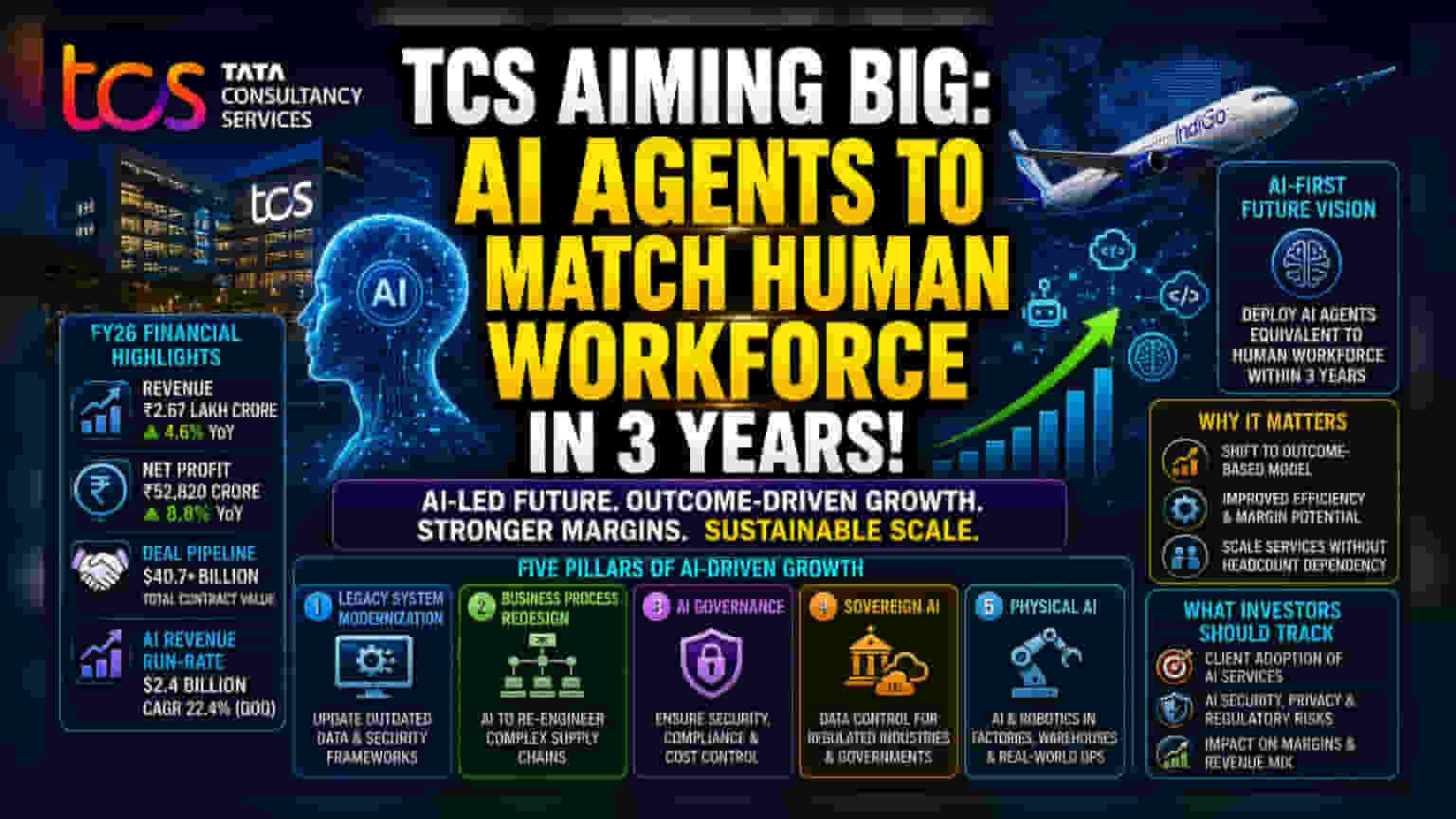


What Happened
Tata Consultancy Services (TCS) has unveiled a strategic roadmap that places artificial intelligence at the core of its future operations. During the company's 31st Annual General Meeting, Chairman N Chandrasekaran announced that the organization aims to deploy AI agents that equal the workload of its human workforce within the next three years. These AI agents—software programs capable of executing tasks, decision-making, and interacting with customers—are being framed not as a replacement for human talent, but as a significant infrastructure shift that expands the company’s service capabilities.
Financial Context and Growth
The company’s push into AI is already showing financial results. By the end of fiscal year 2026, TCS reported an annualized revenue run-rate of $2.4 billion from its AI-related initiatives, growing at a compound quarterly rate of 22.4%. This performance complements the company’s broader financial health, with consolidated revenue for the year reaching ₹2.67 lakh crore, a 4.6% increase compared to the previous year. Net profit also grew by 8.8% to ₹52,820 crore, supported by a strong deal pipeline, with total contract value exceeding $40.7 billion.
Why This Matters For Investors
For shareholders, this transition signals a fundamental change in how large IT services firms might generate revenue in the future. Traditionally, the Indian IT sector has relied on a model where revenue is tied directly to the number of hours employees work. By integrating AI agents that can perform these tasks, companies like TCS aim to move toward an outcome-based model. If successful, this could help improve profit margins by decoupling revenue growth from simple headcount additions, potentially allowing the firm to scale operations more efficiently.
The Strategic Growth Pillars
The management has outlined five specific areas where it expects this AI-driven growth to materialize. First is the modernization of legacy systems, where AI is used to update outdated data and security frameworks for modern use. Second is business process redesign, utilizing AI to re-engineer complex supply chains. The third area involves AI governance, which focuses on security and cost control. Fourth is Sovereign AI, which provides regulated industries and governments with control over their data infrastructure. Finally, the company is looking at physical AI, which involves deploying AI in real-world environments like factories and warehouses, using robotics for monitoring and operations.
How Investors May Read This
While the vision for AI-driven growth is clear, the market will likely monitor how TCS balances this aggressive adoption with the practical realities of technology implementation. The company’s long-standing client relationships and experience with complex systems act as a business advantage, as clients often prefer established firms for high-stakes AI deployment due to the need for trust and context. However, the success of this strategy will depend on the actual uptake of these AI services by global enterprises, which are currently facing decisions on how to allocate their IT budgets amidst global economic shifts.
What Investors Should Track
Moving forward, investors may want to monitor several key factors. First, the pace of client adoption for AI services will be essential, as initial revenue run-rates must translate into sustained, long-term profit growth. Second, the company’s ability to manage risks—such as AI security, data privacy, and the regulatory environment—will be critical to maintaining the trust of its global client base. Finally, analysts and investors will likely watch for updates on how this AI integration affects overall profit margins and whether the company can successfully transition its clients from traditional IT services to these higher-value, AI-augmented solutions.