

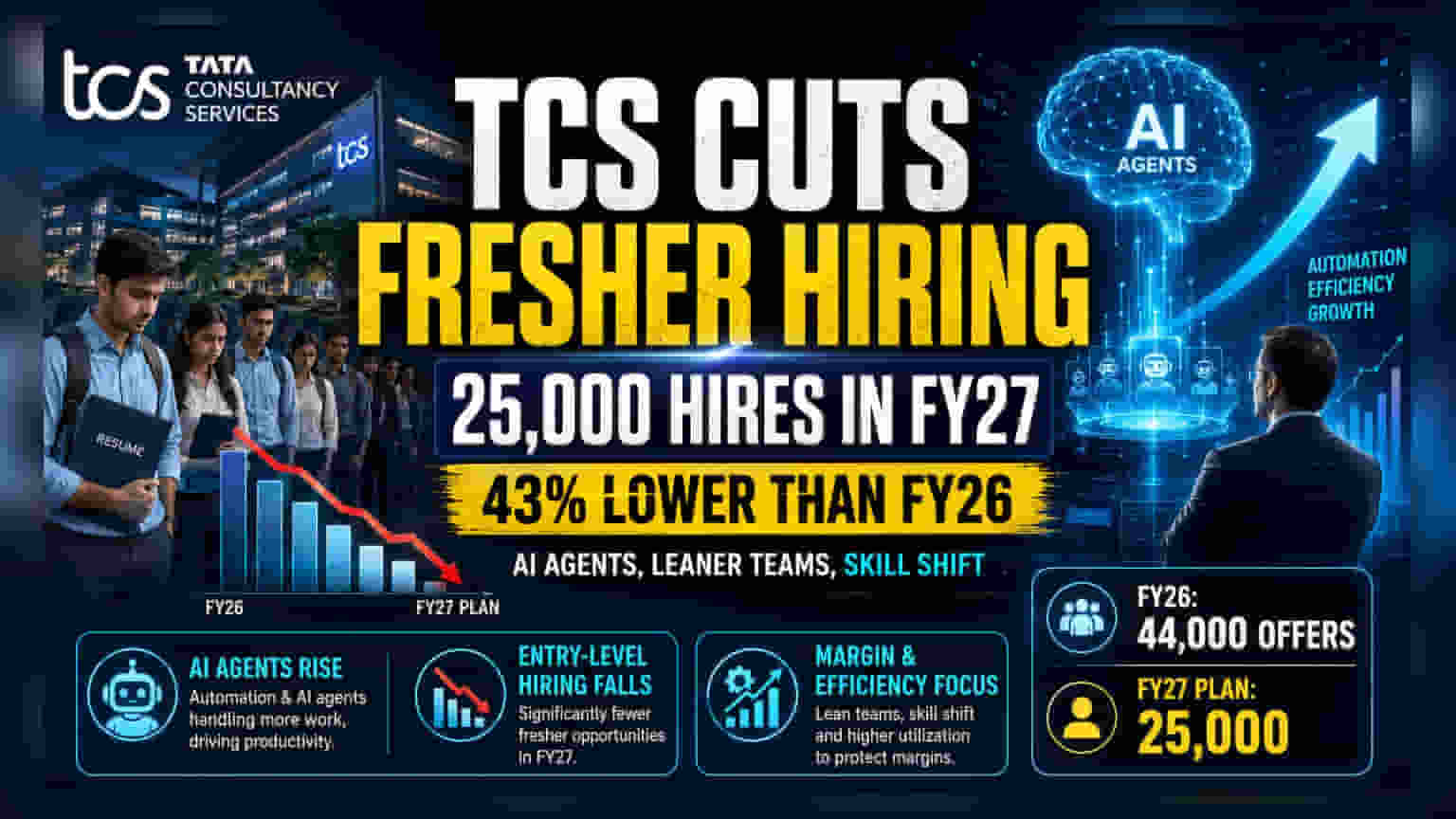
Tata Consultancy Services (TCS) has reduced its fresher hiring target for FY27 to 25,000, a 43% drop from 44,000 in FY26. This move highlights how major IT firms are shifting from volume-based hiring to AI-driven automation, significantly altering the cost structure and workforce requirements of the Indian IT sector.
What Happened
Tata Consultancy Services (TCS), one of India's largest employers, has significantly scaled back its hiring of fresh graduates. In its latest plans for FY27, the company aims to hire 25,000 freshers, which is a 43% reduction compared to the 44,000 offers extended in FY26. This follows a broader trend of workforce optimization at the company, where the total net headcount decreased by over 23,000 in FY26. TCS Chairman N Chandrasekaran recently indicated that the company’s internal use of AI agents could soon match its total employee count, signaling a fundamental change in how the company manages its operations.
The Shift Toward AI Efficiency
The reduction in entry-level hiring is not just a reaction to current economic conditions but reflects a change in the IT business model. Historically, Indian IT firms relied on "labor arbitrage," where thousands of fresh graduates were hired to perform routine coding, testing, and data entry tasks.
Today, Generative AI and automation tools are taking over these repetitive functions. By using AI to handle tasks that previously required human intervention, IT companies are moving toward leaner, more specialized teams. This strategy aims to improve operational efficiency by reducing the reliance on massive entry-level recruitment, which typically carries high training costs and longer time-to-productivity.
Industry Context and Sector Trends
The Indian IT sector is experiencing a significant cooling in entry-level hiring after the pandemic-era boom. Data from talent analytics firm Xpheno shows that fresher hiring in India’s IT sector fell from a peak of approximately 600,000 in FY22 to about 120,000 in FY25, an 80% decrease over three years.
While some of this decline is due to general margin pressures, industry experts note that AI has accelerated the shift toward skill-based hiring. Companies are now prioritizing "AI literacy," data fluency, and problem-solving skills over the traditional mass-hiring model. While this helps firms manage costs, it also changes the landscape for fresh graduates, who now face a steeper learning curve to enter the workforce.
The Future Job Market
Despite the reduction in headcount, industry bodies like Nasscom remain optimistic about the long-term growth of the IT sector, projecting it to reach $315 billion. The narrative is shifting from job loss to job evolution. Research from organizations like ICRIER suggests that AI is more likely to boost productivity than cause an absolute collapse in employment.
This is creating a bifurcated market. There is a growing demand for high-value roles such as AI Specialists and Generative AI Engineers, which often command higher wages. Conversely, roles that are highly susceptible to automation, such as basic documentation and customer service, are seeing reduced demand. For the industry, the challenge will be to balance this move toward efficiency with the need to maintain a pipeline of skilled talent for future growth.
What Investors Should Track
Investors may monitor how this shift in workforce strategy impacts the bottom line of IT companies. Key monitorables include:
- Operating Margins: Whether the reduction in large-scale hiring translates into sustainable improvement in profit margins.
- AI Integration: How effectively companies can monetize their investments in AI to drive revenue growth without relying on linear headcount increases.
- Skill-Based Hiring Trends: Whether companies can continue to source or train enough high-skill talent to fill specialized roles as the demand for traditional entry-level labor drops.