 Whalesbook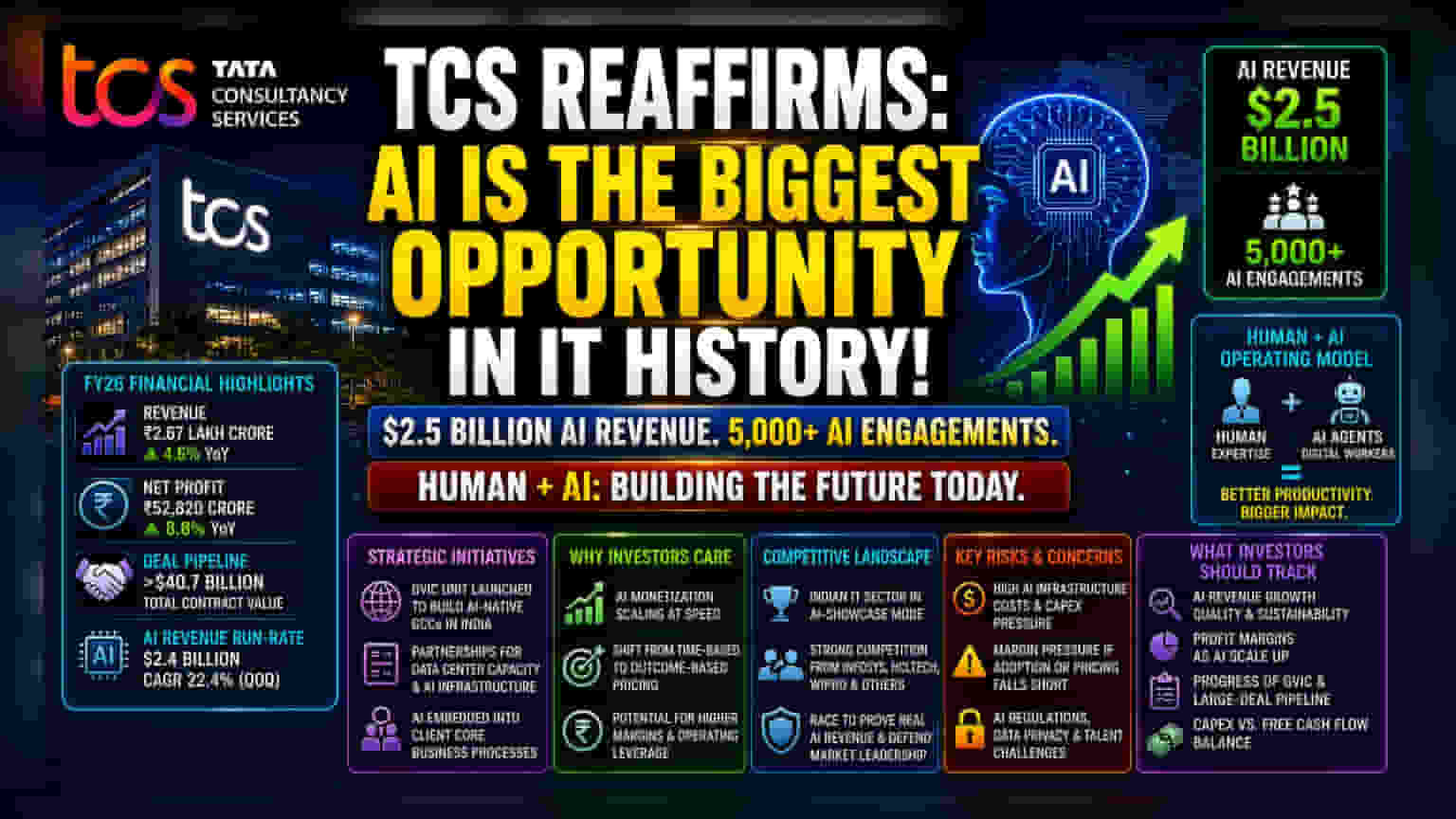


What Happened
Tata Consultancy Services (TCS) has reinforced its strategic pivot toward artificial intelligence, with management declaring AI as the most transformative opportunity in the history of the IT industry. During the company’s recent annual general meeting, Chairman N Chandrasekaran highlighted that AI has evolved beyond a standalone tool into a foundational layer for enterprise operations. TCS reported that its AI-related revenue has now reached nearly $2.5 billion, with the company having successfully delivered over 5,000 AI engagements. This shift is part of a broader corporate strategy to embed AI into the core business processes of its clients rather than treating it as an experimental side project.
Scaling the 'Human + AI' Operating Model
The company is betting on a 'Human + AI' operating model, where digital workers and human expertise work in tandem to improve productivity and service delivery. Management envisions a future where AI systems are deeply integrated into physical operations, even suggesting that the scale of AI-driven systems could one day match the size of its human workforce. To support this, TCS has launched new initiatives, including the Global Value & Innovation Centres (GVIC) unit, aimed at helping global enterprises establish AI-native Global Capability Centres (GCCs) in India. This move positions TCS to capture the growing demand for AI-first infrastructure, further supported by its recent partnerships in data center capacity to facilitate high-performance AI workloads.
How Investors May Read This
For investors, the $2.5 billion AI revenue milestone is a signal of TCS's ability to monetize the AI trend. However, the market’s view on Indian IT stocks has become increasingly nuanced. While AI offers a massive growth multiplier, it also brings a shift in how services are priced. Traditional IT models were largely based on 'time-and-materials' (billing by the hour), whereas AI-led contracts often move toward outcome-based or value-based pricing. While this can improve efficiency and potentially margins over the long term, it requires significant upfront investment in infrastructure, talent reskilling, and R&D. Investors are currently monitoring whether these AI investments will deliver steady margin expansion or if the costs associated with scaling AI infrastructure will weigh on profitability in the near term.
Competitive Landscape and Sector Context
The entire Indian IT sector is currently in an 'AI-showcase' phase. Competitors like Infosys, HCLTech, and Wipro are also aggressively pivoting toward AI-led solutions to counter concerns about the automation of traditional coding jobs. While TCS remains a market leader in terms of scale, the competitive intensity is high. Each firm is racing to prove that its AI revenue is 'real' and not just a relabeling of existing digital transformation contracts. For the sector, the key challenge is the 'AI cannibalization' fear—where automation might reduce the need for traditional software maintenance, forcing companies to find new, high-value growth engines to offset any potential decline in legacy services.
Potential Risks and Concerns
While the AI opportunity is significant, it is not without risks. The primary concern for shareholders is the potential for margin pressure. AI infrastructure—including high-performance computing, data storage, and model training—is capital-intensive. If client adoption is slower than expected or if pricing power is limited by competition, companies may face temporary profitability headwinds. Additionally, there are broader industry risks, including evolving AI regulations, data privacy challenges, and the high cost of training talent to stay relevant in a rapidly changing technological landscape. Any failure to execute complex, large-scale AI projects could also impact client relationships and reputational standing.
What Investors Should Track Next
Looking ahead, investors may focus on the quality and sustainability of AI-led revenue growth. Key monitorables include the trend in profit margins as AI-related projects scale, the progress of new AI-focused business units like GVIC, and management commentary on the stability of large-deal pipeline. Monitoring how the company balances its high capital spending on AI infrastructure with the need to maintain strong free cash flows will be critical for assessing the long-term impact on shareholder value.