 Whalesbook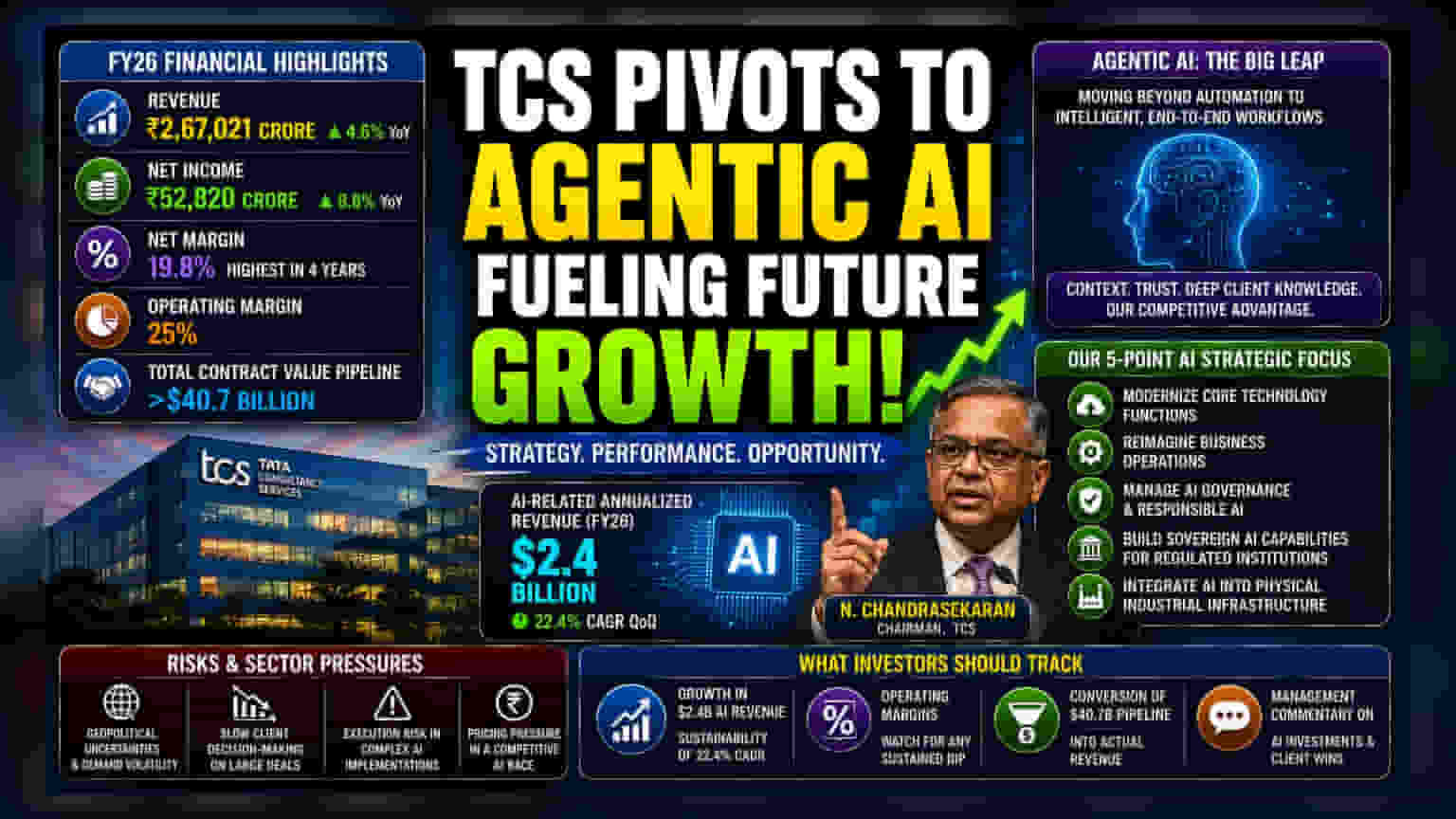


What Happened
Tata Consultancy Services (TCS) Chairman N. Chandrasekaran addressed shareholders at the company's 31st Annual General Meeting, marking a significant strategic pivot toward artificial intelligence. He described AI as the most crucial opportunity in the company's history, moving beyond simple automation to what he termed 'Agentic AI.' This refers to AI systems capable of executing complex, end-to-end workflows independently, rather than just performing simple tasks. TCS aims to use this technology to fundamentally change how its clients operate, from factory floors to supply chains.
Financial Context and Performance
For the financial year 2026, TCS reported a consolidated revenue of Rs 2,67,021 crore, reflecting a 4.6% increase compared to the previous year. Net income rose by 8.8% to Rs 52,820 crore. A notable figure from the company’s report is its net margin, which reached 19.8%, its highest level in four years. Additionally, the company maintained an operating margin of 25%. These figures are underpinned by a robust total contract value pipeline exceeding $40.7 billion, suggesting that the company continues to win large projects despite global economic uncertainties.
The AI Business Strategy
Chairman Chandrasekaran emphasized that in an era where AI models are increasingly accessible, the company’s 'context and trust'—its deep, long-standing knowledge of client businesses—will be its biggest business advantage. TCS is actively positioning itself to capitalize on this by focusing on five specific areas: modernizing core technology functions for large enterprises, reimagining business operations, managing AI governance, building sovereign AI capabilities for regulated institutions, and integrating AI into physical industrial infrastructure. The company reported that its AI-related annualized revenue reached $2.4 billion for FY26, growing at a compound quarterly rate of 22.4%.
How Investors May Read This
For investors, the shift toward AI is a move to secure future growth in a changing IT services market. While the reported growth in AI-related revenue is positive, the industry is currently navigating complex challenges. Investors often compare these moves with competitors in the sector who are also aggressively investing in AI. The key for TCS will be whether it can maintain its 25% operating margins while simultaneously spending heavily on training, infrastructure, and the development of these advanced AI platforms. If the cost of building these capabilities rises faster than the revenue they generate, it could put pressure on profit margins.
Risks And Sector Pressures
The IT sector continues to face hurdles, including geopolitical tensions and fluctuating demand in key markets like West Asia and the West. While TCS has shown resilience, the broader sector is dealing with slower decision-making from clients on large-scale projects and pricing pressures. There is also an execution risk involved; implementing complex AI systems for clients is not straightforward. Delays or cost overruns in these high-value projects could impact the company's bottom line. Additionally, as competitors also race to capture AI market share, pricing power remains a monitorable factor.
What Investors Should Track
Investors looking at the long-term potential of this strategy should watch for a few specific indicators in upcoming quarters. First, the growth rate of the $2.4 billion AI revenue stream will be vital to verify if this trend is sustainable. Second, keep an eye on operating margins; any sustained dip could signal that AI investment costs are outweighing the benefits. Finally, watch for commentary in quarterly reports regarding the conversion of the $40.7 billion deal pipeline into actual revenue, as this will determine the company’s ability to grow in the current global economic environment.