

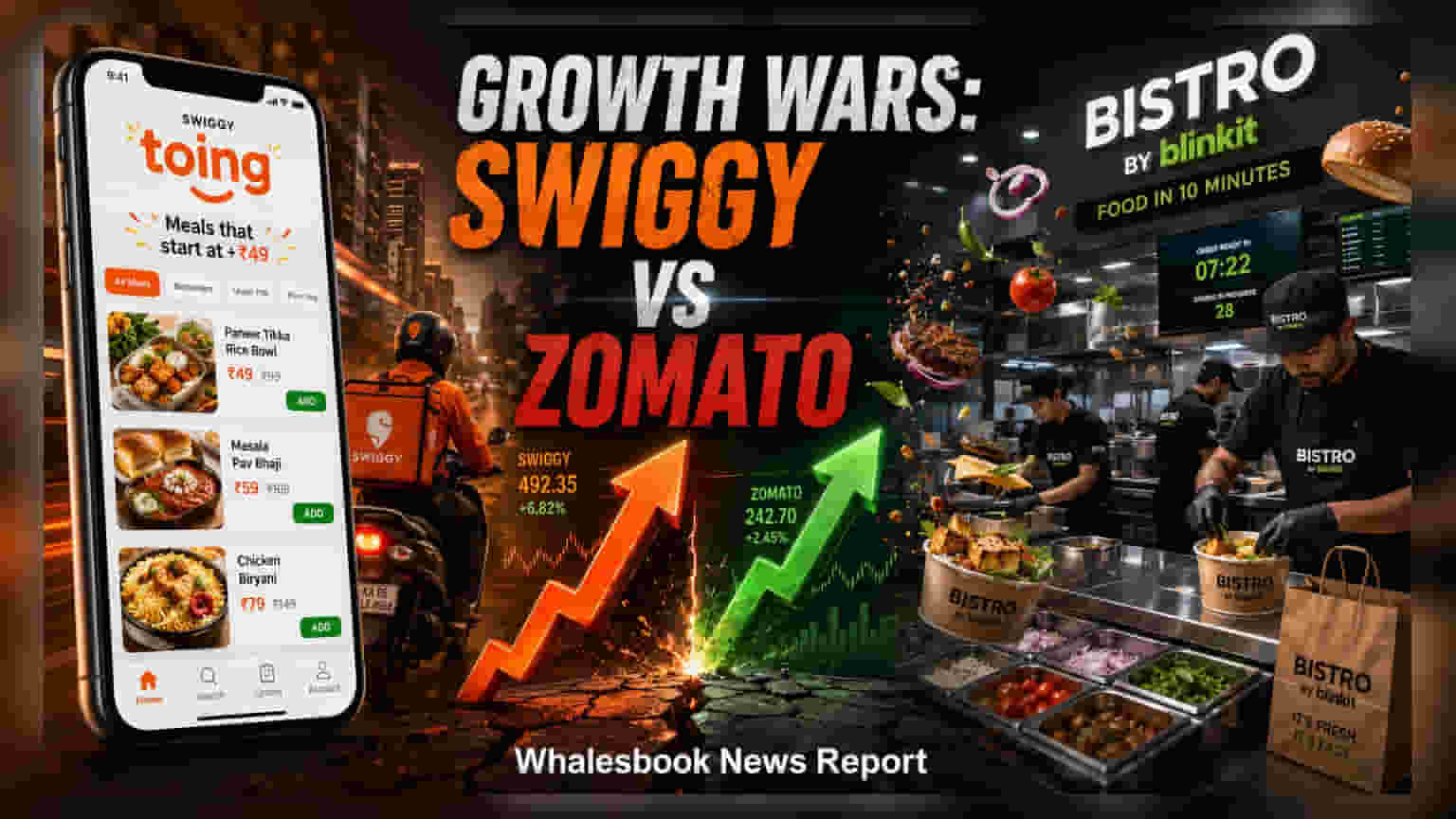
Swiggy and Eternal are targeting new user growth through different models. Swiggy is leveraging its existing logistics for its Toing app to offer affordable meals, while Eternal is investing in its own vertically integrated Bistro kitchens. Both companies face intensifying competition in the food delivery sector as they seek sustainable ways to reach price-sensitive consumers.
India's food delivery giants, Swiggy and Eternal, are shifting their focus toward acquiring new users to fuel future expansion. While both companies reported steady growth in their core delivery segments for the June quarter, they are taking different paths to capture price-sensitive segments of the market. Swiggy reported a 17.4% rise in its food delivery Gross Order Value, reaching ₹9,490 crore, while Eternal saw its Net Order Value grow by over 20% to ₹10,769 crore.
Swiggy’s Logistics-Led Model
Swiggy is using its Toing app to target affordability by utilizing its existing restaurant partnerships and delivery fleet. By plugging this new service into its established network, the company aims to minimize new infrastructure costs. According to the company, a large portion of Toing’s users are either new to the platform or have been inactive for a period, suggesting that the service is helping reach customers who were previously not ordering. The service has already expanded to roughly 50 cities, relying on the company’s current technology and execution framework.
Eternal’s Integrated Kitchen Approach
Eternal, the parent company of Zomato, is pursuing a different route through its Bistro initiative, which operates under its Blinkit division. Rather than focusing only on delivery fees or commission structures, Eternal is investing in vertically integrated kitchens. Founder Deepinder Goyal has emphasized that providing meals in the ₹50-150 range profitably requires re-engineering the food supply chain and production process. This model uses company-operated kitchens and standardized workflows to lower the cost of food production itself, rather than just lowering the price through platform-led discounts.
Competitive Pressures and Market Evolution
Both companies are operating in an increasingly crowded market. New entrants such as Rapido, with its zero-commission platform Ownly, and upcoming services from companies like Flipkart, are putting pressure on incumbent players. Additionally, specialized players like Swish have recently secured funding to expand their own kitchen operations, signaling that investors are backing various approaches to food service.
Analysts have noted that as order frequency stabilizes among existing users, the cost to acquire new customers has become a primary concern. The industry is now moving toward creating distinct offerings rather than just providing discounts on existing platforms. Investors may track how these new ventures—Toing and Bistro—impact the overall profitability of the parent firms. The long-term success of these models will depend on each company’s ability to scale these operations without significantly straining their financial resources or diluting the margins of their core delivery businesses. Future updates on user adoption rates, operational costs, and the scalability of these kitchen-based or logistics-based models will be the key indicators of progress.