

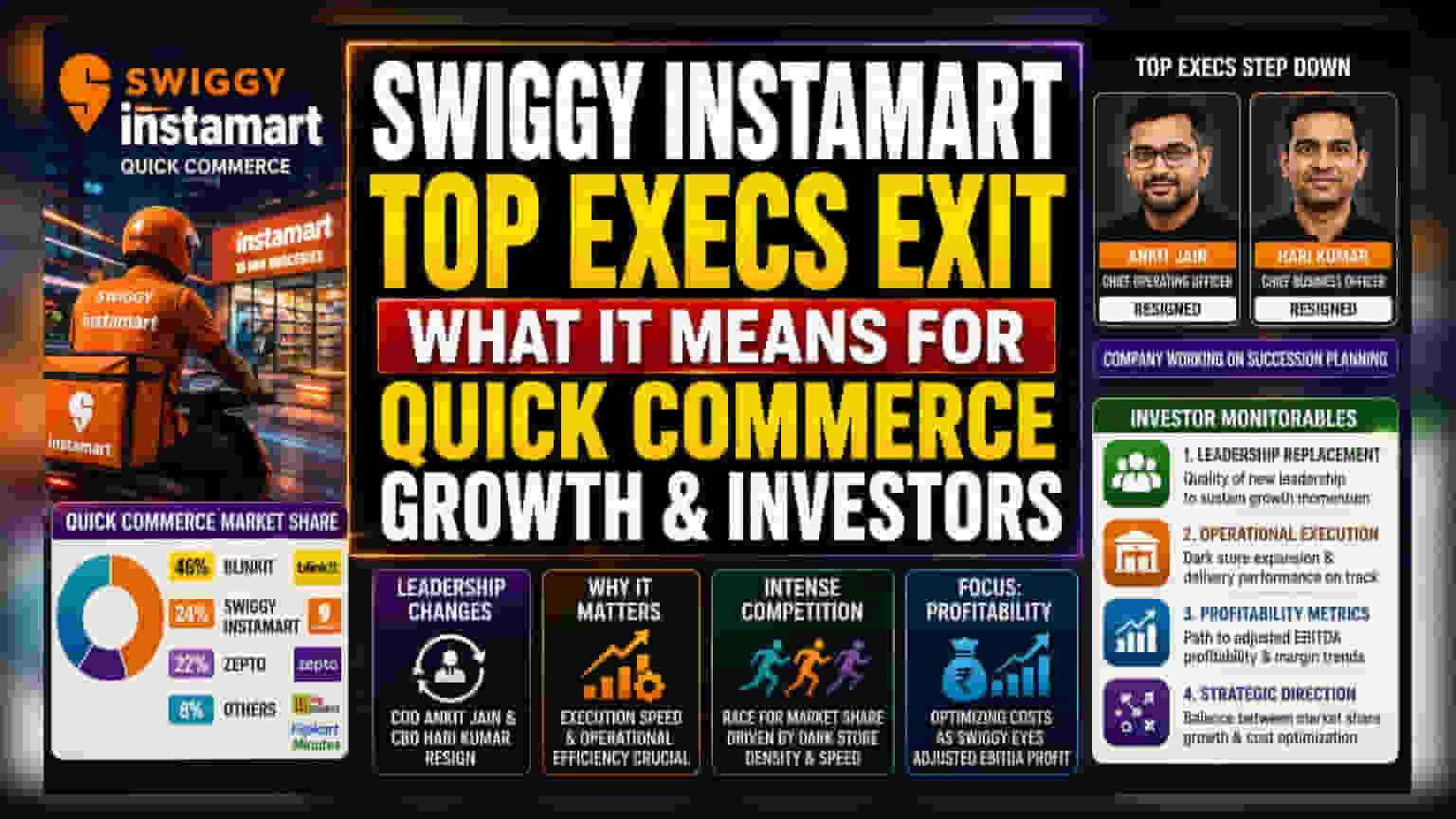
Swiggy Instamart’s COO Ankit Jain and CBO Hari Kumar have resigned, citing personal reasons. This leadership change occurs as the company battles intense competition in the quick commerce sector from Blinkit and Zepto. For shareholders of the listed entity, management stability remains a key monitorable as the firm balances rapid growth with the need for operational profitability.
What Happened
Swiggy’s quick commerce arm, Instamart, has announced the resignation of two of its top executives: Chief Operating Officer (COO) Ankit Jain and Chief Business Officer (CBO) Hari Kumar. Both leaders have decided to step down from their respective roles, citing personal reasons. This development comes as Swiggy, which listed on Indian stock exchanges in late 2024, continues to scale its grocery and hyperlocal delivery business. The company is reportedly working on succession planning to fill these key positions to ensure business continuity.
Why Leadership Stability Matters
For a publicly listed company, the stability of the management team is essential, particularly in a high-growth and capital-intensive segment like quick commerce. Instamart represents a significant part of Swiggy’s future growth strategy, and the platform has been aggressively expanding its network of dark stores to capture more market share. Changes at the top, especially in a sector where execution speed and operational efficiency are critical, often lead investors to closely monitor the transition process. Any delay in finding replacements or a significant change in operational strategy could impact the company’s ability to meet its targets in a fast-moving market.
The Competitive Landscape
The quick commerce industry is currently in a state of intense competition. Swiggy Instamart, holding approximately 24% of the market share, is engaged in a fierce battle against industry leader Blinkit (with about 46% share) and rival Zepto (at roughly 22%). Other players, including Tata’s BigBasket and Flipkart Minutes, are also actively expanding their presence. In this environment, the race for dominance is driven by dark store density, delivery speed, and the ability to maintain profitability at the unit level. Swiggy is currently focused on optimizing its operations and managing costs as it moves toward profitability.
Investor Monitorables
Investors may watch for a few specific updates following this change:
Leadership Replacement: The quality and experience of the incoming executives will be important, as they will need to maintain the growth momentum established by the previous team.
Operational Execution: Shareholders will likely track whether the planned expansion of dark stores continues on schedule and if the company maintains its current delivery service levels.
Profitability Metrics: As Swiggy is now a public company, the market is closely watching its path to adjusted EBITDA profitability. Maintaining margins while managing senior-level exits will be a primary focus for management in the coming quarters.
Strategic Direction: Any signal from management regarding a change in focus, such as pivoting between market share gains and cost-cutting, could influence investor sentiment.