

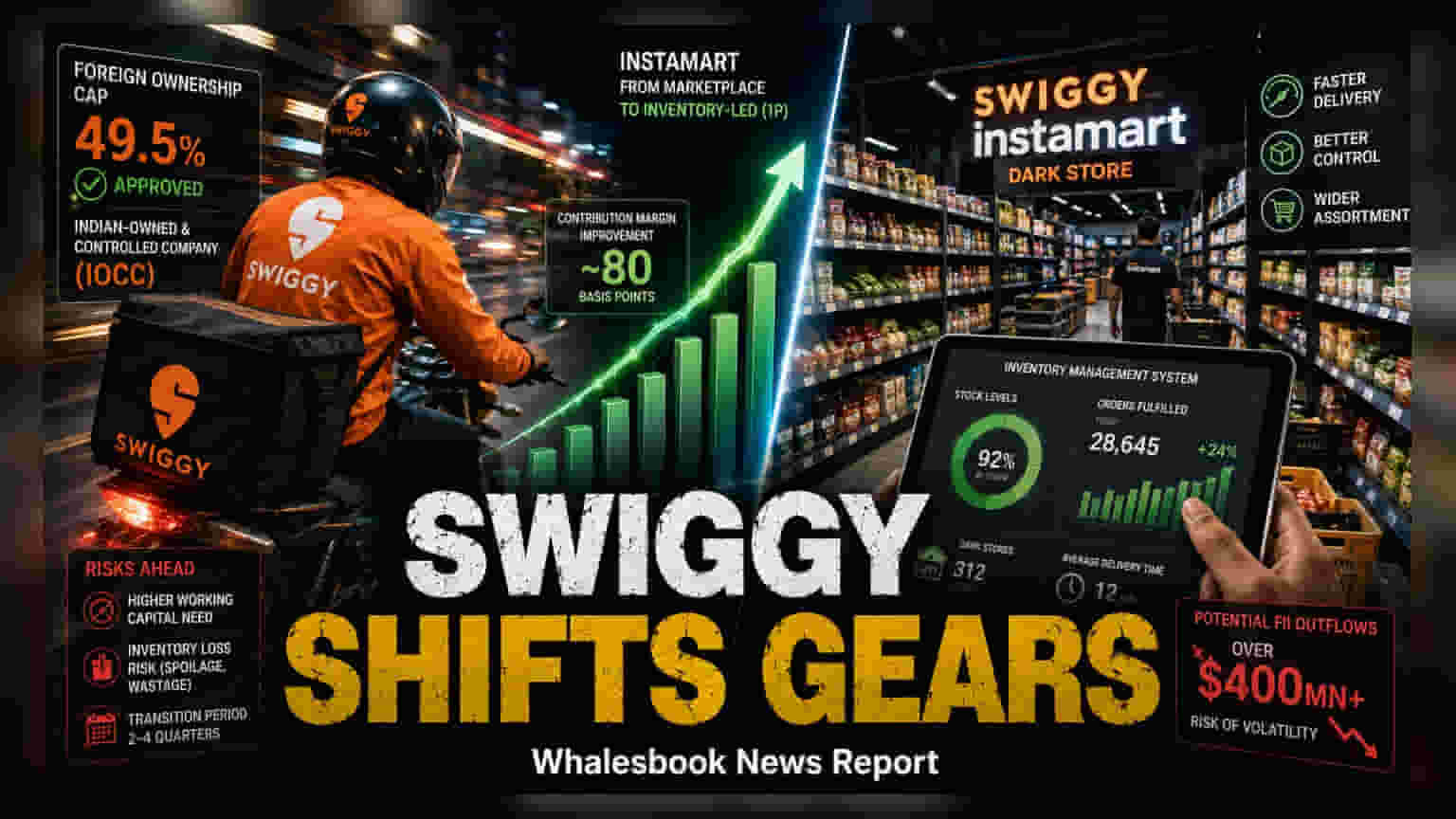
Swiggy shareholders have approved a 49.5% foreign ownership limit, allowing the firm to transition its Instamart service to an inventory-led business model. This strategic shift aims to improve control over pricing and margins but comes with higher capital requirements and potential passive fund outflows.
Swiggy shareholders at the company's Annual General Meeting on August 18, 2026, approved a resolution to cap aggregate foreign ownership at 49.5%. This decision marks a significant shift in the company’s operating structure, allowing it to qualify as an Indian-Owned and Controlled Company (IOCC). This change is the key enabler for Swiggy’s quick-commerce arm, Instamart, to move from a marketplace model to an inventory-led (1P) model.
In the marketplace model, Instamart functioned as an intermediary, connecting buyers with third-party sellers and earning a commission. Under the new inventory-led approach, the company will purchase, own, and manage stock directly from brands. This transition provides the company with greater control over product assortment, pricing, and fulfillment speed, which is a key competitive factor in the crowded quick-commerce sector where rivals like Blinkit and Zepto have already established significant scale.
From an investor perspective, this move is expected to improve Instamart's contribution margins by approximately 80 basis points. Furthermore, the shift will lead to an accounting reclassification. Because the company will now recognize the full sale value of goods as revenue rather than just the commission earned, the reported top-line revenue figures are likely to see a sharp increase, similar to the revenue spikes observed by competitors after adopting similar models.
However, this strategic pivot brings clear operational and financial challenges. Moving to an inventory-led model requires significantly higher working capital to fund and manage inventory across a dense network of dark stores. Investors should monitor the impact on cash flows as the company takes on the risk of inventory management, including potential losses from spoilage, wastage, or unsold goods.
Another specific risk involves potential passive foreign institutional investor (FII) outflows. Analysts have noted that the 49.5% ownership cap could trigger a sell-off of over $400 million by passive funds tracking global indices like MSCI and FTSE, which may create volatility in the stock's holding structure.
Swiggy anticipates a transition period of two to four quarters to fully implement this new structure. For investors, the key monitorables over the coming quarters will be the execution speed of this transition, the company’s ability to manage inventory without significantly hurting operating margins, and how the market adjusts to the shift in reported revenue figures relative to actual business growth.