 Whalesbook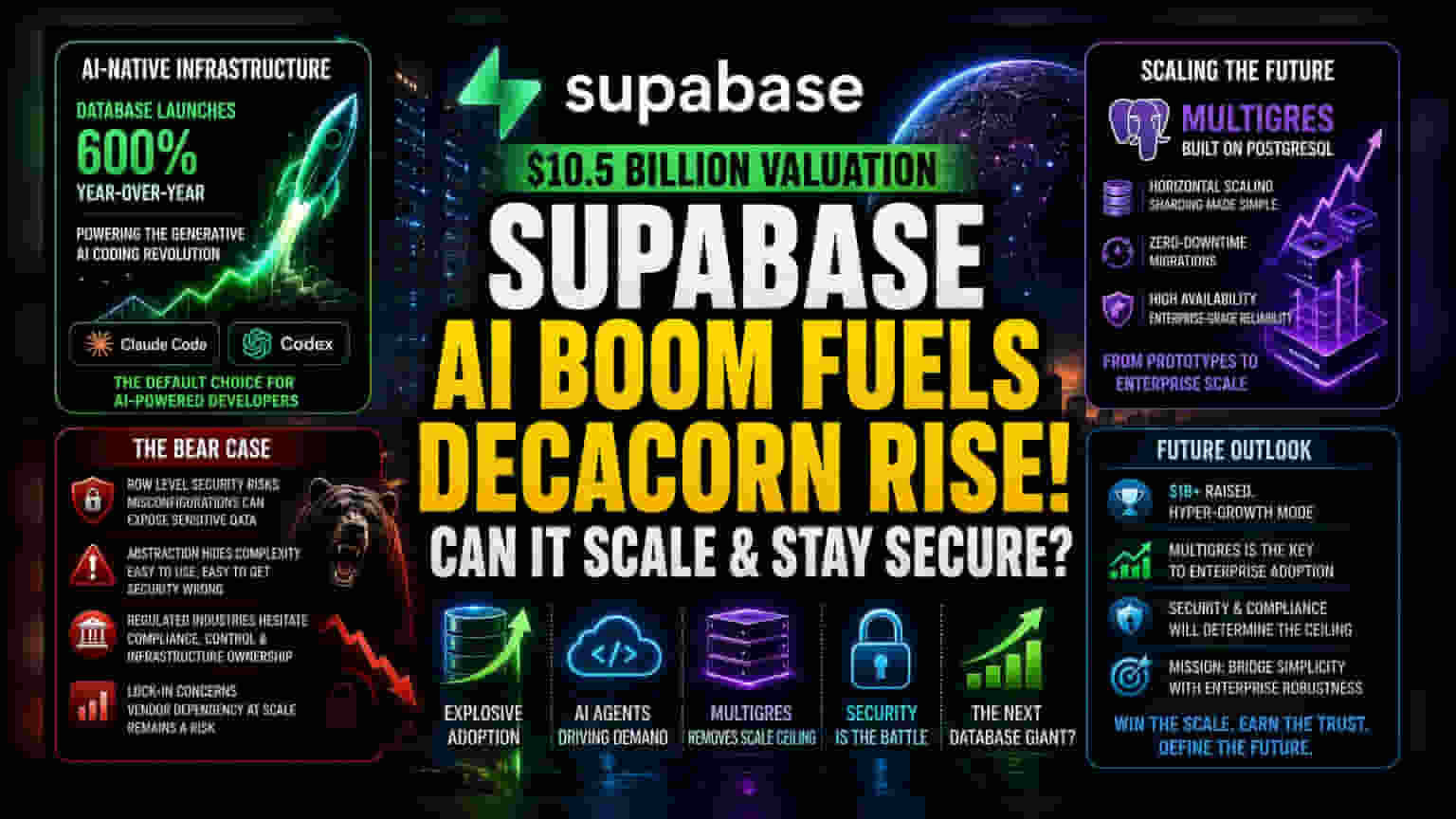


The AI-Native Infrastructure Surge
The rapid ascent of Supabase to a $10.5 billion valuation reflects a fundamental shift in how backend infrastructure is provisioned. While traditional enterprise software sales cycles remain sluggish, Supabase has effectively commoditized database deployment through deep integration with generative AI coding tools. By aligning its development platform with the rise of autonomous agents—specifically platforms like Claude Code and Codex—the company has seen database launches surge by 600% year-over-year. This is not merely a growth metric; it is a structural realignment where software creation is increasingly delegated to AI, and Supabase has positioned itself as the default, frictionless choice for these silicon-based architects.
Scaling Challenges and the Multigres Pivot
To justify its decacorn status, Supabase is attempting to solve the "ceiling" problem inherent to its growth strategy. Historically, developers have used Supabase for rapid prototyping, only to migrate to more complex, specialized database systems once their applications reach significant scale. The launch of Multigres—an open-source horizontal scaling layer for PostgreSQL—is a direct effort to capture that enterprise-tier revenue. By offering sharding, zero-downtime migrations, and high-availability features, the company hopes to keep customers within its ecosystem long after they outgrow their initial database instances. The effectiveness of Multigres will be the primary test of whether Supabase can transition from a "weekend project" tool to a legitimate competitor for hyperscale infrastructure providers like AWS or MongoDB.
The Forensic Bear Case: Security and Control
Despite the exuberant investor sentiment, structural risks remain embedded in the company’s architecture. Supabase’s heavy reliance on PostgreSQL Row Level Security (RLS) has become a recurring point of failure for users. Because RLS requires precise configuration to prevent sensitive data leaks, the abstraction of database management often masks the underlying complexity of these security policies. Forensic analysis of production environments frequently uncovers misconfigured RLS policies, leaving databases exposed to unauthorized access. Furthermore, the company’s business model—which favors ease of use over strict infrastructure control—creates potential friction for highly regulated industries like finance or healthcare. These sectors require stringent vendor due diligence and ownership of infrastructure, areas where Supabase’s managed, cloud-first approach may struggle to meet the compliance requirements demanded by institutional risk management.
Future Outlook and Market Positioning
With over $1 billion in total capital raised, Supabase is now entering a phase of hyper-competition. While it has successfully capitalized on the current AI development boom, its long-term viability will depend on the retention of its user base as these early-stage AI startups mature. If Multigres succeeds in alleviating scaling pain points, the company may successfully bridge the gap between developer-friendly convenience and enterprise-grade robustness. However, if the platform continues to face security scrutiny, the barrier to entry for more traditional, security-conscious enterprise customers will remain high.