

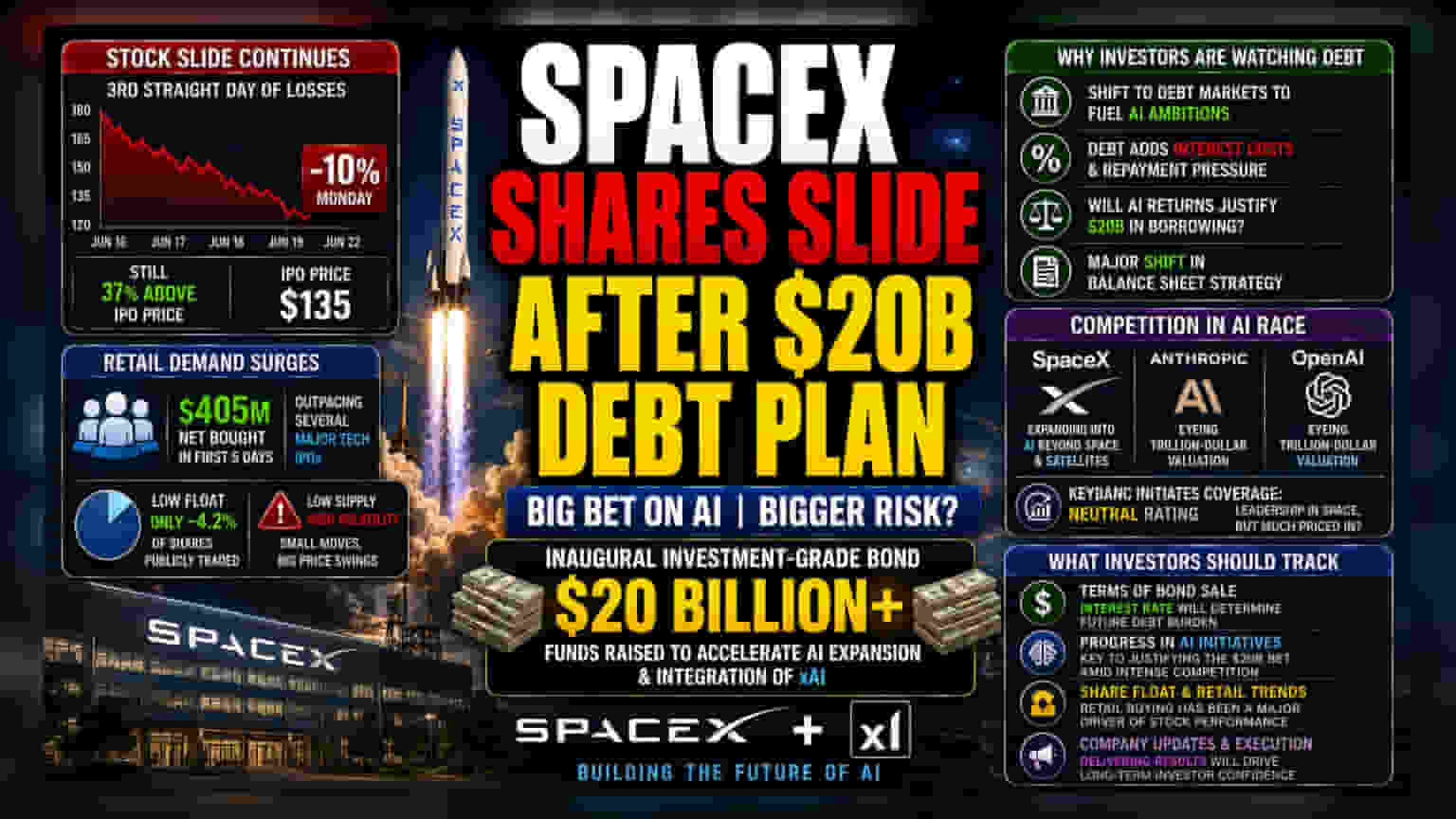
SpaceX shares extended a decline for the third straight day following plans to raise at least $20 billion through a bond sale to finance its artificial intelligence expansion. Investors are now assessing how this significant increase in debt impacts the company's financial health. Despite the recent volatility, the stock remains 37% above its IPO price.
What Happened
SpaceX shares have dipped for the third consecutive trading session following the announcement of a major debt issuance. The Elon Musk-led company plans to raise at least $20 billion through its inaugural investment-grade bond offering. The funds are earmarked for aggressive expansion into artificial intelligence, specifically to support the company’s integration of xAI, which was acquired earlier this year. This announcement caused the stock to drop by 10% on Monday, extending a downward trend seen in the previous week.
Why Investors Are Watching Debt
For investors, this news marks a pivot in how the company funds its growth. Having recently completed an IPO, the company is now turning to debt markets to fuel its AI ambitions. While debt can allow a company to expand without issuing more shares (which would dilute existing shareholders), it also adds interest obligations and repayment pressure. Investors are likely assessing whether the returns from the new AI initiatives will justify the cost of borrowing $20 billion. This debt, if finalized, would be a major shift for the company’s balance sheet.
Volatility And Retail Demand
Since its market debut, SpaceX has experienced significant price swings. Financial data shows that the stock has a relatively low float—meaning only about 4.2% of the company's shares are actively traded by the public. When the available supply of shares is low, even small shifts in buying or selling can cause large price movements. Despite the recent slide, the stock is still trading 37% higher than its IPO price of $135. Data indicates that retail interest has been exceptionally high, with individual investors net-buying $405 million worth of shares in the first five days of trading, outpacing the demand seen for several major tech companies.
Competition And AI Strategy
SpaceX is under intense pressure to prove that its move into AI is a viable long-term business. The company is competing in a sector where firms like Anthropic PBC and OpenAI are also eyeing trillion-dollar valuations. The successful execution of AI projects is now central to the company’s story, beyond its core rocket and satellite business. KeyBanc Capital Markets recently initiated coverage on the stock with a neutral rating, suggesting that while the company remains a leader in space technology, much of the long-term potential might already be priced into the stock at current levels.
What Investors Should Track Next
The main points for investors to monitor will be the official terms of the bond sale, including the interest rate, as this will determine the future debt burden. Additionally, the company's ability to demonstrate progress in its AI initiatives will be key to maintaining investor confidence, especially as it faces high-value competition in the technology sector. Shareholders may also continue to watch for updates on share float and any potential changes in retail buying patterns, which have been a major driver of the stock’s early performance.