 Whalesbook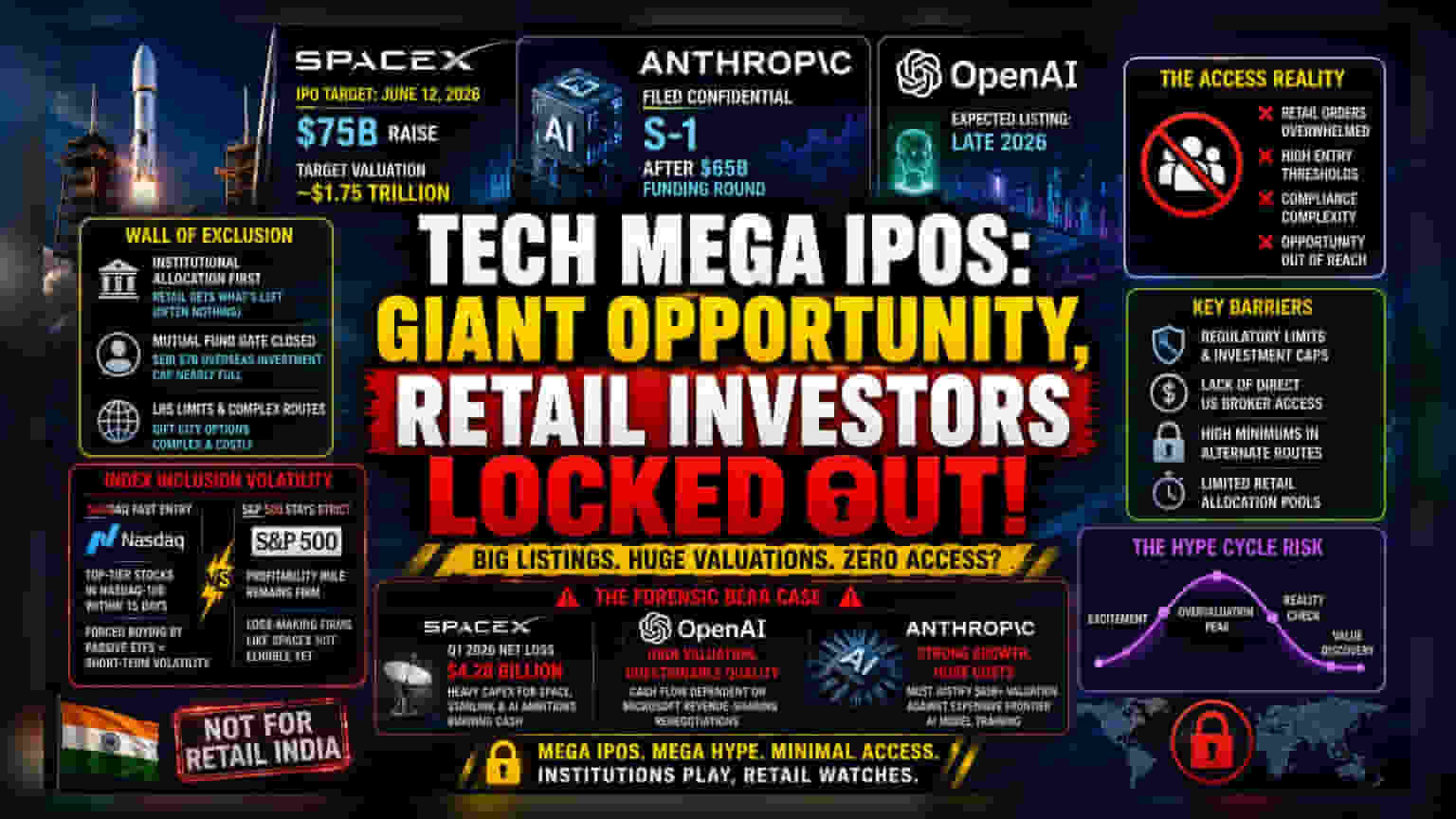


The Institutional Gatekeeping Reality
The upcoming wave of high-profile tech listings is fundamentally shifting the global equity market, yet the opportunity is not distributed equally. SpaceX is moving toward a June 12, 2026, Nasdaq debut with a targeted $75 billion raise, aiming for a valuation near $1.75 trillion. Simultaneously, Anthropic has confidentially filed its S-1 following a $65 billion funding round, and OpenAI remains a prime focus for an anticipated late-2026 listing. Despite the sheer scale of these offerings, Indian retail investors face a wall of structural and regulatory friction that prevents meaningful direct participation.
The Mechanics of Exclusion
While the Liberalised Remittance Scheme (LRS) technically permits foreign investment, the reality for the average investor is defined by institutional preference. IPO allocations for mega-caps are overwhelmingly dominated by institutional desks, leaving little to no room for retail orders. Furthermore, the Indian mutual fund landscape—historically the primary gateway for global exposure—has effectively seized up. SEBI’s $7 billion industry-wide ceiling for overseas investments has reached near-total utilization, forcing major domestic fund houses to pause or severely restrict fresh inflows into international schemes. Even with the emergence of GIFT City-based investment routes, the threshold for entry and the complexity of these new conduits remain prohibitive for the broader retail demographic.
Index Inclusion: The New Volatility Engine
The Nasdaq exchange has introduced a "Fast Entry" mechanism to capture these mega-listings, allowing companies in the top tier by capitalization to join the Nasdaq-100 within just 15 trading days. While designed to provide institutional liquidity, this creates a secondary risk for retail participants. Passive ETFs tracking these indices will be forced to absorb these stocks shortly after listing, potentially triggering artificial price volatility. Notably, the S&P 500 has resisted similar pressure, reaffirming its strict profitability requirements—a hurdle that currently disqualifies loss-making entities like SpaceX from benchmark inclusion, further fragmenting the index-level support available to these companies.
The Forensic Bear Case: Structural Weaknesses
Beyond access hurdles, the underlying financial health of these IPO candidates demands caution. SpaceX, while a leader in launch services and Starlink, reported a $4.28 billion net loss in Q1 2026 alone, highlighting the heavy capital expenditure required for its AI and space ambitions. OpenAI faces a similar narrative; analysts have pointed to its high valuation relative to business quality, noting that its path to positive cash flow is heavily contingent on renegotiated revenue-sharing agreements with Microsoft. Anthropic, while surging on enterprise demand, must still justify its massive valuation against the brutal economics of frontier AI model training. Prospective investors should remain wary of the 'hype cycle' inherent in these listings, where astronomical valuations may disconnect from current operational realities.