

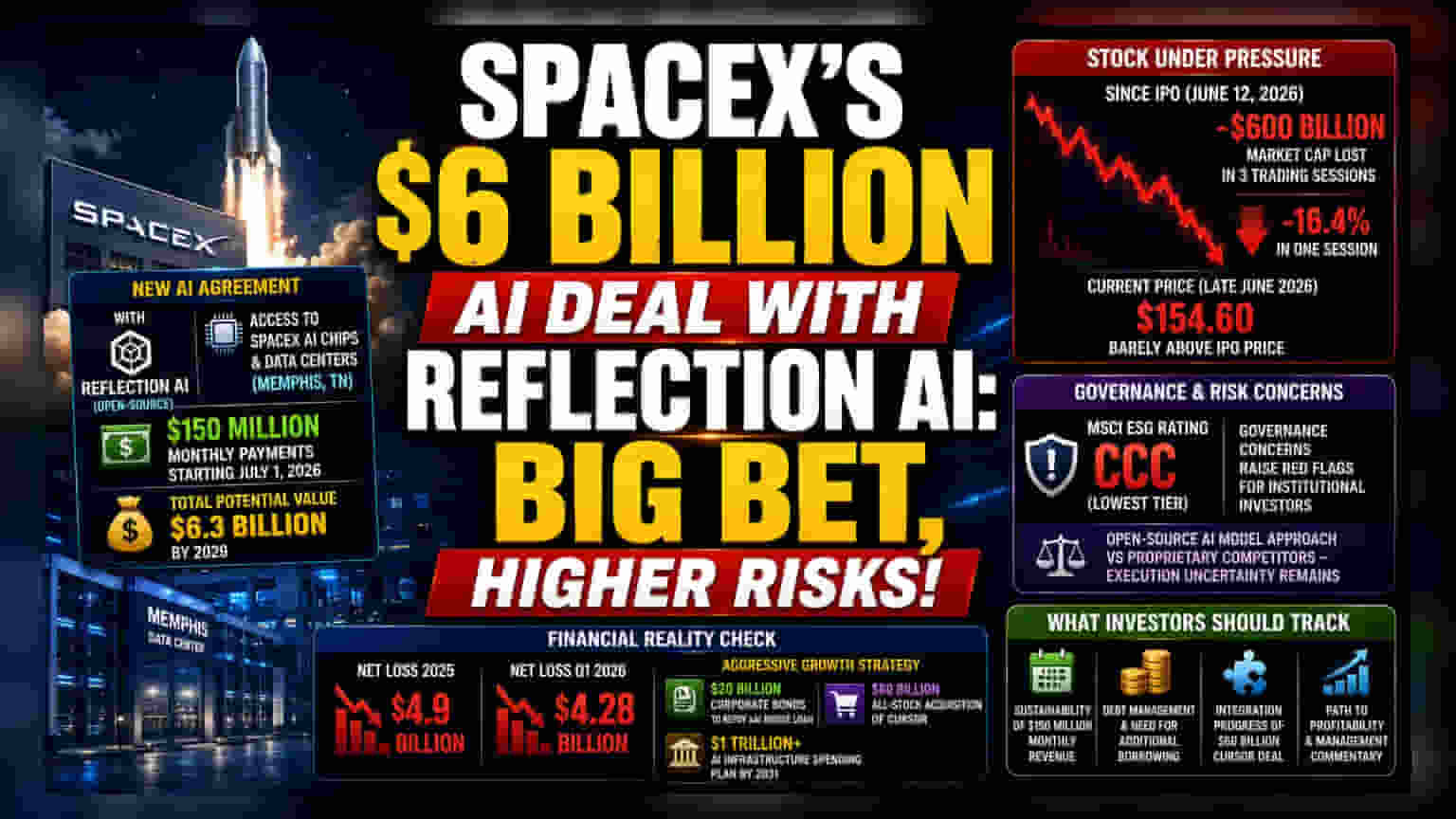
SpaceX has secured a $6 billion deal with Reflection AI, promising $150 million in monthly revenue starting in July 2026. Despite this new revenue stream, the company faces intense investor worry following a $600 billion loss in market value since its June 2026 IPO. Concerns regarding deep net losses, heavy debt from an xAI merger loan, and aggressive spending remain the primary focus for shareholders.
What Happened
SpaceX has signed a significant $6 billion artificial intelligence agreement with the open-source firm Reflection AI. Under the terms, Reflection AI will gain access to SpaceX's AI chips and data center facilities located in Memphis, Tennessee. The contract is structured to bring in $150 million in monthly payments for SpaceX starting on July 1, 2026, with the total potential value reaching $6.3 billion by 2029.
The Financial Reality Check
While the new contract provides a steady stream of revenue, the company’s financials remain a point of concern for investors. SpaceX reported substantial net losses, totaling $4.9 billion in 2025 and an additional $4.28 billion in the first quarter of 2026 alone.
Beyond operating losses, the company is managing significant debt. SpaceX has planned to issue $20 billion in corporate bonds, which are intended to pay off a bridge loan taken for its merger with xAI. This, combined with the $60 billion all-stock acquisition of Cursor, highlights an aggressive, high-spending growth strategy. Analysts have noted that the company’s plans for AI infrastructure spending could exceed $1 trillion by 2031, which places immense pressure on cash flow and requires careful execution.
How The Stock Has Reacted
The deal comes at a sensitive time for SpaceX shareholders. Since its IPO on June 12, 2026, the company has seen extreme volatility. After an early rally, the stock faced a sharp correction, shedding nearly $600 billion in market value over just three trading sessions. In one particular session, the stock price dropped by 16.4%. As of late June 2026, the share price is hovering around $154.60, which is barely above the original IPO price.
The Governance And Risk Perspective
Investors are not just looking at the balance sheet; they are also tracking governance and sustainability factors. The company currently holds an MSCI ESG rating of CCC, which is among the lowest possible grades. This rating often points to concerns regarding management structure and internal governance, which can make institutional investors more cautious. The contrast between the proprietary AI models of industry leaders and Reflection AI’s open-source approach adds another layer of uncertainty regarding how the company’s AI infrastructure will perform against competitors over the long term.
What Investors Should Track
The key for shareholders will be seeing how these aggressive growth plans translate into actual earnings. Investors may track the following:
- Whether the $150 million monthly revenue from the Reflection AI deal is sustained.
- Progress on managing the $20 billion debt burden and if any further borrowing is required.
- Any updates on the integration of the $60 billion Cursor acquisition.
- Management commentary on how they plan to move from heavy losses toward consistent profitability.