 Whalesbook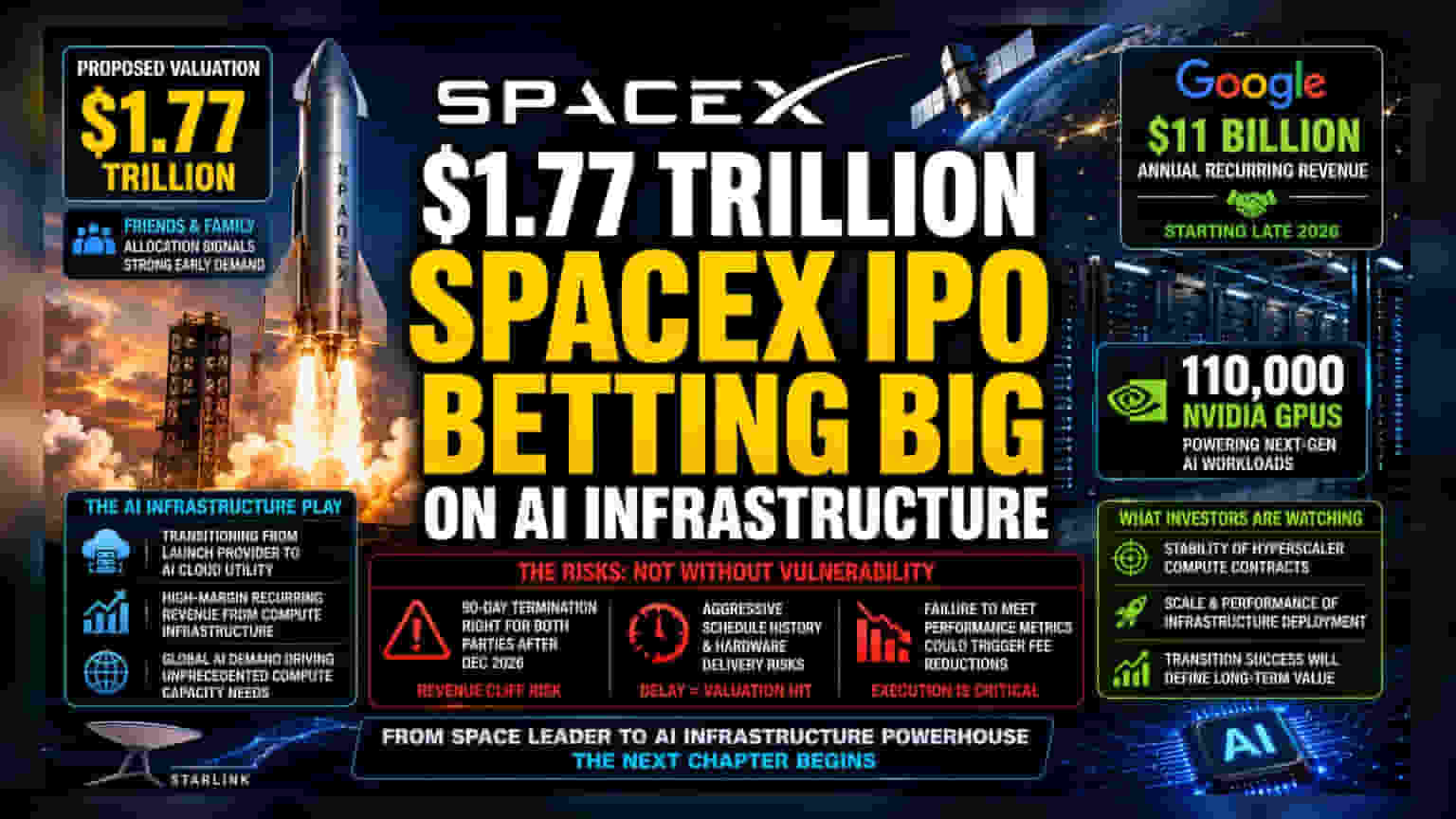


The Compute-Driven Valuation Premium
The proposed $1.77 trillion valuation transforms the perception of SpaceX from a launch-services provider into a high-octane AI infrastructure utility. By securing $11 billion in annual recurring revenue from Google starting in late 2026, the company is effectively leveraging its satellite and data center infrastructure to function as a specialized cloud service provider. This move aligns the firm more closely with the capital-intensive business models of hyperscalers rather than traditional aerospace manufacturers, potentially attracting a broader institutional investor base focused on compute-hungry AI development.
Infrastructure Capacity and Market Benchmarking
The reliance on 110,000 Nvidia GPUs is the primary anchor of this valuation. By diverting capacity that might have been utilized for internal Starlink optimization toward external compute leasing, the firm is prioritizing high-margin recurring income over immediate operational expansion. Compared to established data center REITs or traditional cloud providers, the premium pricing of this IPO implies a belief that SpaceX can operate compute nodes in low-earth orbit or remote terrestrial locations with efficiency levels that rival ground-based competitors. Investors must look closely at how this revenue stack differentiates the firm from Anthropic, which similarly utilizes SpaceX compute capacity, as the interdependency between these entities suggests a concentrated risk profile within the AI sector.
The Forensic Risk Assessment
The structure of the Google partnership reveals significant operational vulnerabilities. With both parties holding a 90-day termination right after December 2026, the revenue stream is far from guaranteed. This creates a "cliff risk" for shareholders; should the compute infrastructure fail to meet the delivery or latency performance metrics defined in the filing, Google maintains the leverage to exit the arrangement entirely. Furthermore, the firm's history of aggressive schedule projections for Starship and orbital deployment introduces a non-trivial risk that hardware delivery milestones will miss, thereby triggering the reduction clauses that curb initial fee payments. Any failure to scale this capacity linearly will likely result in immediate downward revisions to the valuation, as the market is pricing this stock based on future compute availability rather than historical launch performance.
Forward Trajectory
Market participants are likely to focus on the "friends and family" allocation as a signal of early demand, yet the underlying reality remains tied to the execution of this compute-heavy pivot. While the capital raised will certainly bolster the company's ability to maintain its lead in the aerospace domain, the long-term stock price will ultimately track the stability of these hyperscaler contracts. If SpaceX can successfully navigate the transition from a niche aerospace operator to a foundational AI infrastructure provider, the current valuation may represent a floor. Conversely, any delay in compute capacity deployment risks derailing the entire premise of the AI-driven IPO narrative.