 Whalesbook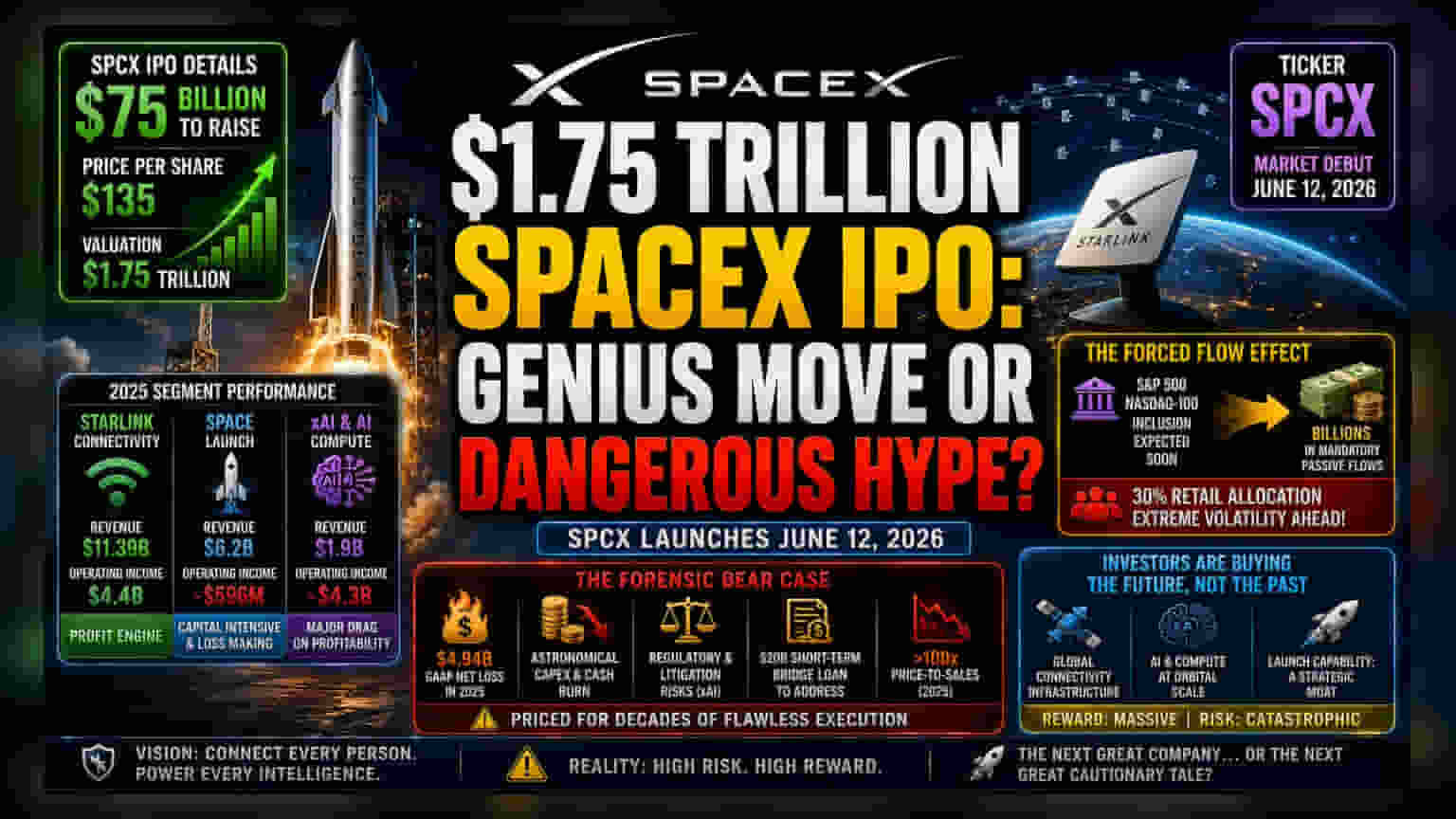


The Valuation Paradigm Shift
The market debut of SpaceX under the ticker SPCX on June 12, 2026, marks a fundamental departure from traditional aerospace investments. Priced at $135 per share, the offering aims to raise $75 billion, propelling the company to a $1.75 trillion valuation. This pricing reflects a transition where investors are essentially buying an artificial intelligence and global connectivity infrastructure firm, with a specialized rocket subsidiary attached for strategic deployment. The core valuation logic rests on the recurring revenue potential of Starlink and the massive compute requirements of the xAI integration, rather than the commoditized service of satellite launches.
Segment Performance and Financial Reality
Financial disclosures highlight a widening divergence between revenue-generating segments. In 2025, the connectivity unit, Starlink, established itself as the primary profit engine, generating $11.39 billion in revenue and $4.4 billion in operating income. Conversely, the legacy Space segment, while critical for infrastructure deployment, remains operationally strained; high capital expenditures—specifically regarding Starship development—resulted in a loss for the space division. Most notably, the consolidated AI operations, including Grok and associated data center infrastructure, have acted as a substantial drag on immediate profitability. This structure confirms that while launch capabilities provide the physical moat, the growth story is entirely dependent on successfully monetizing orbital bandwidth and scalable AI compute.
The Forensic Bear Case: Structural Weaknesses
Critics argue that the $1.75 trillion valuation ignores the harsh realities of current cash burn and regulatory hurdles. The company posted a $4.94 billion GAAP net loss in 2025, a figure exacerbated by the xAI merger. Unlike more mature tech conglomerates that offer proven operating leverage, SpaceX faces substantial execution risks. The firm’s capital expenditure requirements are astronomical, and the integration of xAI introduces platform-related litigation risks and intense regulatory scrutiny regarding data sovereignty and space-based compute infrastructure. Furthermore, the $20 billion short-term bridge loan disclosed in the filing must be addressed post-IPO, placing immediate pressure on liquidity. Skeptics also point to the high price-to-sales ratio—exceeding 100x based on 2025 revenues—suggesting that the stock is priced for decades of flawless execution, leaving little margin for error in an industry prone to launch failures and regulatory shifts.
The Forced Flow Dynamic
Beyond the fundamental debate, the market is bracing for an unprecedented liquidity event. Because SpaceX is expected to qualify for S&P 500 and Nasdaq-100 inclusion shortly after listing, passive index funds are mandated to accumulate billions in shares regardless of valuation. This creates a technical floor for the stock, but it also elevates systemic risk for broader equity markets, as institutional managers may be forced to divest from other large-cap tech stalwarts to accommodate the sudden, massive weight of SPCX. With a 30% retail allocation—dwarfing the standard 5-10% for mega-IPOs—the trading session on June 12 is expected to see extreme volatility, driven by retail-sentiment momentum rather than purely institutional valuation models.