

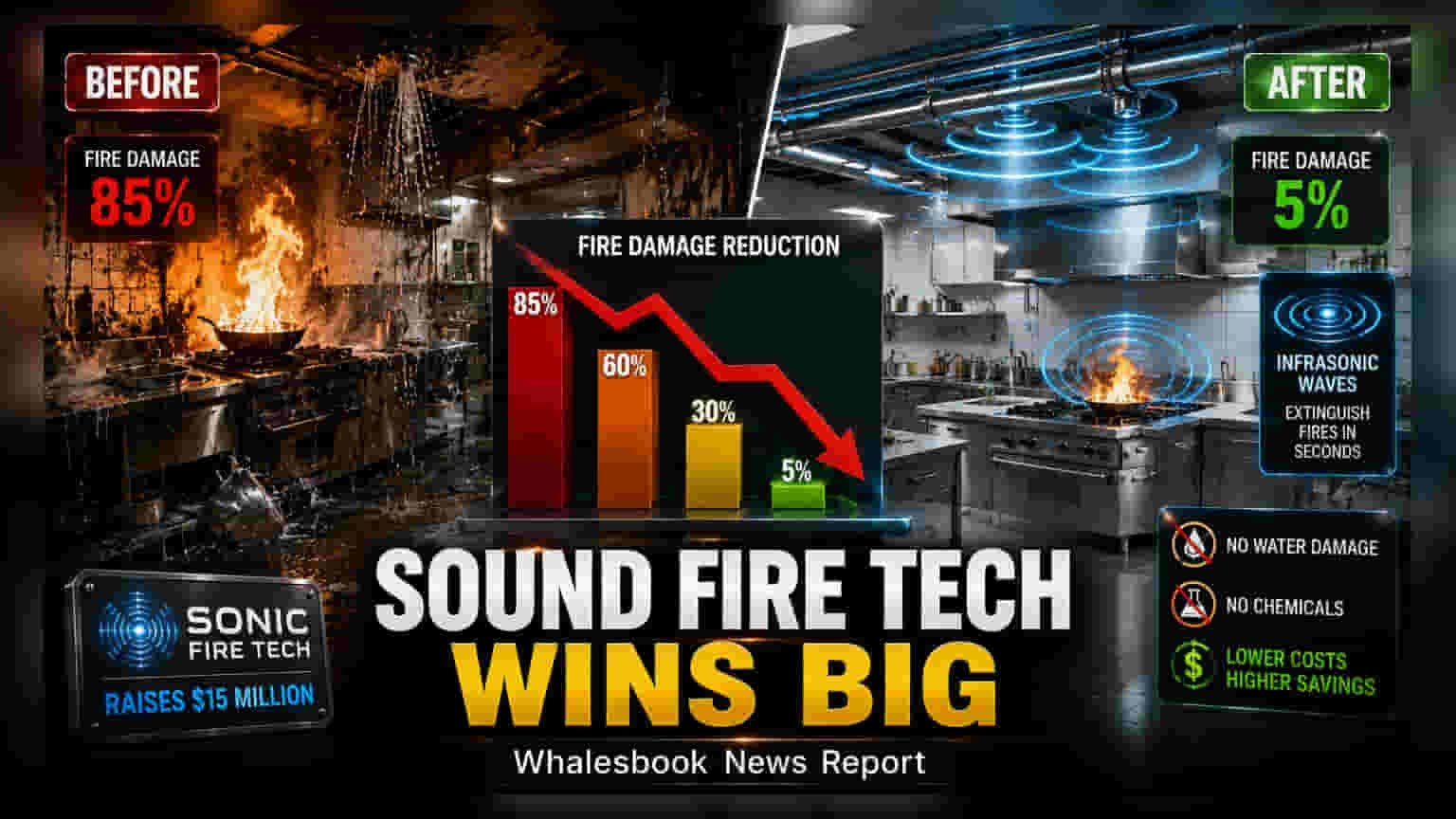
Private startup Sonic Fire Tech has raised $15 million in a funding round led by The O.H.I.O. Fund and Khosla Ventures. The company is developing technology that uses infrasonic waves to extinguish fires without water or chemicals. While the funding supports workforce and testing, the company faces significant challenges in obtaining mandatory regulatory certifications for commercial and residential use.
Sonic Fire Tech, a private startup based in Cleveland, has successfully raised $15 million to advance its fire suppression technology. The funding round was led by The O.H.I.O. Fund with participation from Khosla Ventures. The company is focused on developing systems that extinguish fires using infrasonic waves rather than traditional water or chemical sprays.
The technology works by generating low-frequency sound waves, around 20 Hz, which are sent through pipes to the fire source. According to the company, these sound waves disrupt the combustion process and extinguish flames within seconds. By avoiding the use of water or foam chemicals, the system aims to prevent the significant property damage and cleanup costs that often occur during traditional fire suppression efforts.
The company is targeting specific high-risk environments, including commercial kitchens, which frequently face financial distress or permanent closure after major fire damage. It is also looking at applications for lithium-ion battery storage, where conventional methods often struggle to contain rapid heat spread. The company suggests that its system could potentially slow the spread of fires in these batteries by limiting flame engulfment.
Despite the innovative approach, the company faces significant business and operational challenges. The most critical hurdle is the regulatory approval process. Fire safety standards in the United States and elsewhere are strictly governed by bodies such as the National Fire Protection Association (NFPA), FM Global, and Underwriters Laboratories (UL). Introducing a new, non-traditional technology into these established safety codes is a rigorous, years-long process. The startup must prove through extensive laboratory testing that its acoustic system is as reliable and safe as the century-old standards currently in use.
Furthermore, moving from a technology prototype to a widely installed commercial product involves major operational scaling. The company must prove its manufacturing capability and long-term reliability in various real-world conditions, from residential homes to large commercial buildings. As a venture-backed startup, the company will need to manage its capital carefully to sustain operations during the slow and costly certification timelines required to enter the market legally.
Future progress will likely depend on the company's ability to secure these safety certifications and build partnerships with the insurance industry. The company has indicated it is in discussions regarding potential insurance premium discounts for properties that install its system, which could be a major driver for adoption if the technology gains regulatory approval.