

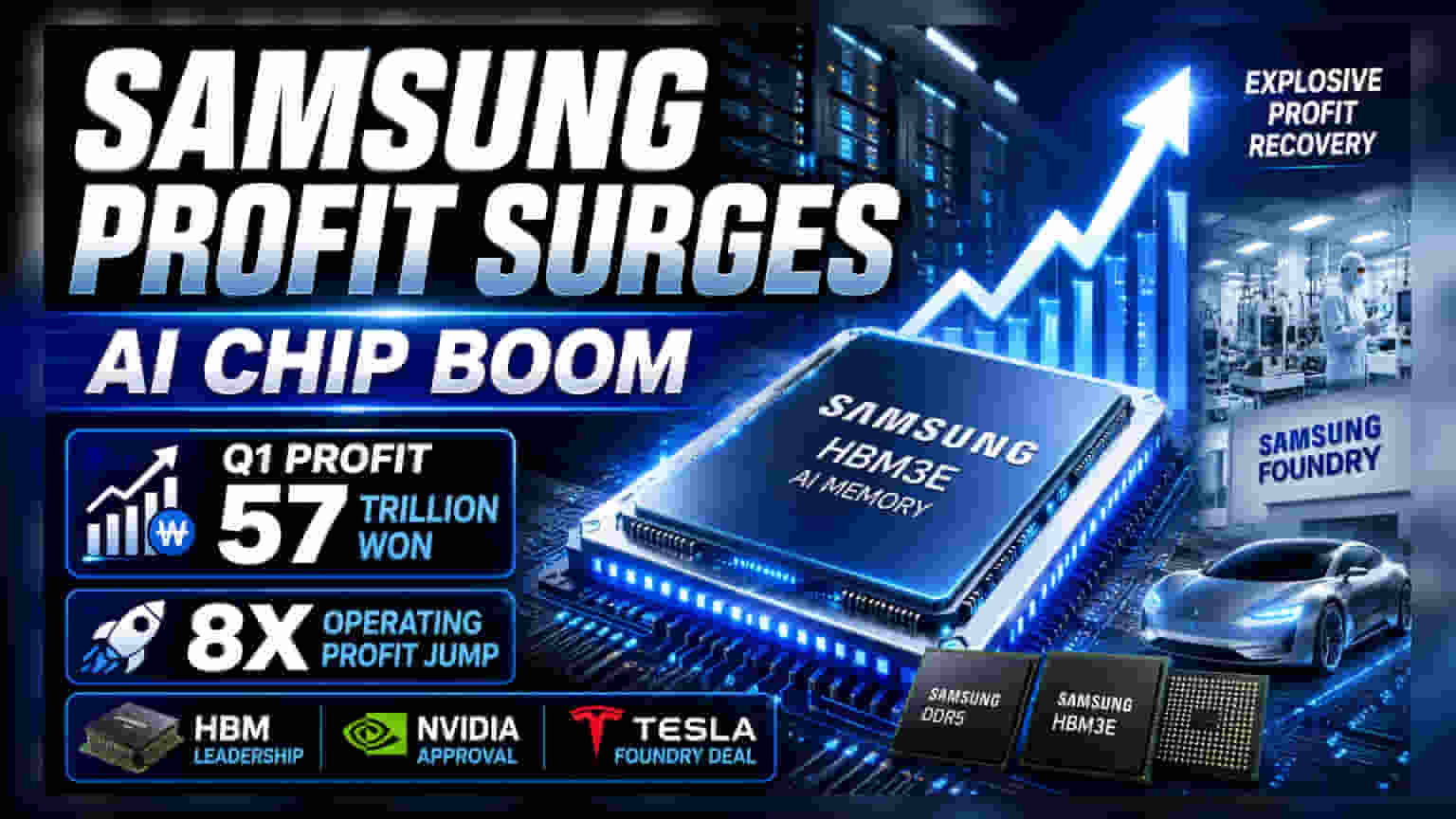
Samsung Electronics reported a record $38 billion operating profit for Q1 2026, an eight-fold increase driven by its semiconductor division. The surge follows key supply deals with Nvidia and Tesla, fueling a 'supercycle' in AI memory demand. Investors are now balancing this immediate revenue growth against long-term cyclical risks and heavy capital spending plans.
What Happened
Samsung Electronics has reported a massive first-quarter 2026 operating profit of 57 trillion won, approximately $38 billion. This represents an eight-fold increase compared to the same period last year. The primary driver of this performance is the company's semiconductor division, which has become the core of its business, contributing 61% of total sales and 94% of overall operating profits. This financial jump marks a strong recovery, largely fueled by the global surge in demand for AI-related memory chips.
Why The Market Is Excited
The company’s profit growth is tied to two major operational breakthroughs. First, Samsung secured approval from Nvidia for its High-Bandwidth Memory (HBM) chips. HBM is a specialized type of memory essential for powering the GPU clusters used in AI data centers. By becoming a supplier for these high-demand clusters, Samsung has effectively integrated itself into the central AI supply chain.
Second, the company’s foundry division—which manufactures chips designed by other companies—signed a manufacturing agreement with Tesla. This is a significant competitive win for Samsung, as it has historically struggled to gain market share against industry leader TSMC. These two deals have helped boost Samsung's stock price by roughly 60% over the last few months, reflecting investor optimism about the company's place in the AI era.
The Memory Market Reality
The AI boom is creating a unique supply dynamic in the semiconductor sector. Both the training and inference stages of AI models, such as ChatGPT and Gemini, require massive amounts of memory. Data from the industry shows that memory chip volume rose about 20% in the first quarter, while average selling prices jumped 90%.
Major cloud service providers, often called hyperscalers, are currently securing multi-year contracts to guarantee their supply. This aggressive buying behavior has left other sectors, such as PC and server manufacturers, struggling to secure the components they need, with some receiving only 70% of their required stock.
Risks And The Reality Check
Despite the positive headlines, the semiconductor memory business is historically cyclical, meaning it goes through phases of high profit followed by sharp downturns. Management at Samsung remains cautious, balancing the current boom with the reality that demand can fluctuate.
There is also a question of capital allocation. The company plans to spend $55 billion on a new fabrication facility. However, this plant is not expected to be operational until 2030. This creates a long gap between when the money is spent and when the new facility contributes to revenue. Additionally, the company faces operational complexities, including labor union negotiations and potential government policy changes, which could impact margins in the long term. There is also a theoretical risk that future improvements in AI efficiency could eventually reduce the intensity of memory demand.
What Investors Should Track
The most important factor for investors in the coming quarters will be the sustainability of current pricing and demand. While the current 'supercycle' is driving profits, shareholders should watch for any signs of inventory buildup at major customers or shifts in the spending plans of big technology firms. Additionally, the execution of the $55 billion expansion project and the company's ability to maintain its newfound market share against rivals like SK Hynix and Micron will be key to long-term performance.