

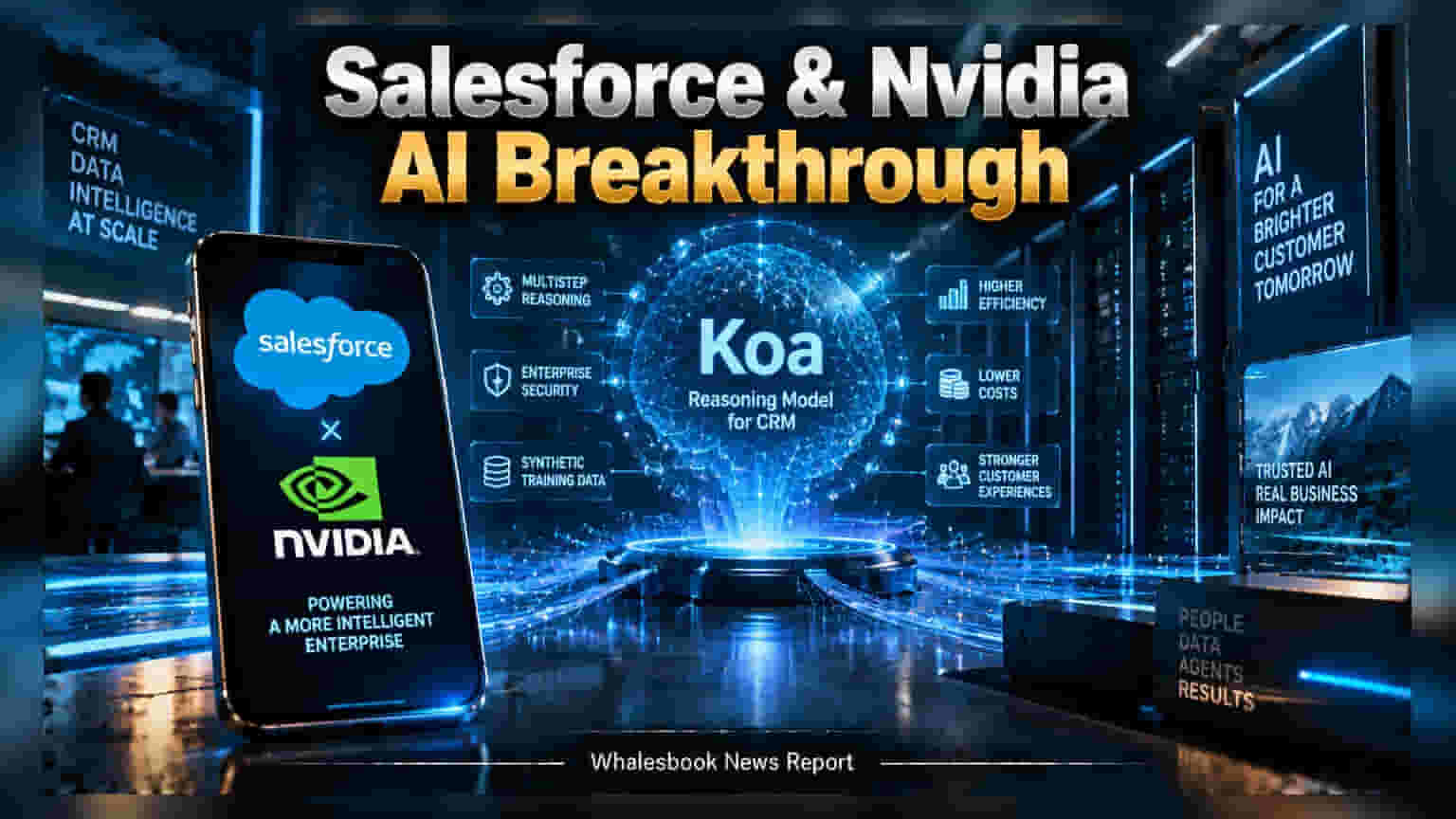
Salesforce has introduced Koa, a specialized AI model built with NVIDIA to handle complex CRM workflows using synthetic data. This move aims to improve data privacy and reduce operational costs compared to general-purpose AI. Investors are tracking whether this launch will accelerate the adoption of the company's Agentforce platform ahead of its wider release in winter 2026.
Salesforce officially unveiled its latest innovation, the Koa reasoning model, during its annual Dreamforce conference on September 15, 2026. Developed in partnership with NVIDIA, Koa is designed specifically to handle complex, multistep tasks within a customer relationship management (CRM) environment. The model is built on NVIDIA’s Nemotron open-weight architecture, marking a significant step in Salesforce’s strategy to bring more of its AI infrastructure in-house.
The primary focus of Koa is to address enterprise concerns regarding data privacy and security. Unlike many broader artificial intelligence models that are trained on massive, varied datasets, Koa was post-trained using synthetic data derived from 27 years of Salesforce’s internal CRM intelligence. By avoiding the ingestion of actual proprietary customer information, the company aims to eliminate the risk of sensitive data leakage, a key priority for corporate clients.
Strategic Shift in AI Approach
For years, Salesforce has largely routed complex reasoning tasks through an AI gateway to third-party providers. With the introduction of Koa and its integration into the broader Agentforce platform, the company is attempting to exert more control over its AI stack. This approach is intended to lower the costs associated with high-volume, automated business tasks, such as scheduling appointments or generating customer service responses. By reducing reliance on external frontier AI models, Salesforce seeks to offer a more stable and cost-efficient alternative for its enterprise users.
Despite this internal move, the company is maintaining its broader AI partnerships. Salesforce continues to collaborate with other AI providers to integrate their models into its secure infrastructure, positioning itself as an orchestrator of multiple AI technologies. The goal is to provide business clients with the flexibility to choose between high-performance general-purpose models and the specialized, domain-specific Koa model.
Monitoring Risks and Adoption
While the technology offers potential benefits in privacy and efficiency, investors are observing several challenges. The model is currently available only to a select group of pilot customers, meaning the company must prove that Koa can consistently outperform broader, more established AI alternatives in real-world scenarios. The ultimate success of this initiative depends on customer migration to the Agentforce platform, where these advanced tools are prioritized.
Furthermore, the financial impact of this shift remains a point of interest. Salesforce has previously adjusted its free-cash-flow growth forecasts for fiscal 2027, and market sentiment continues to be highly sensitive to the company’s ability to turn its AI investments into consistent, long-term revenue growth. Investors will likely monitor the transition from the current pilot phase to the planned general availability in winter 2026 to gauge the model's actual impact on customer retention and platform adoption.