 Whalesbook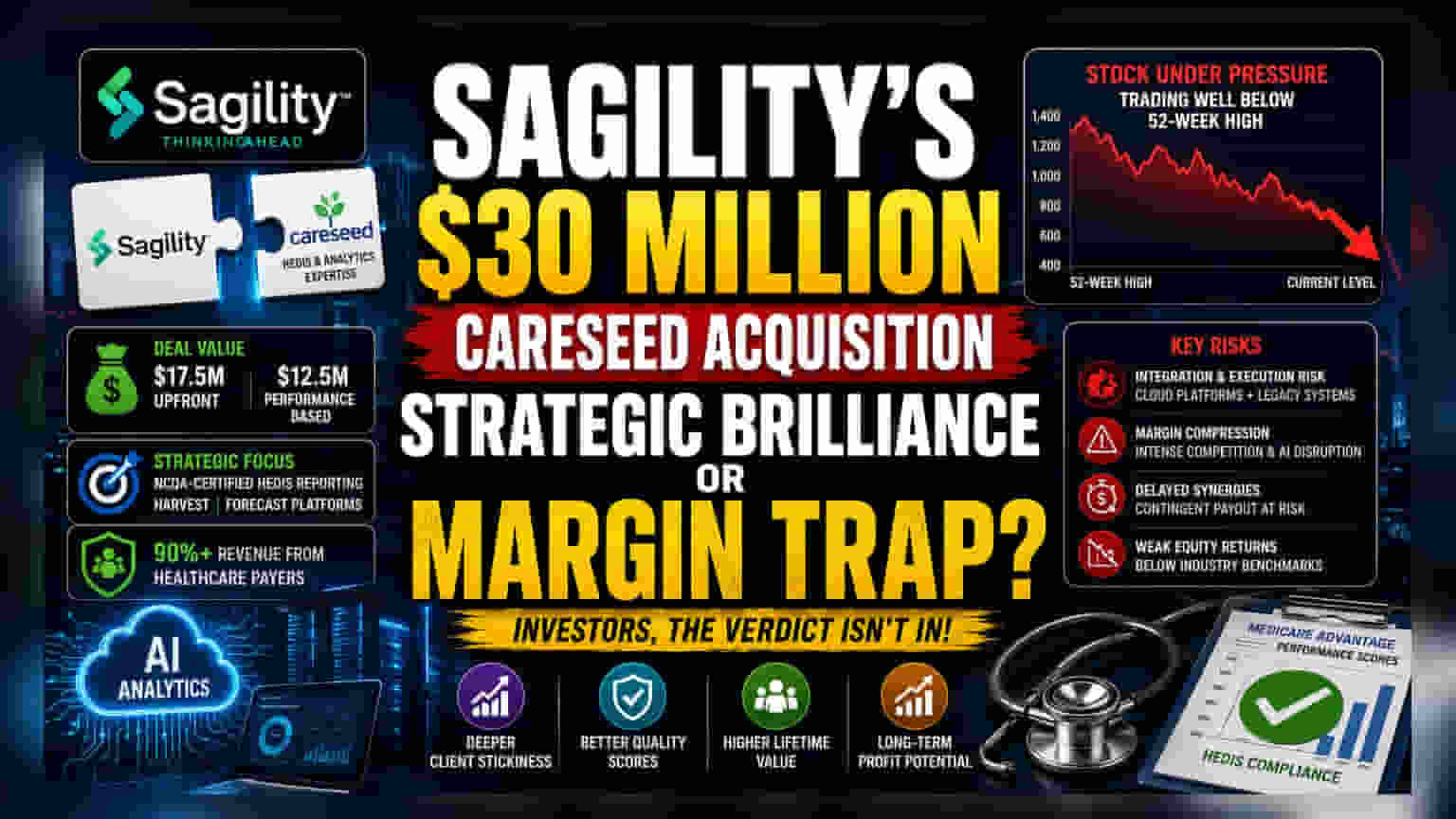


Sagility has acquired US-based CareSeed for up to $30 million, integrating AI-driven HEDIS reporting to capture the lucrative Medicare Advantage segment. While the deal promises to enhance quality outcomes for US health plans, the market remains cautious as Sagility’s stock struggles with volatility and narrowing margins.
The Valuation Gap
Sagility’s acquisition of CareSeed, a niche player in NCQA-certified HEDIS reporting, represents a targeted attempt to deepen its technological moat in the competitive US healthcare outsourcing market. By securing an upfront payment of $17.5 million with an additional $12.5 million contingent on future performance, management is betting that proprietary platforms like Harvest and Forecast will serve as the engine for its next phase of growth. However, the market’s response to this expansion has been muted; the stock currently trades significantly below its 52-week highs, reflecting investor fatigue regarding the company’s ability to turn top-line growth into sustainable, bottom-line efficiency.
The Analytical Deep Dive
When viewed against the broader industry backdrop, Sagility’s move to acquire mid-market expertise is a defensive reaction to margin compression. Unlike its larger competitors who often rely on massive scale, Sagility is increasingly reliant on specialized, high-margin software integrations. Historical performance shows that the company has struggled with equity returns, reporting an average return on equity and capital employed that sits well below industry leaders. This acquisition must be viewed through the lens of client stickiness; with over 90 percent of its revenue historically derived from healthcare payers, adding CareSeed’s specialized regulatory analytics capability is a clear effort to increase the lifetime value of its existing client base rather than a mere attempt to capture new market share.
The Forensic Bear Case
From a risk perspective, this transaction carries significant execution uncertainty. The company’s recent performance has been hampered by broader sector weakness, and the integration of cloud-native analytics platforms into a sprawling legacy service framework often results in hidden technical debt. Furthermore, Sagility faces intense competition from established revenue cycle management firms that are also aggressively deploying AI to automate the same medical record review processes. Any delay in the revenue synergies tied to the contingent $12.5 million payment could signal to investors that the integration is failing to move the needle on profitability, further depressing valuation multiples that have already faced downward pressure throughout the current fiscal year.
The Future Outlook
Analysts remain divided on whether this localized acquisition is sufficient to pivot the company toward higher profitability. While the integration of CareSeed’s HEDIS-specific data tools provides a direct route to improving Medicare Advantage performance scores for clients, the ultimate success rests on management’s ability to scale these tools across its global service centers. Future guidance will likely hinge on whether this AI-centric model can lower the cost of service delivery faster than the company loses ground in its legacy business units.