 Whalesbook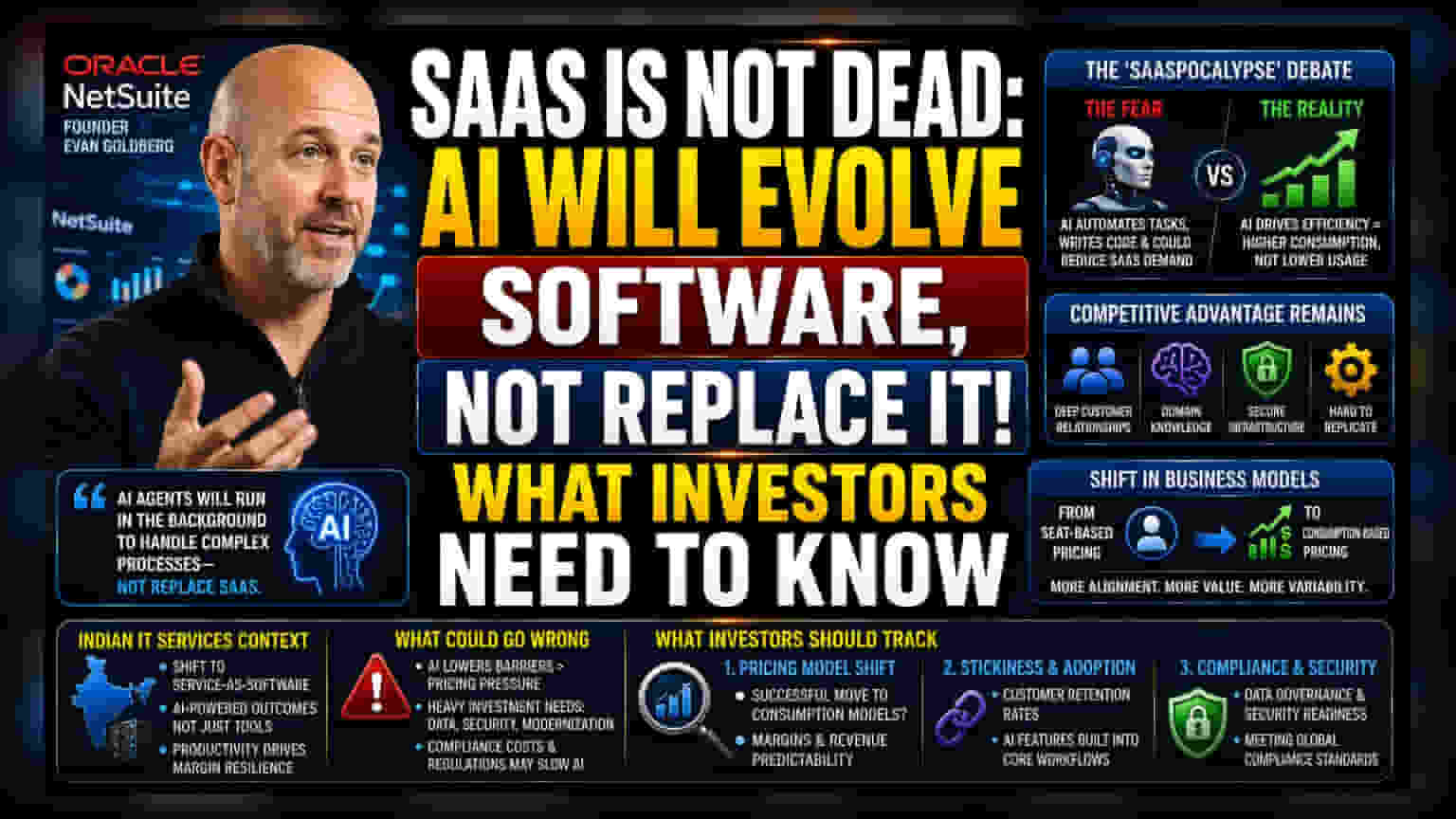
NetSuite founder Evan Goldberg believes AI will transform—not destroy—the Software-as-a-Service (SaaS) model. For Indian investors, this clarifies that software businesses aren't becoming obsolete, but they must adapt to new consumption-based pricing models. While market fears of a 'SaaSpocalypse' persist, the true test for tech companies lies in their ability to provide deep domain expertise, governance, and reliable integration—areas where AI agents still struggle to replicate human-led outcomes.
What Happened
Evan Goldberg, the founder of NetSuite, has addressed the growing market anxiety regarding the future of Software-as-a-Service (SaaS). He argues that artificial intelligence will not render software companies obsolete. Instead, he views AI as an evolutionary step, where AI agents operate in the background to handle complex processes rather than replacing the software itself. He emphasized that the competitive advantage for established firms remains in their deep customer relationships, domain knowledge, and secure infrastructure, which are far harder to replicate than basic coding.
The 'SaaSpocalypse' Debate
For investors, the narrative that "SaaS is dead" has become a significant source of uncertainty. This fear stems from the rapid rise of generative AI, which can automate tasks, write code, and potentially perform jobs that previously required software subscriptions. Critics argue that this commoditization could lead to falling demand for traditional SaaS platforms. However, industry analysis suggests that treating all software as a commodity ignores the reality that many platforms run the critical workflows, payments, and compliance systems that entire industries depend on. In many cases, efficiency gains from AI lead to higher consumption rather than lower usage, a phenomenon similar to historical productivity shifts in other sectors.
How Investors May Read This
The shift toward AI is forcing a change in business models. Many SaaS companies are moving away from traditional seat-based pricing—where customers pay per user—toward consumption-based models where costs align with usage or actual business outcomes. For investors, this creates both a risk and an opportunity. A consumption-based model can lead to more variable revenue, making it harder to predict cash flows in the short term. Conversely, it creates stronger alignment between the software's value and its price, which can drive long-term adoption.
The Indian IT Services Context
This debate is particularly relevant for the Indian IT services sector, which has built its foundation on managing enterprise software and digital workflows. Companies in this space are increasingly shifting toward a "service-as-software" model, where AI-powered systems deliver specific business outcomes rather than just providing tools. Investors may note that Indian IT majors are actively integrating AI to drive productivity, which may help them maintain margins as the industry transitions away from older, labour-intensive service models.
What Could Go Wrong
While the industry may not be disappearing, it faces genuine risks. If AI significantly lowers the cost of entry for new competitors, established players may see their pricing power erode. There is also the challenge of execution; companies must invest heavily in data governance, security, and application modernisation to make their platforms "AI-ready." Furthermore, compliance requirements, such as those imposed by evolving global regulations, could increase operational costs and slow down the deployment of new AI features.
What Investors Should Track
Going forward, investors may monitor a few key indicators. First, track management commentary on pricing model shifts—are companies successfully moving to consumption-based models without diluting margins? Second, watch for evidence of "stickiness," such as customer retention rates and the integration of AI features into existing core workflows. Finally, look for how companies are addressing the compliance and security challenges that come with large-scale AI adoption, as these factors will determine which platforms remain indispensable to their enterprise clients.