

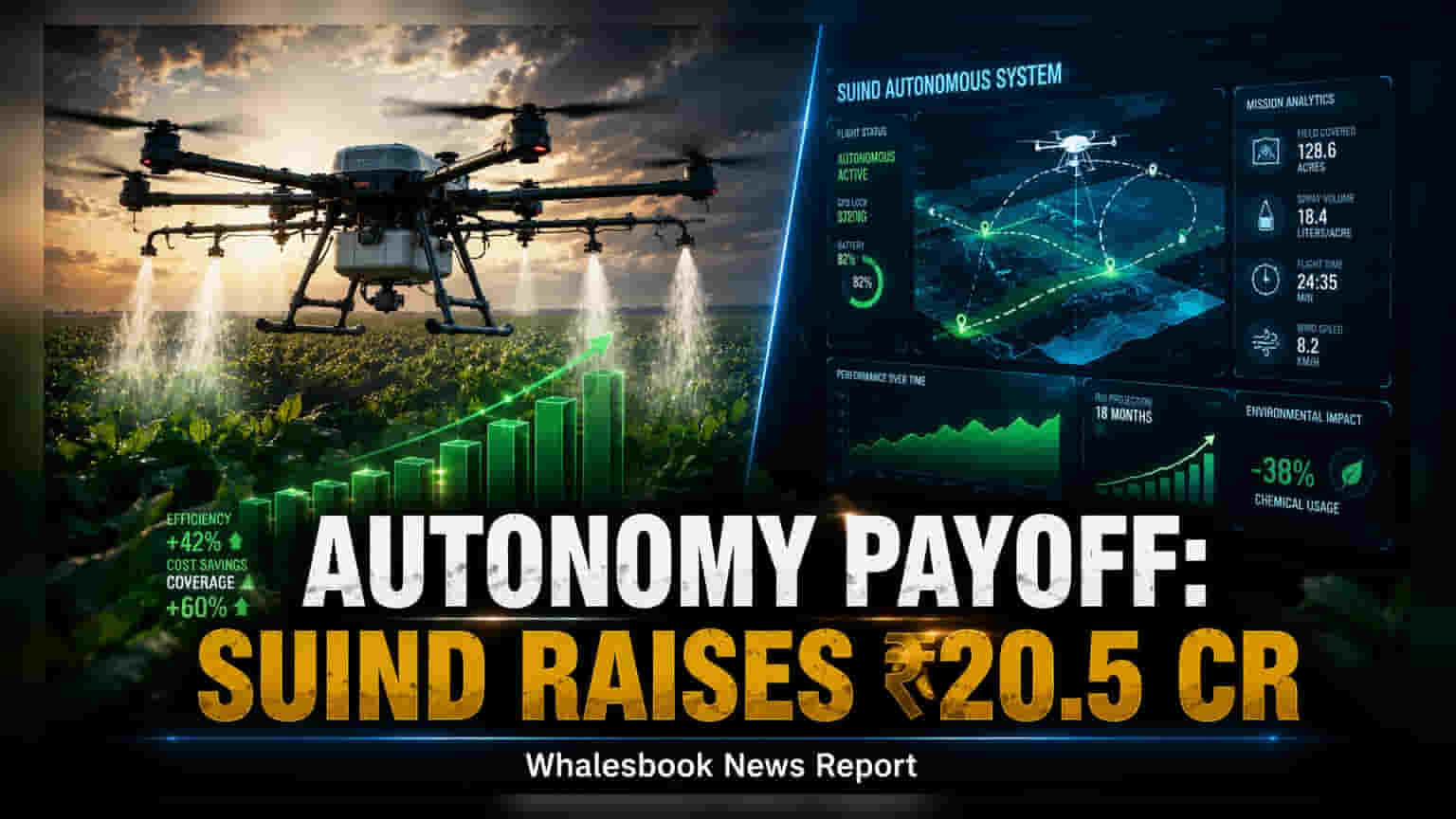
SUIND, an autonomous drone developer, has secured ₹20.5 crore in seed funding led by Transition VC and IIMA Ventures. The company will use the capital to scale its commercial spraying drone, Bumblebee, and advance development of its Wasp inspection UAS. This funding highlights the growing investor focus on specialized drone hardware and AI-driven navigation in GPS-denied environments.
SUIND, a startup focusing on autonomous unmanned aerial systems (UAS), has successfully raised ₹20.5 crore in a seed funding round. The investment was led by Transition VC, with participation from IIMA Ventures. This fresh capital marks a significant stage in the company's growth as it seeks to move beyond traditional remotely operated drones toward more advanced, intelligent robotic systems.
Scaling Commercial Deployment and Technical Capabilities
The company plans to allocate these funds toward scaling the commercial deployment of its Bumblebee drone. This specific model is already type-certified by the Directorate General of Civil Aviation (DGCA) and is designed primarily for agricultural spraying. By automating the application of fertilizers and pesticides, the company aims to help farmers reduce chemical usage and labor costs.
Beyond agricultural applications, the company is accelerating the research and development of its Wasp drone. This model is intended for aerial intelligence and inspection tasks, marking the firm's strategic push into more complex service sectors. A significant portion of the funding will also be used to improve the company's core autonomy technology and engineering team, focusing on vision-based navigation systems that operate effectively in environments where GPS signals may be weak or unreliable.
Strategic Focus on Autonomous Intelligence
Kunal Shrivastava, Co-founder and CEO of SUIND, stated that the company’s primary objective is to develop intelligent robots capable of handling hazardous or repetitive tasks with minimal human intervention. Unlike standard drones that require constant manual piloting, SUIND emphasizes vision-first autonomy. This approach allows the systems to make independent decisions based on their surroundings, an essential feature for both industrial inspections and specialized defense applications.
Investors are increasingly evaluating the drone sector based on the company's ability to provide a complete software and hardware solution. Transition VC, which spearheaded this round, noted that SUIND’s strategy of developing AI-based software stacks before building specific hardware applications provides a distinct approach to the market.
Future Monitorables for Investors
While the company is currently focused on agricultural and inspection markets, its long-term roadmap includes potential expansion into defense, surveillance, and critical infrastructure monitoring. As the company scales, the key factors for observers will be the successful commercial adoption of the Wasp inspection drone, the ability to maintain consistent profit margins in the competitive drone manufacturing sector, and the regulatory environment regarding autonomous flight in non-agricultural sectors. The effectiveness of its AI-driven autonomy in complex, real-world conditions will remain a primary metric for its competitive advantage in the coming years.