

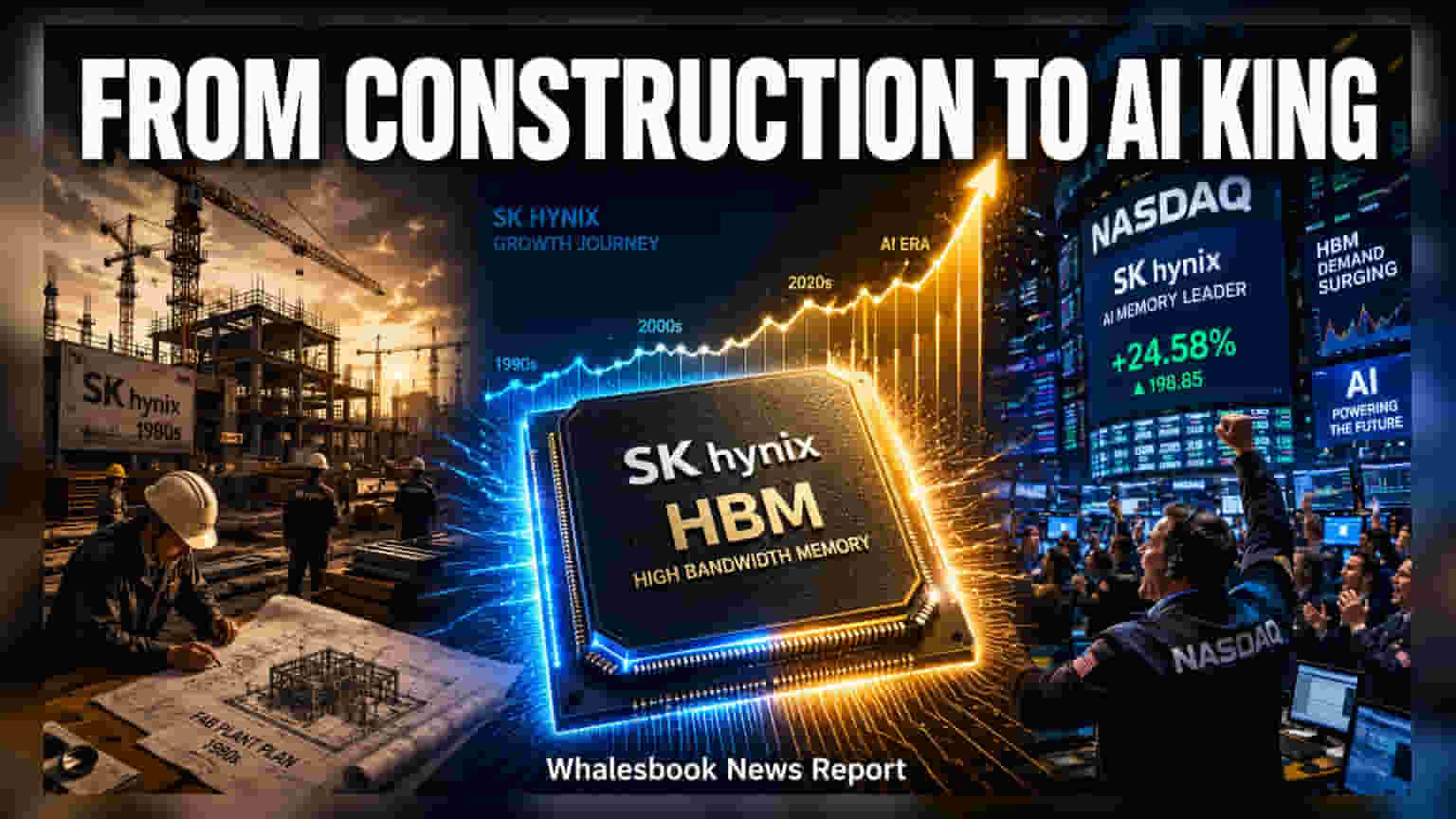
South Korean semiconductor giant SK Hynix is preparing to list on Nasdaq, aiming to raise up to $29 billion through American depositary receipts. This expansion follows the company’s success as a major supplier of high-bandwidth memory chips for artificial intelligence. Investors should note that while growth is strong, the memory chip sector remains highly cyclical and sensitive to market demand.
SK Hynix is expanding its global footprint by launching an American depositary receipt (ADR) offering on the Nasdaq, with plans to raise approximately $28 billion to $29 billion. This move comes as the company maintains a valuation exceeding $1 trillion on the Korea Exchange (Kospi). By listing on a US exchange, the firm aims to attract international investors and leverage the high demand for memory technologies essential for artificial intelligence.
Transition to AI-Driven Growth
The company’s current success is largely tied to its strategic focus on High-Bandwidth Memory (HBM) chips. These specialized products have become a cornerstone for AI infrastructure, making SK Hynix a vital partner for companies like Nvidia. The firm was notably the first to mass-produce 12-layer HBM chips, a breakthrough that helped it transition from a producer of standard memory chips to a central player in the global AI supply chain.
Historical Context and Capital Spending
Tracing its history back to 1949 as Gukdo Construction, the entity underwent major shifts, including its entry into semiconductors in 1983 and its acquisition by SK Group in 2012. After years of navigating significant debt and market cycles, the company is now directing substantial capital toward long-term expansion. The proceeds from the upcoming Nasdaq listing are earmarked for building new manufacturing facilities in South Korea and a $4 billion advanced-packaging plant in Indiana, which is expected to be finished by 2028.
Industry Risks and Market Outlook
While the company’s technological advancements have been a driver of its recent performance, the semiconductor industry is known for its cyclical nature. Fluctuations in supply and demand for memory products can directly impact profit margins. Furthermore, analysts often point to the high level of speculative interest currently surrounding AI-related hardware. For investors, the long-term benefit of these investments will depend on whether the global demand for AI-specific chips continues to grow steadily to support the large capacity being added to the company’s infrastructure. The next important milestones for the market to follow will be the finalization of the ADR pricing, the execution timeline of the Indiana facility, and any updates on capital expenditure efficiency regarding its new manufacturing clusters in South Korea.